



As AI systems take on more autonomous work, one question keeps surfacing in every governance conversation: who is responsible for this action, under what authority, for what purpose, and within what limits? NeuroNest set out to answer it directly, by building accountability into the way its agents run rather than reconstructing it after the fact.
Executive summary
Traditional observability tells an organization what happened. It rarely explains who initiated an action, what intent justified it, whether execution stayed inside approved boundaries, and how responsibility moved across a chain of agents. As workflows span multiple agents, tools, and APIs, that gap widens.
NeuroNest closed it by integrating AuthR, the authorship layer of identity, directly into its agent orchestration platform. AuthR is a third primitive alongside authentication, which establishes who you are, and authorization, which establishes what you may do. It answers a third question: who is responsible for what was done.
AuthR defines six primitives that travel with a workflow: Author, Actor, Intent, Scope, Provenance, and Drift. Together they form a signed chain of responsibility that follows a decision from start to finish. By embedding them into its execution lifecycle, NeuroNest makes every significant action attributable, explainable, and auditable, and it detects when an agent begins to drift from the intent it was authorized to pursue. This is not a specification on paper. It is a working runtime implementation, in a domain where accountability is not optional.
The challenge
Modern agent ecosystems face a widening accountability gap. When a single workflow spans multiple agents, tools, APIs, and execution stages, the questions that matter for security, compliance, and trust become hard to answer:
Which entity originally requested the outcome?
Which agent performed each action?
Was the action still aligned with the original objective?
Did execution remain within approved boundaries?
Can responsibility be reconstructed after the fact?
These are not edge cases. Agents re-plan, branch, and chain tools dynamically. They run long, asynchronous tasks where the original context decays between the request and the irreversible effect. Authorization can confirm that a call was permitted. It cannot confirm that the call still reflects what the author intended. Without a standardized accountability model, decision lineage is lost precisely when it is needed most.
Why AuthR
AuthR was designed for one problem: maintaining authorship and accountability across an autonomous execution graph. Instead of treating decisions as isolated events, it carries a signed chain of responsibility that travels with the workflow, so the system can answer who originated a decision, who executed it, why it was made, what limits applied, and where accountability finally rests.
AuthR is deliberately narrow. It does not replace authentication, authorization, or existing delegation standards, and it sits above them. Authentication still establishes that an agent is what it claims to be. Authorization still establishes that an action is permitted. OAuth On-Behalf-Of, token exchange, SPIFFE, and the agentic identity work underway at CoSAI all stay in place. AuthR is the authorship assertion those layers do not carry, traveling alongside the token rather than replacing it. The point is not that delegation of access is broken. It is that delegation of access was never built to carry durable authorship and intent across evolving, long-running agent graphs.
NeuroNest before AuthR
Before the integration, NeuroNest already kept detailed telemetry and workflow state. Events could be reconstructed, but accountability relationships took interpretation. The platform knew what happened. The open question was who was responsible for it.
+----------------+
|      User      |
+--------+-------+
         |
         v
+----------------+
|  Orchestrator  |
+--------+-------+
         |
         v
+----------------+
|   AI Agents    |
+--------+-------+
         |
         v
+----------------+
|  Tools / APIs  |
+----------------+
NeuroNest after AuthR
AuthR added an accountability layer that follows execution across the whole system. Every workflow now carries a structured authorship record from start to finish.
        +------------------+
        |      Author      |
        |  Original Owner  |
        +--------+---------+
                 |
                 v
        +------------------+
        |      Intent      |
        | Desired Outcome  |
        +--------+---------+
                 |
                 v
        +------------------+
        |      Scope       |
        | Allowed Actions  |
        +--------+---------+
                 |
                 v
+---------+  +------------------+  +---------+
| Agent A |->|      Actor       |->| Agent B |
+---------+  +------------------+  +---------+
                 |
                 v
        +------------------+
        |    Provenance    |
        |  Action History  |
        +--------+---------+
                 |
                 v
        +------------------+
        |      Drift       |
        | Confidence/Stale |
        +------------------+
The six primitives
NeuroNest implements all six primitives and enforces their rules at runtime.
Author is the real-world referent whose judgment is being executed: a person, a verified digital twin, a process owner, or a governance authority. It is not the agent that runs the code. NeuroNest anchors every workflow to an Author and treats it as the root accountability anchor, tied to verifiable evidence such as an HR record or an approval.
Actor is the entity that performs the work: an AI agent, a tool, an orchestration service, or an automation pipeline. NeuroNest records every Actor and links each action back to its originating Author, with the model and code behind an agent captured so a silent swap is detectable.
Intent captures the objective in the Author’s own terms at authorization time. Rather than storing only instructions, NeuroNest keeps a normalized representation of intent that persists across the chain and is inherited by downstream steps. That persistence is what makes later misalignment visible.
Scope defines the limits: allowed actions and resources, time windows, caps, and delegation depth. The central rule is that scope only narrows. A sub-agent can be given less than its parent. It can never grant itself more. NeuroNest enforces this at verification time, not in application logic.
Provenance is the lineage. Every decision records the ordered chain of prior records, a correlation identifier that ties the whole graph together, and the data sources that shaped it.
Author -> Intent -> Actor -> Action -> Result
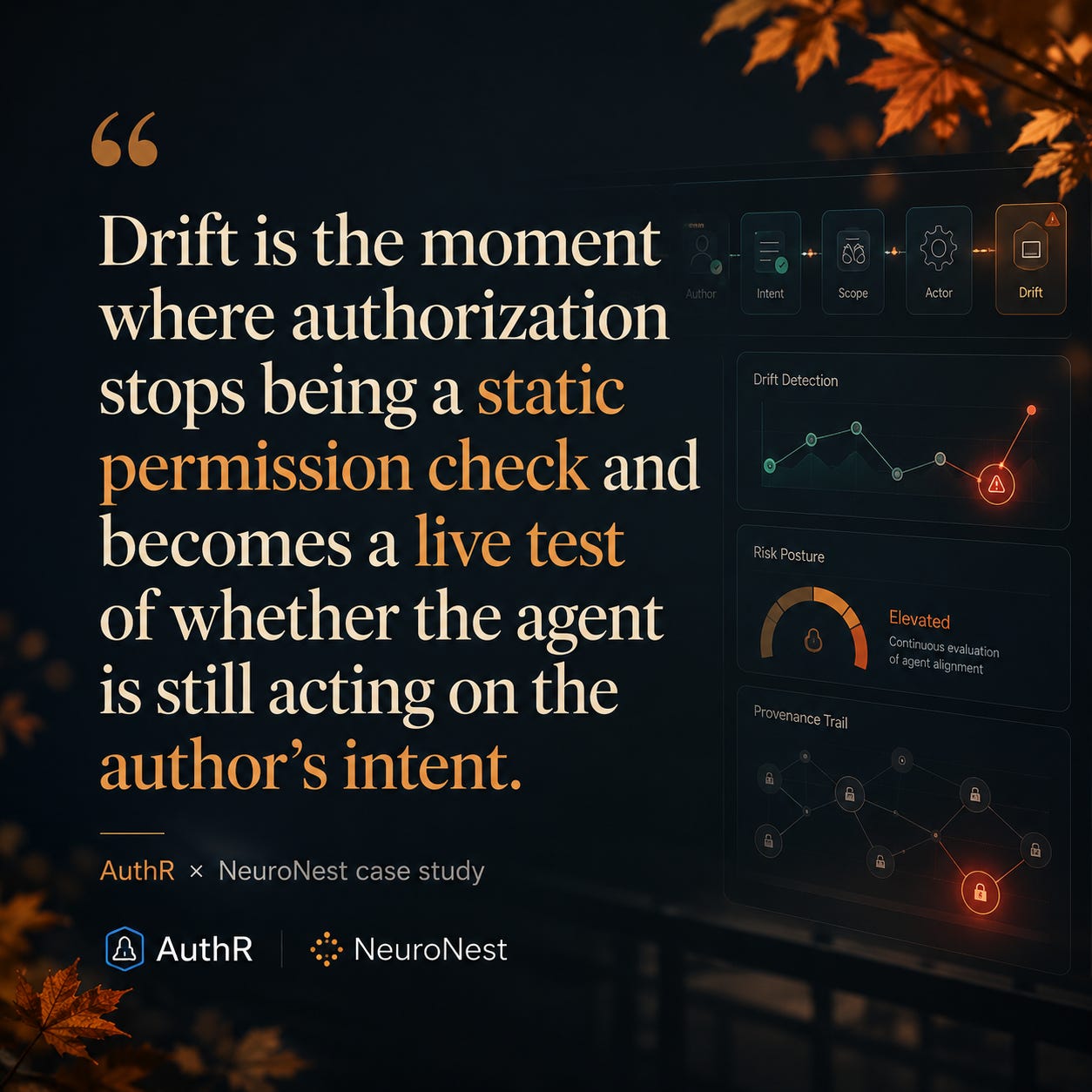
Drift is first-class awareness of uncertainty and staleness. It carries the system’s confidence at decision time, a point after which the authorization should be treated as stale, and signals that the original intent may no longer match reality. Drift is the primitive that turns governance from a record into a live control, and it is the center of the NeuroNest integration.
How a record travels
In practice the model is one record and three moments. When a workflow begins, NeuroNest issues a root record that binds the Author, the Actor, the Intent, and the Scope. When the orchestrator hands work to a sub-agent, it extends that record: the Author is preserved, the Intent is inherited, the Scope narrows, and the new record links back to its parent. At each point where an action would touch a real resource, NeuroNest verifies the record against the chain, confirming that it has not expired, that the Author is stable, that scope has only narrowed, and that the lineage is intact. Enforcement is structural. A sub-agent that tries to act beyond what its parent granted is stopped before the action lands, not flagged afterward.
Drift detection at runtime
Drift detection is the heart of the integration. As a workflow runs, NeuroNest continuously evaluates intent alignment, scope adherence, actor behavior, decision consistency, and confidence against the authorized intent. When divergence appears, it raises a governance signal so an operator can step in before misalignment becomes consequential.
Original Intent
       |
       v
+---------------+
|   Execution   |
+-------+-------+
        |
        v
  Drift Analysis
        |
        +--> Aligned
        |
        +--> Warning
        |
        +--> Escalation
This is the difference between checking intent once and governing it continuously. Most approaches evaluate intent at the moment of approval and then trust the grant. Drift is about what happens after approval, as conditions change and execution unfolds. NeuroNest treats that divergence as a monitored signal rather than something discovered in a post-incident review, which turns governance from a retrospective activity into a real-time one.
The accountability graph
Together the six primitives produce something NeuroNest did not have before: a reconstructable accountability chain. The data surfaces through governance dashboards, where operators can see intent relationships, Author-to-Actor delegation, scope boundaries, decision lineage, and drift events for any workflow.
Author
  |
  +-- Agent A
  |     |
  |     +-- Tool X
  |
  +-- Agent B
        |
        +-- Tool Y
        |
        +-- Agent C
The result is visibility not only into what occurred, but into how responsibility propagated through the system. Months later, a compliance officer can reconstruct who authored a workflow, which agent ran which step, what intent was stated, what sources were consulted, and exactly what was permitted at each hop.
Business outcomes
The integration changed how the platform can be trusted and governed:
Trust. Every action traces to an accountable source.
Explainability. Decision lineage is visible and verifiable.
Governance. Intent and scope stay measurable throughout execution, not only at approval.
Auditability. Complete provenance exists across autonomous workflows.
Enterprise readiness. AuthR provides a governance foundation suited to regulated and high-assurance environments, where proving who authorized an action is a requirement rather than a feature.
Because authorship travels inside the execution graph rather than sitting beside it in a log, governance becomes part of how the work runs, not an interpretation applied afterward.
What comes next
This implementation demonstrates the authorship model and runtime drift enforcement end to end. The path to federated, cross-organization deployment hardens the lineage further: cryptographic signing of every record so the chain is tamper-evident, a distributed way for any party to verify a chain without a shared control plane, and near-real-time revocation that cascades through every downstream hop. These are the items the next version is designed to close.
Conclusion
Autonomous AI systems cannot scale safely without accountability. AuthR preserves authorship, intent, scope, provenance, and drift awareness across complex execution graphs, and reduces governance to a small set of rules a verifier enforces rather than an operator hopes for. By embedding it directly into the NeuroNest orchestration engine, governance becomes part of execution rather than an afterthought, and the platform can answer the question that defines the agentic era:
Who made this decision, why was it made, and can we prove it?
Build agent workflows with visibility you can trust
NeuroNest is building the agent-first IDE for teams that want to ship production AI workflows with more control, visibility, and confidence.
Explore NeuroNest and download it here: https://neuronest.cc/download
