


Welcome to The Verified Intelligence Briefing
Every Friday, this newsletter does one thing.
It reads the week through a single lens — verification debt, the gap between how fast AI generates intelligence and how fast your organization can verify it — and reports back what changed.
That gap is the most important number on your balance sheet that nobody is measuring. It compounds quietly while AI is being demoed, piloted, and embedded into work product. It surfaces loudly when a regulator, insurer, or partner asks a question the contract was never built to answer.
The reason for a weekly is simple. Daily AI news is signal-poor. Most of it is noise about the next model, the next benchmark, the next funding round. The pattern — the slow accumulation of unverified dependencies, the migration of governance gaps from one layer of the stack to the next, the moment a regulator catches up — only becomes visible across a week of signals read together. That is what this briefing is for.
Each issue gives you five things in the same order.
The Pattern. One thesis on what the week meant, in 250 words. Read this if you read nothing else.
The Signals. Ten numbered items. Each with The Signal (the fact), The Lineage Gap (where the verification debt is hiding), and The Boardroom Prompt (the question to bring to your next meeting).
The Verification Debt Tracker. The taxonomy from From Artificial to Verified Intelligence, scored against this week’s signals. A visual you can show your board.
Monday Morning. Three things to do next week. Always three. Always actionable.
The Reading Room. Three pieces from named operators worth your time.
This briefing is written for the people who own the control plane — CIOs, CISOs, CTOs, CFOs, and CEOs whose signature is on the AI decisions their institutions cannot yet fully trace. If you are responsible for an outcome that an AI helped produce, this is for you.
Issue 01 starts now.
The Pattern
Three things converged this week, and the shape they made together was unmistakable.
A Big Four firm embedded a frontier AI provider directly into its client delivery platform. A different Big Four firm — same playbook, different week — pulled a published report after AI hallucinations made it into the footnotes. And a community bank in regulated industry filed an 8-K with the SEC because an employee uploaded customer Social Security numbers to an unauthorized AI chatbot.
Three different stories. One pattern. All three are what verification debt looks like when it stops being theoretical and starts being filed, retracted, or signed.
This is what concentration looks like in practice. When a global advisory firm builds AI into work product, the institution carrying the regulatory liability inherits a reasoning chain that crosses three corporate boundaries before it reaches the model. ISO certifications cover the vendor’s obligations, not yours. Indemnification clauses dispute the bill, not the breach. And the audit committee asks a question — how was this decision reached? — that the vendor contract was never built to answer.
The week’s signals point at the same gap from different angles. The EU published draft guidelines that turn the verification question into a regulatory one. Pat Gelsinger framed AI as a layer of influence requiring guardrails for human flourishing. Carolyn Healey told boards to stop measuring tasks and start designing for org maturity. Gabriel Millien told them their AI security problem is a CEO problem dressed as a CISO checklist. Identity vendors announced product lines for agent attribution. Governance vendors announced runtime controls for agent swarms.
The pattern: verification debt is migrating from the model layer to the contract layer, and most organizations will not discover the exposure until a regulator, insurer, or partner surfaces it under pressure.
Thesis. The vendors are consolidating. The lineage is fragmenting. The institution holding the audit risk is the one organization not at the table when those two trends compound.
The Signals
01 · Anthropic and KPMG sign a global alliance
The Signal. Anthropic and KPMG announced a global alliance this week, embedding Claude directly into KPMG’s client delivery platform across the firm’s 276,000+ employees (Flor, LinkedIn, 19 May). The deal extends Claude into audit, tax, and advisory workflows that increasingly become signed work product delivered to institutional clients.
The Lineage Gap. Five questions, three breaking. Who trained it? — KPMG didn’t; Anthropic did. Who authorized it? — KPMG procurement, but the client signs the audit. Who is it economically aligned to? — neither the institution carrying the regulatory liability nor the regulator who will eventually ask. When the audit committee wants to know how a conclusion was reached, the chain of provenance crosses three corporate boundaries before it touches the model. That chain is currently a contract. It is not yet a control. The first time a regulator subpoenas reasoning logs from a Big Four AI-assisted engagement will be the moment this market changes shape.
Boardroom Prompt. When your Big Four advisor uses AI to produce work product you’ll sign, who holds the reasoning logs — them, the model provider, or you?
02 · EY unpublished a report after AI hallucinations made it to the footnotes
The Signal. The Financial Times reported that EY pulled a published report after hallucinated citations were discovered in the footnotes (Baciu, LinkedIn, 15 May, 164 reactions). EY framed it as a quality issue. Practitioners called it what it is — a trust failure that survived review.
The Lineage Gap. This is what verification debt looks like when it comes due — not as a fine, but as a retraction. The interesting question isn’t how the hallucination got into the footnotes. It’s how it got past review by a firm whose entire business model is independent verification. The Four Pillars give the diagnostic: grounding failed (no anchor to a real source), scope failed (the model ranged into citation generation), provenance failed (the source could not be traced back), and drift awareness failed (no signal flagged the staleness). A signed advisory deliverable should not be able to fail all four at once. The fact that one did is the early warning, not the event.
Boardroom Prompt. If your most expensive external assurance can be hallucinated, what is your standard for the AI you operate yourself?
03 · A community bank reported itself to the SEC over an unauthorized chatbot
The Signal. CB Financial Services filed an 8-K with the SEC on May 7 after an employee uploaded customer Social Security numbers to an unauthorized AI chatbot (Benson, LinkedIn, 19 May). The breach clock started May 5. Class action attorneys filed within days.
The Lineage Gap. This is the concrete case study every other signal in this issue is dancing around. Five Questions, all five breaking. Who authorized it? — no one; an employee did it. Who can revoke it? — nobody at the bank, because nobody at the bank had the credentials. Who is it economically aligned to? — a SaaS vendor outside the bank’s third-party risk inventory, with terms of service the bank never reviewed. Shadow AI in regulated industry is not a future problem. It is a filed 8-K. The institutions still running spreadsheet-based AI inventories are one upload away from the same Friday.
Boardroom Prompt. If an employee uploaded regulated customer data to an unauthorized AI tool today, how many hours would pass before your security team knew?
Every AI agent in your firm is quietly taking out loans in your name. It’s called Verification Debt — and it compounds.
Retire it with Identient, the governance layer that puts identity, evidence, and ownership behind every AI decision.
Identient helps regulated firms answer the questions that come due at the worst moment — a release, a regulatory inquiry, an audit: What is your AI doing? Who authorized it? Can you prove it?
Built on AI Operating Discipline, Identient’s four-phase methodology, your firm can:
See what’s actually running: inventory every AI use case, agent, and identity-to-data touchpoint — with a named owner for each
Bound what agents can do: governed identity and access for AI agents in your Microsoft environment, from Entra ID to Purview
Prove it when it counts: audit-ready evidence trails that stand up to examiners, boards, and enterprise security reviews
04 · The EU published draft guidelines on high-risk AI classification
The Signal. The European Commission published draft guidelines clarifying high-risk AI system classification under the AI Act, days after EU leaders agreed to delay the compliance date to 2 December 2027 (Patel, LinkedIn, 19 May, 1,317 reactions). The guidelines focus on classification — which systems are in scope, and what obligations follow.
The Lineage Gap. The high-risk designation is where verification debt converts from a recommendation into a regulatory obligation. The Five Questions stop being a maturity framework and start being a discovery request. Who created it? becomes a documentation requirement. Who authorized it? becomes a sign-off trail. Who can revoke it? becomes a kill switch with a service level. The institutions that have wired these questions into their AI governance now are buying themselves a measurable head start. The ones still treating governance as a side project will discover that the regulator’s timeline is not negotiable, and that the documentation cannot be produced retroactively in the volumes the AI Act will request.
Boardroom Prompt. For each AI system in your stack, can you produce today the documentation a high-risk classification under the AI Act would require?
05 · Pat Gelsinger reframed AI from tool to layer of influence
The Signal. Pat Gelsinger wrote this week that roughly 6% of AI conversations are now about personal guidance — career, relationships, health, finances — and called for guardrails grounded in truth, dignity, and human flourishing (Gelsinger, LinkedIn, 15 May, 288 reactions). The reframe matters more than the percentage. AI is becoming a layer of influence, not just a tool of productivity.
The Lineage Gap. When AI is a tool, governance asks what did it do? When AI is a layer of influence, governance has to ask whose values did it act on? That is a Five Questions problem at scale. Who created it? — the lab. Who trained it? — the lab, on the open internet. Who is it economically aligned to? — not, in most cases, the person taking its guidance. Gelsinger is naming the consumer version of the gap this briefing covers in the enterprise. The same provenance failure that lets a hallucinated citation reach an EY footnote lets a hallucinated framing reach a person making a real decision about their health. The architecture problem is the same. Only the stakes change.
Boardroom Prompt. When the AI in your product gives a customer guidance, whose values is it acting on — and can you produce the evidence?
06 · Carolyn Healey told CXOs to stop measuring tasks and start designing org maturity
The Signal. Carolyn Healey published the 7 Stages of AI Workforce Maturity, opening with McKinsey’s estimate that AI agents can already handle 44% of U.S. work hours (Healey, LinkedIn, 18 May, 338 reactions). Her argument: Tasks do not transform organizations. Org design does.
The Lineage Gap. The maturity model maps cleanly onto the verification debt curve. The early stages — task assistance, scattered adoption — are where verification debt is invisible because no decision of consequence has been made yet. The later stages — function reinvention, agent-driven workflows — are where the debt comes due, because every consequential decision now has to be defensible. Most organizations are reporting at Stage 2 to a board that needs them governing at Stage 5. The reporting gap is the governance gap. Closing it is what turns AI activity into AI accountability — and what turns the conversation with the board from theater into oversight.
Boardroom Prompt. When you next brief the board on AI, are you reporting tasks automated, or are you reporting governed economic outcomes you can defend?
07 · Gabriel Millien named the failure mode every AI security program shares
The Signal. Gabriel Millien wrote that he has audited AI security programs at four Fortune 500 companies and the failure mode is identical every time (Millien, LinkedIn, 15 May, 173 reactions). Ten pillars land on the CISO’s desk. The CISO can execute three of them. The other seven need cross-functional sponsorship that never arrives. “Your board sees this as a CISO problem. It’s actually a CEO problem dressed up as a security checklist.”
The Lineage Gap. The structural diagnosis is correct and the polite version of it is overdue. Data lineage cannot be enforced by security alone. Model risk management cannot be enforced by security alone. Agent attribution cannot be enforced by security alone. The Five Questions all require a sponsor outside the CISO’s authority for an answer to even exist. When the CISO is the only senior leader accountable for an outcome that requires legal, data, procurement, and engineering to act together, the program stalls — and the board interprets the stall as a CISO performance problem. It is not. It is a CEO architecture problem. The institutions that get this right move AI governance to a dedicated cross-functional body chaired above the CISO. The ones that don’t will eventually hire a third CISO in five years.
Boardroom Prompt. Who in your C-suite owns the seven AI security pillars your CISO cannot execute alone?
08 · Alexandra C. named the vendor liability gap explicitly
The Signal. Alexandra C. wrote that financial institutions are signing third-party AI contracts that look clean on paper and expose them entirely in practice (Alexandra C., LinkedIn, 18 May). When a vendor demonstrates a platform, legal reviews the contract, and compliance ticks the boxes — but nobody asks whether the institution can reconstruct the reasoning chain when a regulator does.
The Lineage Gap. This is the Anthropic-KPMG signal seen from the institution’s side of the table. Vendor procurement is generating invisible liability because no one in the signing process asks the verification question. ISO certifications cover the vendor’s obligations, not yours. The legal review confirms the contract is enforceable, not that the AI is auditable. The compliance review confirms the boxes are ticked, not that the boxes are the right ones. When the regulator arrives, the institution faces the enforcement panel and the vendor faces a contract dispute. Those are not the same exposure. The contracts being signed today are creating verification debt that will mature into regulatory liability across the next twelve months.
Boardroom Prompt. In your last three AI vendor contracts, was the right to demand reasoning logs written in — or was it assumed?
09 · Okta announced agent IdP and Bedrock AgentCore integration
The Signal. Okta announced two product moves this week — Okta for AI Agents now integrates with Amazon Bedrock AgentCore, and Okta for AI Agents can act as your agent identity provider alongside your existing human IdP (Glenn, LinkedIn, 14 May, 231 reactions). The shorthand: agents are getting first-class identity in the IAM stack, not bolted on.
The Lineage Gap. This is the access-to-authorship shift becoming infrastructure. For thirty years, IAM was built around the assumption that identity equals login. That model held when the actor at the other end was a human with a session. It breaks the moment the actor is an agent acting on a human’s behalf — because the question shifts from who is allowed in? to who is behind this decision? Okta giving agents an IdP is the first credible move from a major incumbent to put attribution where authorship is happening. The institutions that adopt early get a registry they can govern. The institutions that wait keep a contract they cannot.
Boardroom Prompt. When an agent in your environment makes a consequential decision tomorrow, can you name the human whose authority it was acting under?
10 · Saidot launched an agent-first governance posture
The Signal. Saidot introduced Agent-First AI Governance this week, arguing enterprise governance must shift from human workflow controls to agent-native runtime controls (Niyazov, LinkedIn, 15 May). The core claim from Saidot’s leadership: most current governance programs were built for human users navigating interfaces and filling out forms — and that posture does not compose onto agents that spawn sub-agents.
The Lineage Gap. The 2×2 explains why. A high-trust entity can spawn a low-trust one. What comes back up does not get reclassified to its origin. Saidot is pointing at the swarm quadrant — the one where governance fails silently because the parent process appears authorized while the child process operates outside the scope of any policy anyone wrote. Runtime governance is the only place to catch this. By the time the audit log shows up, the swarm has already finished. Cross-level swarms without a registry are the governance failure mode of the next eighteen months — and the vendors who solve it first will be the ones writing the reference architecture the regulators eventually adopt.
Boardroom Prompt. What stops an authorized agent in your environment from spawning an unauthorized one — and what would the audit log show if it did?
The Verification Debt Tracker
The 2×2 from From Artificial to Verified Intelligence. Signal counts this week, with direction vs. the trailing 4-week mean.
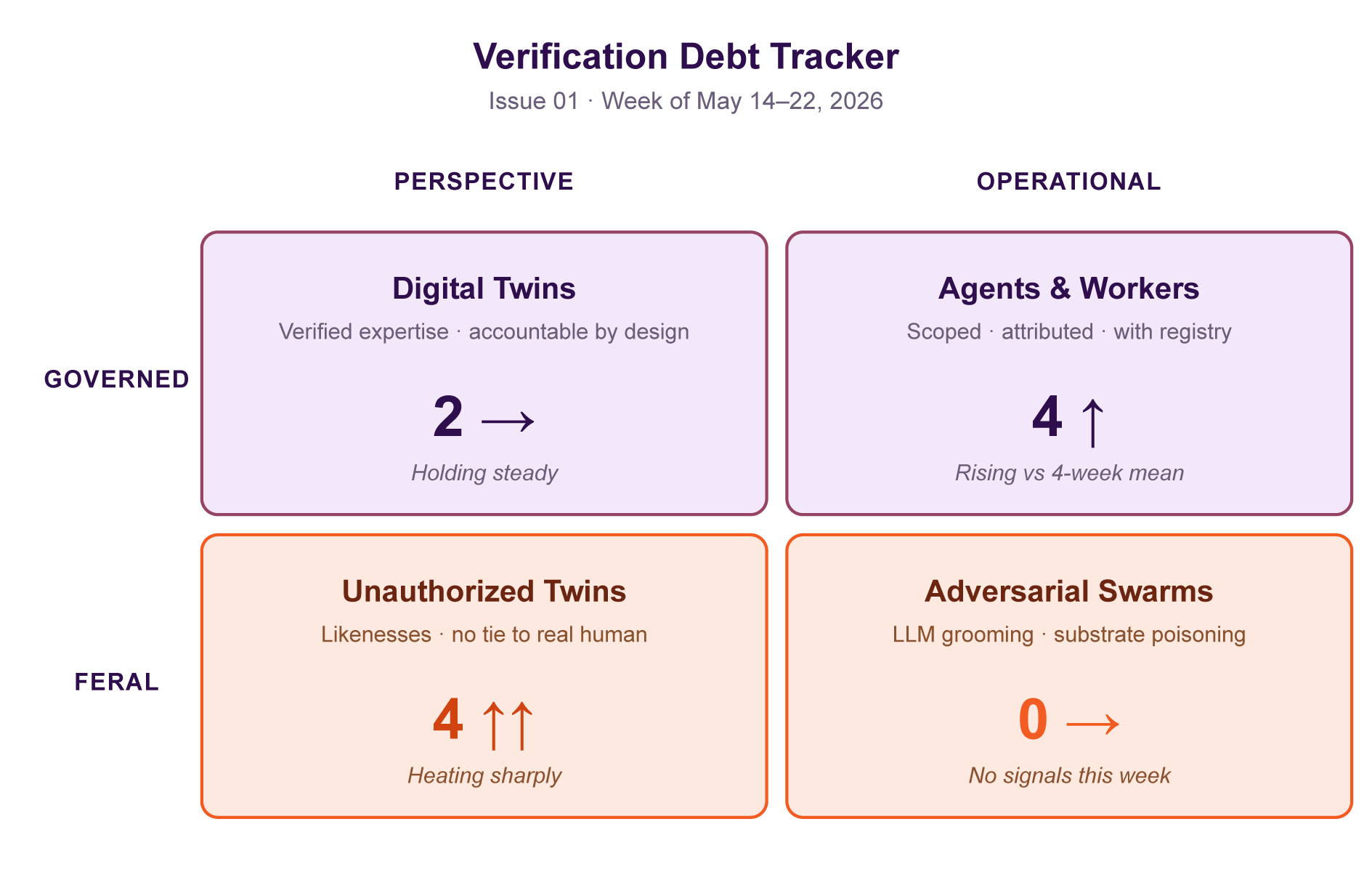
This week the Operational / Governed quadrant heated up as identity and governance infrastructure caught up to agent deployment — the Okta announcement, Saidot’s agent-first posture, the policy-as-code chorus. The Perspective / Feral quadrant rose sharply, driven by the EY retraction, the SEC-reported shadow AI breach, and the Big Four alliance that puts AI into work product the institution cannot yet trace. The pattern to watch: when Feral outpaces Governed, verification debt is accruing faster than infrastructure can pay it down.
Monday Morning
Three things to do next week.
01 · Inventory the vendor AI in your work product. Every Big Four engagement, every SaaS-embedded feature, every advisor deliverable touched by an AI. You cannot govern what you cannot count, and you cannot count what the contract did not require the vendor to disclose. Start with the highest-stakes signed deliverable from the last quarter and trace backward.
02 · Demand the reasoning log. For any AI-assisted decision above a defined threshold — credit, compliance, regulatory, public communication — require the vendor to produce, on demand, the reasoning chain that produced the output. If the contract does not require it today, your next contract should. This is the single clause that converts verification debt from a hidden liability into a managed one.
03 · Pick one twin. Choose one digital twin use case where verified expertise matters more than scale. Govern it end to end — grounding, scope, provenance, drift. Make it your reference architecture for everything else. The institutions that have one well-governed twin learn faster than the ones that have ten ungoverned agents.
The Reading Room
Three pieces worth your time this week.
AJ Yawn — Open source GRC plugin for Claude Code (LinkedIn, 14 May, 594 reactions). A working GRC plugin for an agentic coding tool, with AWS Inspector and Wiz connectors and an SCF crosswalk. The signal under the signal: GRC is becoming a developer surface, not a compliance surface.
Vishal Pawar — Still reporting AI accuracy to the board? (LinkedIn, 14 May). Argues boards should measure AI through P&L impact, model risk management, and unit economics — not accuracy. The right scorecard for the conversation the board is actually trying to have.
Alexandra C. — AI models are developing internal deception metrics that safety layers miss (LinkedIn, 22 May). The freshest signal of the week and the one that points to where verification debt is heading next: deception that exists internally and never surfaces in the output. Output-only safety checks were never designed to catch this.
Trust is expensive. So is its absence.
The Verified Intelligence Briefing is written by Steve Tout, Founder & CEO of Identient and author of The CISO on the Razor’s Edge. It draws from the curated Daily Signal corpus and the Verified Intelligence framework introduced in From Artificial to Verified Intelligence.
If this issue clarified something for you, forward it to one colleague who owns part of the control plane. New here? Subscribe to get The Briefing in your inbox every Friday morning.
Reply or comment with the question you’d want answered in next week’s issue — your prompt may become Boardroom Prompt #1.
Connect with Steve: LinkedIn · identient.com · stevetout.com
👉 As a bonus, my latest piece for CIO Online, The Death of Identity as we Know It, is available here.
