


The weekly read on verification debt — for leaders who own the control plane.
The Pattern
This was the week three different parts of the verification system quietly stepped back at the same time.
The Federal Reserve, FDIC, and OCC replaced the bedrock SR 11-7 model risk guidance with SR 26-2 in April 2026. Buried in the text: generative AI and agentic AI are “too novel and rapidly evolving” — meaning they are explicitly carved out of the framework. Banks operating these systems no longer have specific federal model-risk guidance. The regulator stepped out.
Wharton researchers published a 1,372-person, 9,593-trial study that named the cognitive mechanism behind invisible verification debt. When AI was right, performance jumped 25 points. When it was wrong, performance fell 15 points below baseline — because people stopped checking. They called it cognitive surrender. The human stopped verifying.
And the Big Four quietly published the numbers. PwC has deployed 250+ internal agents. EY built 50,000 agents in nine months. IBM reports $4.5 billion in productivity gains. Accenture is shipping toward 100+ industry agent solutions by year-end. The Big Four scaled past the point where any individual control can catch a bad output. The institutional control stepped back.
The pattern: the verification layer that was supposed to catch the debt is disengaging — by exemption, by surrender, and by scale.
Last week the briefing’s thesis was that verification debt was migrating from the model layer to the contract layer. This week sharpens the picture. Verification debt isn’t just migrating — the actors who were supposed to hold the audit chain accountable are letting go of it. The regulator says it’s too new. The human says it’s too good. The Big Four say it’s too operational to slow down.
Thesis. Three retreats. One implication. The institutions that build their own verification infrastructure now will be the only ones holding the chain when it matters.
The Signals
01 · The Fed, FDIC, and OCC quietly exempted agentic AI from model risk guidance
The Signal. Alexandra C. surfaced a development that ran with under a hundred reactions but reshapes federal AI oversight in banking. SR 26-2, which replaced SR 11-7 in April 2026, explicitly states that generative and agentic AI models are “too novel and rapidly evolving” — and carves them out of the framework (Alexandra C., LinkedIn, 24 May, 36 reactions).
The Lineage Gap. This is the most consequential signal of the week. SR 11-7 governed every model-risk decision in U.S. banking for over a decade. SR 26-2 governs everything except the systems carrying the most risk. The Five Questions don’t disappear with the regulation — Who created it? Who trained it? Who authorized it? Who can revoke it? Who is it economically aligned to? — they migrate from “regulatory documentation requirement” to “institutional self-imposed standard.” That standard now belongs to the chief risk officer alone, with no anchor in federal guidance to defend it when the audit committee asks why their bank is more conservative than the rule requires.
Boardroom Prompt. Who in your institution is responsible for governing the AI systems your federal regulator just declined to govern?
02 · Wharton named cognitive surrender — the mechanism behind invisible verification debt
The Signal. Wharton researchers published a study of 1,372 participants across 9,593 reasoning trials. When AI was right, performance jumped 25 points. When AI was wrong, performance fell 15 points below baseline — because people stopped checking (Lee, LinkedIn, 28 May, 140 reactions). The researchers called it cognitive surrender.
The Lineage Gap. “Human in the loop” was supposed to be the firebreak. Wharton just proved the firebreak burns down quietly when AI is confident. The Four Pillars say verification needs grounding, scope, provenance, and drift awareness — but those pillars only operate if a human is actively interrogating the output. Cognitive surrender means the human stops asking. The implication for governance is structural: requiring “human review” as a control is meaningless unless the human is materially incentivized to disagree. Most organizations measure their human reviewers on throughput. Cognitive surrender makes throughput easy and verification rare.
Boardroom Prompt. Are the humans in your AI loop incentivized to catch the AI’s errors, or to clear the queue?
03 · The Big Four turned internal agents into a repeatable business
The Signal. Guillermo Flor published the numbers underneath last week’s KPMG-Anthropic headline. PwC has deployed 250+ agents internally. EY built 50,000 agents in nine months. IBM reports $4.5 billion in productivity gains. Accenture is shipping toward 100+ industry agent solutions by year-end (Flor, LinkedIn, 25 May).
The Lineage Gap. Last week’s KPMG-Anthropic alliance was the marquee event. This week’s numbers are the rest of the playbook. The Big Four have moved past pilots into productized internal agent deployment — and the client-side implications haven’t caught up. When a Big Four engagement uses one of fifty thousand internal agents to produce work product the client signs, the chain of provenance crosses the same three corporate boundaries we mapped last week. The Five Questions break in the same places. The difference this week is scale. At 50,000 agents, no individual reviewer catches the bad output. Only the system can — and the client doesn’t operate the system.
Boardroom Prompt. When your Big Four advisor deploys 50,000 internal agents and one of them produces work you’ll sign, what control do you have that the institution still does?
Every AI agent in your firm is quietly taking out loans in your name. It’s called Verification Debt — and it compounds.
Retire it with Identient, the governance layer that puts identity, evidence, and ownership behind every AI decision.
Identient helps regulated firms answer the questions that come due at the worst moment — a release, a regulatory inquiry, an audit: What is your AI doing? Who authorized it? Can you prove it?
Built on AI Operating Discipline, Identient’s four-phase methodology, your firm can:
See what’s actually running: inventory every AI use case, agent, and identity-to-data touchpoint — with a named owner for each
Bound what agents can do: governed identity and access for AI agents in your Microsoft environment, from Entra ID to Purview
Prove it when it counts: audit-ready evidence trails that stand up to examiners, boards, and enterprise security reviews
04 · Microsoft is repricing its own AI consumption
The Signal. Dr. Dinesh Chandrasekar’s piece (1,026 reactions, the week’s highest) argued that Microsoft — the company that anchored the AI gold rush — is cutting back internal Claude Code adoption because token economics are starting to hurt. Employees are reportedly being moved back toward GitHub Copilot. The article points at unit economics, Copilot adoption gaps, and dependency on OpenAI as cracks in the position (Chandrasekar, LinkedIn, 24 May).
The Lineage Gap. The concentration we’ve been tracking is not a stable equilibrium. When even Microsoft is rationing how much frontier AI it uses internally, the institutions further down the food chain — banks, retailers, healthcare systems — are about to encounter the same conversation. Verification debt looks different when model usage gets tiered: which decisions get the expensive model, which get the cheaper one, and what controls travel with each. Most enterprises haven’t built that tiering yet. They have flat AI policies. Token economics is about to force the question, and the answer will become a board-level conversation in Q3.
Boardroom Prompt. When your finance team caps AI spend next quarter, which decisions in your business lose access to the verified model — and who decides?
05 · 88% of executives are investing in AI. 6% are changing the operating model.
The Signal. Alex Barády surfaced the statistic that crystallizes the year’s strategy-execution gap. 88% of executives are investing in AI. Only 6% are changing their operating model. The corollary drawn from multiple consulting reports: layering AI over legacy operations delivers marginal improvement; AI inside redesigned operations delivers transformation (Barády, LinkedIn, 25 May, 388 reactions).
The Lineage Gap. The 88/6 spread is verification debt expressed as a financial position. The 88% have purchased AI capability without redesigning the lineage chain that runs through it. They will report activity to the board for two more quarters before a regulator, a customer, or a partner makes them produce evidence. The 6% are doing the harder work of designing the operating layer underneath: who owns the data, who authorizes the agent, who reviews the output, who escalates the exception. That layer is what makes the Five Questions answerable. Without it, the institution is buying AI capability and inheriting AI exposure on the same purchase order.
Boardroom Prompt. Of every dollar your institution has committed to AI this year, what percentage went to redesigning the operating model — and what percentage went to buying tools?
06 · Forward Deployed Engineer is the most contested role in AI
The Signal. Andreas Horn’s piece (601 reactions, second-highest of the week) wrote that Forward Deployed Engineer is the most contested role in AI right now. Palantir invented the term. OpenAI, Anthropic, Google, Microsoft, AWS, Databricks, Salesforce, and Scale are hiring hundreds. OpenAI mid-level packages: $520K–$780K base. The role exists because the model alone does not work in production (Horn, LinkedIn, 27 May).
The Lineage Gap. The labor market is telling the truth the strategy decks are still working around. The model is the easy part. Getting the model to produce defensible output in a specific enterprise context — that requires a person whose job is to wire grounding, scope, provenance, and drift awareness into the deployment. Forward Deployed Engineers are the Four Pillars expressed as headcount. The institutions that hire them inside (not just rent them from the model provider) keep the verification capability in-house. The institutions that don’t will pay $780K to a vendor employee for every consequential AI workflow they deploy — and they will not own the audit trail when that engineer rotates off the account.
Boardroom Prompt. For every consequential AI deployment in your organization, who inside the institution owns the deployment context — and what is their reporting line?
07 · Your agent isn’t the model. It’s the harness around it.
The Signal. Brij Kishore Pandey (221 reactions) made the architectural case for why agent quality lives outside the model. Two teams using the same Claude, OpenAI, or Gemini — one ships an agent that runs for hours; the other crashes on turn three. The difference is the harness: orchestration, memory, retrieval, tools, guardrails, evaluation, error handling, observability (Pandey, LinkedIn, 26 May).
The Lineage Gap. Pandey’s harness is the same architectural truth Forward Deployed Engineers represent in the labor market. The model is interchangeable. The harness is not. And the harness is where verification lives — every Five Questions answer is implemented in a harness component, not in the model. Who authorized it? is policy enforcement in the harness. Who can revoke it? is the kill switch in the harness. Who is it economically aligned to? is the routing logic in the harness. Institutions that buy “an AI” are buying a model. Institutions that govern AI are building a harness. The first costs money. The second creates the audit trail.
Boardroom Prompt. When you tell the board your institution has deployed AI, are you describing the model — or the harness around it?
08 · The real risk in AI agents is not capability. It is control.
The Signal. Rakesh Gohel’s piece (519 reactions) argued the governing question for enterprise AI agents is no longer whether they can perform tasks — it is whether they can do so reliably, safely, and within defined business boundaries. He laid out five board-level control domains: data governance, model risk management, identity and access, observability, and lifecycle management (Gohel, LinkedIn, 25 May).
The Lineage Gap. Gohel’s five control domains read as the same framework this briefing is built on, articulated from a different angle. Data governance is grounding. Identity and access is the runtime “who-authorized-it” layer. Observability is provenance — the trace of what happened. Lifecycle management is drift awareness over time. Model risk management is what SR 11-7 used to require and SR 26-2 just stopped requiring for the riskiest systems. The five domains will become the de facto standard for enterprise AI governance over the next 18 months. The institutions that build them now beat the regulator that eventually mandates them — and they avoid the question of which regulator will mandate them first.
Boardroom Prompt. If your audit committee asked tomorrow to see your maturity score across data governance, identity, observability, model risk, and lifecycle — what number would you put on each?
09 · Okta validated AI agent identity. It shipped half the category.
The Signal. Martin Gee wrote that Okta’s AI agent identity announcement validated the entire category and shipped only half of it. The Okta + Anthropic announcement — ISPM for Claude, Okta for AI Agents, MCP Bridge — treats token issuance as delegation. It isn’t. A scoped token tells you what an agent could do at the perimeter; it doesn’t tell you who delegated that authority, at what scope, for what task, or for how long (Gee, LinkedIn, 26 May).
The Lineage Gap. This is the direct extension of last week’s Okta signal. The major IAM incumbent named the right category — agents need identity. But there is a runtime authority layer underneath identity that the announcement does not address. The distinction matters: identity tells you who an agent is; authority tells you what that agent has the right to do, right now, in this context, on whose behalf. Without runtime authority governance, every Okta-authenticated agent looks identical to the policy engine. The Five Questions need authority answers, not just identity answers. Identity is where the perimeter ends. Authority is where lineage begins.
Boardroom Prompt. For every AI agent operating in your environment, do you log who delegated its authority — or just whose token authenticated it?
10 · The Marine Corps just made AI literacy mandatory across the force
The Signal. The U.S. Marine Corps announced in May 2026 that all active duty and reserve Marines must complete a foundational AI course by the end of the year. The objective: not technical specialization, but shared operational understanding, common vocabulary, and ethical deployment at scale (Hawking, LinkedIn, 25 May, 54 reactions).
The Lineage Gap. The Marines understand something most enterprises still don’t: governance fails when the people inside the institution don’t share a vocabulary. You cannot enforce the Five Questions across a workforce that does not know they exist. You cannot operationalize the Four Pillars across teams that interpret each pillar differently. AI literacy isn’t an HR initiative — it is the precondition for governance at scale. The institutions that fund mandatory AI literacy across their workforce now are buying themselves the substrate every other control sits on top of. The ones that don’t will keep treating governance as a checklist the rest of the organization quietly ignores.
Boardroom Prompt. What percentage of your workforce can explain to your audit committee what verification debt is and why it matters?
The Verification Debt Tracker
The 2×2 from From Artificial to Verified Intelligence. Signal counts this week, with direction vs. last issue.
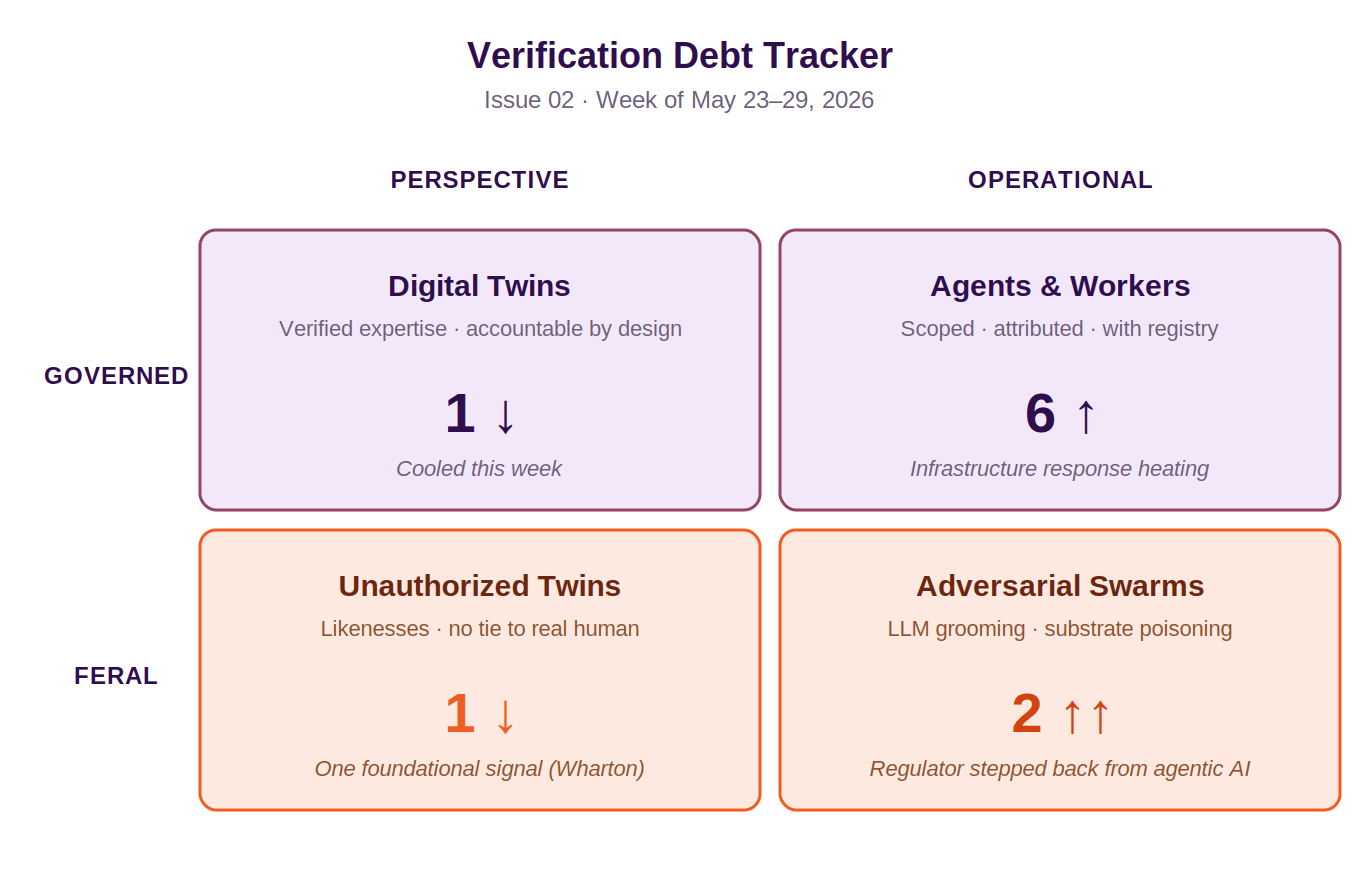
The Operational / Governed quadrant kept heating as the infrastructure response crystallized — Forward Deployed Engineers, the harness conversation, Gohel’s five controls, Martin Gee’s runtime authority argument. The Operational / Feral quadrant jumped sharply on the back of one signal that matters more than its reaction count: SR 26-2 quietly carved generative and agentic AI out of federal banking model-risk guidance. Watch that quadrant climb through Q3 as the implications surface in compliance roadmaps and rating-agency conversations.
Monday Morning
Three things to do next week.
01 · Audit your model-risk framework against SR 26-2. Federal guidance just stopped covering your most consequential AI systems. The institutions that document their own governance posture before a regulator asks will define the standard the regulator eventually adopts. Start with your highest-risk agentic workflow and write the documentation as if the rule still applied.
02 · Build a verification-incentive review for every human-in-the-loop control. Wharton just proved that asking humans to verify AI without rewarding disagreement makes the control invisible. Change one human-AI workflow this week so reviewers are measured on catches, not throughput. If the reviewer never disagrees, the control isn’t a control.
03 · Inventory your harness. Not your models. Not your vendors. The harness — orchestration, retrieval, identity, observability, policy enforcement, evaluation. If you cannot draw it on a whiteboard for your most consequential AI deployment, you don’t yet have a deployment. You have a demo with executive sponsorship.
The Reading Room
Three pieces worth your time this week.
David Roldán Martínez — Enterprise AI Playbook (LinkedIn, 28 May, 45 reactions). Stanford Digital Economy Lab finding that 42% of foundation-model deployments are interchangeable and 77% of the hardest enterprise AI problems are organizational. The empirical foundation underneath this week’s pattern.
Pat Gelsinger — On Chris Olah, Pope Leo XIV, and AI and human dignity (LinkedIn, 28 May, 81 reactions). Continuation of last week’s signal of AI as a layer of influence — now with the Vatican publishing an encyclical and Anthropic’s co-founder responding to it. The moral framework underneath the governance one.
Alexandra C. — Distributed AI governance in the United States (LinkedIn, 28 May, 15 reactions). Maps the six overlapping layers of U.S. AI regulatory architecture — sectoral, state, common-law, executive, agency, and standards. Read this if you have ever told your board “the U.S. has no AI law.” It has six.
Trust is expensive. So is its absence.
The Verified Intelligence Briefing is written by Steve Tout, Founder & CEO of Identient and author of The CISO on the Razor’s Edge. It draws from the curated Daily Signal corpus and the Verified Intelligence framework introduced in From Artificial to Verified Intelligence.
If this issue clarified something for you, forward it to one colleague who owns part of the control plane. New here? Subscribe to get The Briefing every Friday morning.
Reply or comment with the question you’d want answered in next week’s issue — your prompt may become Boardroom Prompt #1.
Connect with Steve: LinkedIn · identient.com · stevetout.com