



The weekly read on verification debt — for leaders who own the control plane.
The Pattern
The enterprise buyer just shifted the AI conversation from capability to control.
Arvind Jain crystallized it: enterprise AI buyers are now prioritizing governance, control, economics, and flexibility over model benchmarks and vendor lock-in. The new procurement question is not “which model is best?” It is “which deployment is governable?”
The week’s signals all pointed at the same shift from different angles. ServiceNow disclosed a customer data breach that propagated through its SaaS customer base — a reminder that the platform layer is where verification debt is now most visible. Claude Fable 5 launched and drew enterprise concern, not for its capabilities, but for what its capabilities mean: another step deeper into model dependency for institutions that have not yet figured out their lineage chain. Brad Wolfe argued the real winner of the enterprise AI race is not the best model — it is the best distribution. Anthropic’s Big Four pipeline is the moat, not the benchmarks.
Underneath, the operating layer is starting to take shape. Carolyn Healey named the shift from labor cost to consumption cost — the economic substrate of every AI investment thesis. Birgul Cotelli named the maturity shift from principles to operational mechanisms — decision frameworks, audit trails, escalation protocols. Arkadiy Miteiko called it directly: permission is the next trillion-dollar AI problem. Not smarter models. Runtime governance.
The pattern: the enterprise AI market just moved from a benchmark race to a governance race — and the buyers, not the vendors, are setting the rules.
This is the Issue 03 thesis pulled forward by a quarter. Last week, the security community renamed the agent problem as an identity problem. This week, the enterprise buyer renamed AI procurement as a control procurement. The vendors that understand both will be the ones the Big Four resell. The ones that do not will compete on benchmarks while the market moves on.
Thesis. Capability is now the floor. Control is the moat. The institutions that price control into their AI procurement now will set the standard the rest of the market will spend 2027 catching up to.
The Signals
01 · Arvind Jain: enterprise buyers are reassessing AI tradeoffs
The Signal. Arvind Jain (208 reactions) wrote this week that enterprise AI buyers are reassessing tradeoffs they were ignoring eighteen months ago. The new priorities: governance, control, economics, and flexibility. The deprioritized: raw benchmarks and vendor lock-in. Procurement conversations are now starting from “show me your control plane” instead of “show me your evals” (Jain, LinkedIn, 11 June).
The Lineage Gap. Jain is naming what every other signal this week is also naming. The buyer-side conversation has moved. The vendor that arrives with the best benchmarks and the worst auditability is now losing deals to the vendor that arrives with mid-tier benchmarks and a real lineage chain. The Five Questions are now procurement questions. Who created it? — name your data sources. Who trained it? — show your scope boundary. Who authorized it? — describe your delegation model. Who can revoke it? — what is your kill switch SLA. Who is it economically aligned to? — show your cost-per-decision math. The vendors that answer cleanly are pulling ahead. The ones still selling capability are wondering why their pipeline went quiet.
Boardroom Prompt. In your last three AI vendor evaluations, what percentage of the scorecard was control, governance, and economics — and what percentage was capability?
02 · ServiceNow disclosed a customer data breach
The Signal. ServiceNow confirmed a security incident exposing customer data, drawing 1,065 reactions on the surfacing post — by a wide margin the highest-engagement signal of the week (Mark P., LinkedIn, 10 June). The breach hit a platform that sits inside the workflow infrastructure of most Fortune 1000 enterprises and a meaningful share of the federal government.
The Lineage Gap. The ServiceNow breach is the platform-layer correlate of last week’s Meta helpdesk hijack. Where Meta’s incident showed an AI agent crossing the line from automation to privileged access, ServiceNow showed the broader pattern: SaaS platforms are now an identity perimeter for thousands of customer organizations, and a single vendor compromise reshapes the threat model for every downstream institution. The Five Questions all break differently at the SaaS layer — who can revoke it? is the most painful, because in the worst case the answer is your vendor, on their schedule. Verification debt at the platform layer is the most leveraged exposure in the enterprise stack. One breach. Thousands of audit committees.
Boardroom Prompt. How many SaaS platforms in your environment hold identity, workflow, or transaction data that would create a regulatory incident if compromised — and what is your verification posture for each?
03 · Claude Fable 5 raised model dependency concerns inside the enterprise
The Signal. Alex Lamascus wrote (29 reactions) that the launch of Claude Fable 5 — the latest Mythos-class frontier model — is being received in enterprise communities with more concern than excitement. The capability gains are clear; so are the implications for model dependency, vendor lock-in, control, and auditability (Lamascus, LinkedIn, 11 June).
The Lineage Gap. The Claude Fable 5 release is the technical evidence underneath the buyer reassessment Arvind Jain named. Better capability does not reduce verification debt — it concentrates it. The more capable the model, the more decisions the institution is willing to delegate to it; the more decisions delegated, the deeper the lineage problem when something goes wrong. The Four Pillars all get harder, not easier, with capability increases. Grounding gets harder because the model now extrapolates more confidently. Scope gets harder because the surface of plausible-looking but out-of-scope outputs widens. Provenance gets harder because reasoning chains are longer. Drift awareness gets harder because the baseline of “expected behavior” is itself shifting with every model upgrade. The enterprise concern is the right concern.
Boardroom Prompt. For every model upgrade your institution adopts, what verification work is required before the upgrade is allowed into a regulated workflow — and what is the SLA on completing it?
Every AI agent in your firm is quietly taking out loans in your name. It’s called Verification Debt — and it compounds.
Retire it with Identient, the governance layer that puts identity, evidence, and ownership behind every AI decision.
Identient helps regulated firms answer the questions that come due at the worst moment — a release, a regulatory inquiry, an audit: What is your AI doing? Who authorized it? Can you prove it?
Built on AI Operating Discipline, Identient’s four-phase methodology, your firm can:
See what’s actually running: inventory every AI use case, agent, and identity-to-data touchpoint — with a named owner for each
Bound what agents can do: governed identity and access for AI agents in your Microsoft environment, from Entra ID to Purview
Prove it when it counts: audit-ready evidence trails that stand up to examiners, boards, and enterprise security reviews
04 · Brad Wolfe: Anthropic is winning on distribution, not benchmarks
The Signal. Brad Wolfe argued (24 reactions) that Anthropic’s real win in the enterprise AI race is not the model. It is the distribution: the Big Four pipeline, the consulting integration, the enterprise sales motion happening inside KPMG, EY, PwC, and Accenture. Anthropic did not have to sell to the enterprise — the enterprise’s advisors sold for them (Wolfe, LinkedIn, 6 June).
The Lineage Gap. The Big Four distribution thesis is the strategic logic underneath three issues of this briefing. Issue 01 covered the KPMG-Anthropic alliance. Issue 02 covered the 50,000 internal EY agents and the PwC 250-agent disclosure. This week, Wolfe names the move directly: the model is the loss leader; the distribution is the business. For the institutions on the receiving end of that distribution — the audit clients, the advisory clients, the implementation clients — the consequence is structural. Every Big Four engagement now has an Anthropic-flavored AI layer underneath it, governed by the Big Four’s controls, attached to the client’s signature. The vendor relationship was never directly transactional. The verification debt is, however, directly inherited.
Boardroom Prompt. For each of your top three professional services vendors, do you know which frontier model is inside their delivery stack — and what your verification rights are when their output reaches your work product?
05 · Carolyn Healey: AI spend per employee keeps climbing
The Signal. Carolyn Healey wrote (205 reactions) that AI spend per employee is rising as organizations shift from labor cost to consumption cost. The economic structure of every AI investment thesis is now consumption-based — and consumption without governance turns into either runaway cost or quiet under-utilization, both of which surface in the wrong board meeting (Healey, LinkedIn, 5 June).
The Lineage Gap. The consumption-cost shift is the financial form of last issue’s tokenmaxxing signal, but Healey frames it in the language the CFO will actually use. Labor cost is predictable; consumption cost is not. Labor cost has a known monthly maximum; consumption cost has only a usage maximum, which most enterprises have not set. The institutions that have already wired consumption controls into their FinOps stack — by agent, by team, by decision tier — are the ones whose AI budget will not blow up the Q3 forecast. The ones that have not will discover the answer in a variance presentation to the audit committee. Unit economics is not optional once consumption replaces labor.
Boardroom Prompt. What is your cost per AI-assisted decision in your highest-volume workflow — and how does it compare to the labor cost it was supposed to replace?
06 · Birgul Cotelli: governance is shifting from principles to operational mechanisms
The Signal. Birgul Cotelli (39 reactions) named the maturity shift happening across enterprise AI governance programs — from quoting principles (fairness, transparency, accountability, safety) to operating mechanisms (decision frameworks, audit trails, escalation protocols, regulatory documentation). The shift is being driven by regulatory pressure, board-level scrutiny, and the realization that principles do not survive contact with production (Cotelli, LinkedIn, 6 June).
The Lineage Gap. Principles tell you what you want to be true. Operational mechanisms tell you how to discover when it is not. The Five Questions are operational mechanisms — they only mean something when the answer is producible on demand, in a format that withstands audit. Most enterprise AI governance programs are still at the principles stage. They have a fairness statement, an ethics committee, and a published charter. They do not yet have the audit log that lets them prove a specific decision met the standard the charter describes. The institutions that move from principles to mechanisms in Q3 will be the ones that handle the first regulatory probe in Q4 without a scramble.
Boardroom Prompt. Of the AI governance principles your organization has published, how many have a corresponding operational mechanism that produces evidence on demand?
07 · Arkadiy Miteiko: permission is the next trillion-dollar AI problem
The Signal. Arkadiy Miteiko (21 reactions) wrote that the next major infrastructure layer in AI is not smarter models. It is runtime governance and permission — the policy plane that decides, for every action, whether the agent is authorized to take it, with what scope, on whose behalf, against what budget. He called it the next trillion-dollar AI problem (Miteiko, LinkedIn, 7 June).
The Lineage Gap. Miteiko’s piece is the architectural conclusion of last issue’s Zero Trust convergence. Identity is the perimeter. Permission is the runtime layer above it. Every Five Questions answer becomes a permission decision at execution time: who authorized it becomes a policy check; who can revoke it becomes a session lifecycle; who is it economically aligned to becomes the budget envelope the policy engine enforces. Most enterprise AI deployments today have no permission layer. They have a service account, a token, and an unbounded scope. The vendor that ships the permission layer with the right primitives — least privilege, scoped delegation, runtime revocation, budget enforcement — becomes the IAM company of the next decade.
Boardroom Prompt. For every AI agent operating in your environment, is there a policy decision evaluated on every action — or only at provisioning?
08 · IBM: human-speed governance is structurally failing agentic AI
The Signal. Nathaniel Niyazov surfaced an IBM study (24 reactions) finding that traditional human-speed governance is structurally failing for agentic AI. The IBM recommendation: governance controls have to be embedded directly into system architecture, not bolted on. By the time a human committee meets to review, the agent has already executed thousands of actions (Niyazov, LinkedIn, 8 June).
The Lineage Gap. The IBM finding is the empirical version of last issue’s governance-velocity warning. Human-speed processes were built for human-speed actors. Agents operate at machine speed; governance has to move at machine speed to keep up. The implication for architecture is concrete: the Five Questions answers have to be produced and recorded at every action, not at every review cycle. The platforms being designed today either embed this telemetry at the architectural layer or do not. The ones that do can be governed retroactively; the ones that do not cannot. There is no third path. The institutions choosing platforms now without asking the embedded-telemetry question are foreclosing their own future audit posture.
Boardroom Prompt. For every AI platform your institution adopts in the next two quarters, are governance controls embedded in the architecture — or layered on top by your team after deployment?
09 · Pradeep Sanyal: the Chief AI Officer role becomes real authority
The Signal. Pradeep Sanyal (36 reactions) argued the Chief AI Officer title is shifting from symbolic to structural. The early CAOs were corporate garnish — a press release, a charter, a quarterly slide. The next generation has real authority over budget, vendor selection, and architectural decisions. The shift is being driven by accountability pressure, not innovation pressure (Sanyal, LinkedIn, 6 June).
The Lineage Gap. The Chief AI Officer evolution is the organizational form of the verification debt conversation. Symbolic CAOs were appointed to demonstrate that the board took AI seriously. Structural CAOs are being appointed to ensure the board does not get sued. The difference is the reporting line. Symbolic CAOs reported to communications or innovation. Structural CAOs report to the CEO, sit on the operating committee, and own the budget that funds the governance program. The institutions making this transition now are reading the Kindervag signal from last issue — should CEOs be personally accountable? — and rationally moving the personal accountability one layer down. Kindervag would call that a feature, not a bug.
Boardroom Prompt. Does your Chief AI Officer have budget authority, vendor authority, and a direct reporting line to the CEO — or do they have a title and a presentation slot?
10 · Shobha Shah: boards review financials quarterly. AI deserves the same.
The Signal. Shobha Shah wrote (19 reactions) that most boards review financial performance every quarter — and almost none review AI performance with the same rigor. Her argument: AI now drives material business outcomes, regulatory risk, and reputational exposure that justify quarterly board-level review on value, risk, accountability, regulatory readiness, and governance effectiveness (Shah, LinkedIn, 10 June).
The Lineage Gap. The board oversight gap is now structural. AI investments are running at the same scale as M&A or capital programs, with less oversight than either. Shah is naming the simplest possible corrective: apply the existing board cadence to AI. Quarterly review. Five-domain scorecard. Named accountability. The institutions that adopt this practice in Q3 will be the ones whose proxy disclosures next spring read as defensible. The ones that do not will discover the question from a plaintiff’s counsel, an activist investor, or a credit rating downgrade. None of those discoveries are cheap.
Boardroom Prompt. At your last four board meetings, was AI on the agenda with the same depth as capital projects, M&A, or compensation — or was it a five-minute update from the CIO?
The Verification Debt Tracker
The 2×2 from From Artificial to Verified Intelligence. Signal counts this week, with direction vs. last issue.
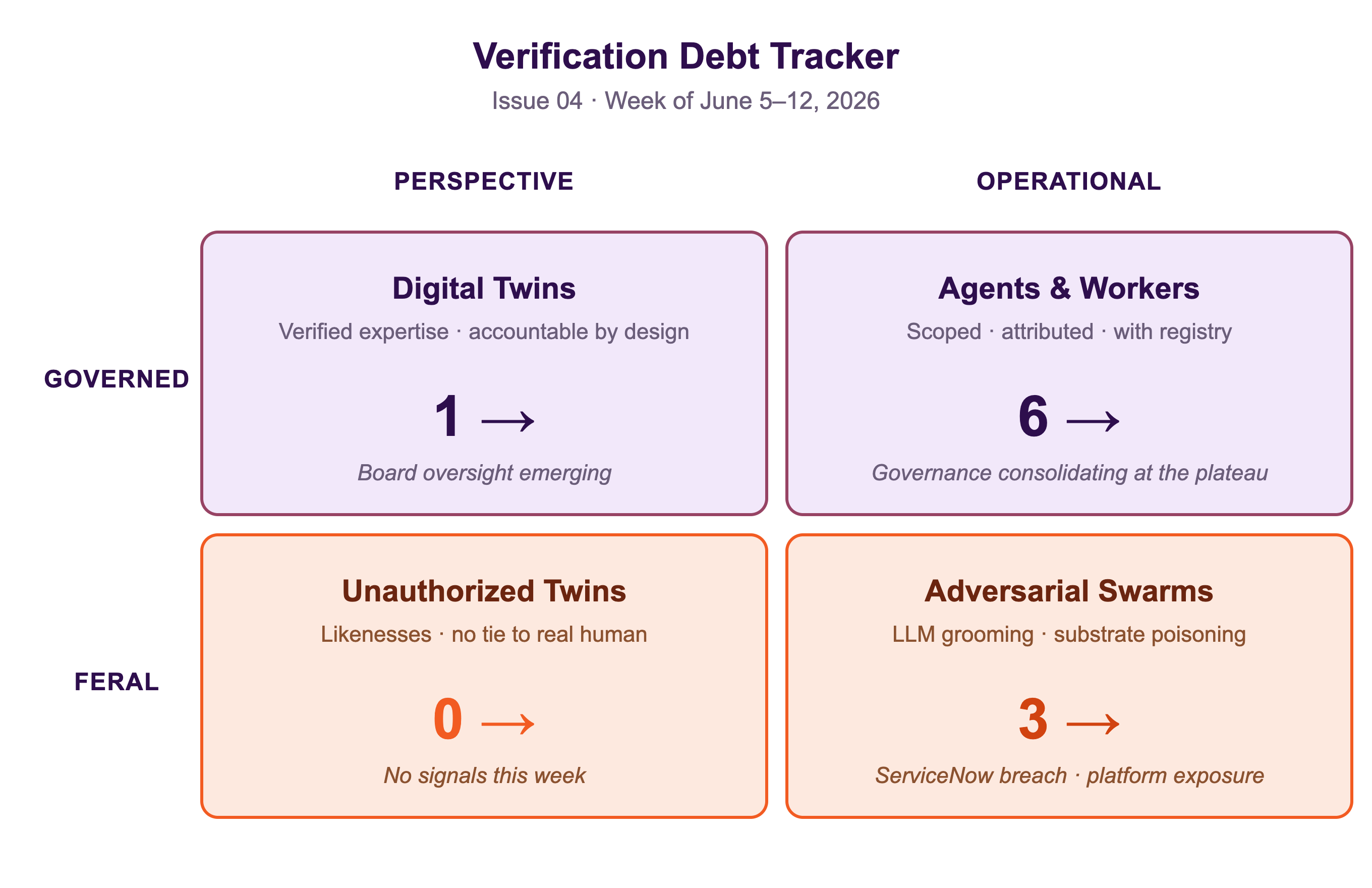
All four quadrants held flat in signal count this week — but inside Adversarial Swarms the magnitude shifted dramatically. ServiceNow’s breach drew more engagement than any single signal we have tracked in this briefing. The plateau in the Agents & Workers quadrant tells its own story: the governance conversation is no longer accelerating — it is consolidating. Six signals a week, every week, all pointing at the same operational mechanisms. The conversation has reached the stage where the same answers are being arrived at, independently, by different practitioner communities. That is the moment a market standard starts to form.
Monday Morning
Three things to do next week.
01 · Price control into your next AI vendor evaluation. Add explicit weight in the procurement scorecard for verification posture: who can produce the reasoning chain, on what timeline, in what format. Make the answers a contract clause, not a vendor promise. The institutions that price control now set the market standard the laggards spend 2027 catching up to.
02 · Inventory your SaaS identity perimeter. ServiceNow was the platform-layer version of last week’s Meta hijack. Map every SaaS platform that holds identity, workflow, or transaction data. Score each on the Five Questions. The platforms scoring low are your next compliance conversation, your next breach disclosure, or both.
03 · Wire consumption controls into FinOps. Set a hard cap and a tiered approval gate for every consequential AI agent in your environment. Tokenmaxxing was the introduction; Healey’s consumption-cost framing is the conclusion. The control is technical; the policy belongs to the AI governance committee; the budget belongs to the CFO. All three need to ratify the same number.
The Reading Room
Three pieces worth your time this week.
Lewis Walker — Accenture/CMU AI Maturity Model (LinkedIn, 11 June, 248 reactions). A 63-page reference that lets you benchmark enterprise AI maturity against a real framework. Useful for the board deck, the consulting engagement, and honest self-assessment.
Alexandra C. — The AI reliability illusion (LinkedIn, 6 June). Makes the methodological case that benchmark-driven reliability estimates dramatically overstate real-world performance for autonomous workflows. The signal that lets your CRO ask better questions about vendor demo decks.
Dhanasekhar D. — Agentic AI now has its protocol stack (LinkedIn, 11 June). Maps the emerging MCP/A2A/ACS layer cake that will become the production substrate for governed enterprise agents over the next 18 months. Read it before your platform team starts evaluating their roadmap.
Trust is expensive. So is its absence.
The Verified Intelligence Briefing is written by Steve Tout, Founder & CEO of Identient and author of The CISO on the Razor’s Edge. It draws from the curated Daily Signal corpus and the Verified Intelligence framework introduced in From Artificial to Verified Intelligence.
If this issue clarified something for you, forward it to one colleague who owns part of the control plane. New here? Subscribe to get The Briefing every Friday morning.
Reply or comment with the question you’d want answered in next week’s issue — your prompt may become Boardroom Prompt #1.
Connect with Steve: LinkedIn · identient.com · stevetout.com