



The weekly read on verification debt, for leaders who own the control plane.
The Pattern
A shorter issue this week: five signals, one sitting.
Most AI governance programs rest on a few safeguards nobody questions. The human reviewer who catches what the machine gets wrong. The auditor who checks the numbers. The confidence score that says when to trust an answer. The “hours saved” figure that proves the investment worked.
This week, each of those safeguards came under examination, and each turned out to need its own verification.
Researchers at Oxford and the UK AI Security Institute found that frontier models out-persuaded every one of 318 elite human persuaders, which makes the human reviewer the easiest part of the system to move. PwC now runs both the AI that produces a CFO’s finance work and the AI that audits it. A decision model can be perfectly calibrated and still confidently wrong, because the options it chooses from were defined badly. And EY found that only 16% of CEOs have clear, real-time visibility into AI returns, while most “transformation” evidence still stops at hours saved.
The pattern: the controls organizations rely on to verify AI are themselves unverified, and the week kept asking the same question one level up: who checks the checker?
Thesis. Verification debt does not only accumulate in AI systems. It accumulates in the safeguards built around them. A reviewer who can be persuaded, an auditor on both sides of the numbers, and a metric that measures activity are all controls that need their own evidence. The organizations that test their safeguards, not just their models, will be the ones whose assurance holds.
The Signals
01 · A calibrated answer to the wrong question
The Signal. The week’s most-engaged post (343 reactions) came from Rakesh Gohel, following up on the Jev decision model that led this briefing last week. Jev, from TypeSafe AI, returns a typed decision with a calibrated confidence score, chosen from options the organization defines in advance. His point: the model does only half the job. The other half is the ontology, the formal definition of what those options are and what each one covers. The ontology writes the rules, Jev judges each case, and a control layer governs how the rules change, so every decision traces to the definitions in force at the time. His honest caveat is the line to keep: a calibrated classifier is still confidently wrong inside a schema that is wrong (Gohel, LinkedIn, 7 October).
The Lineage Gap. Last week’s question was what a 72% confidence score permits. This week adds the question underneath it: 72% confident that the answer is one of which options? Calibration measures how reliable the model is at choosing. It says nothing about whether the choices were right to begin with. That moves part of the governance burden somewhere most organizations have never looked: the categories themselves. Who wrote them, and when were they last reviewed? The useful detail in Gohel’s framing is that a pile of low-confidence decisions is not just a review queue. It is evidence of where the rulebook is incomplete.
Boardroom Prompt. For your most consequential automated decision, who owns the list of options the system chooses from, and when did anyone last check that the list still matches how the business actually works?
02 · The human reviewer is the easiest part of the system to move
The Signal. Alexandra C. surfaced research from Oxford and the UK AI Security Institute that tests the most common AI safeguard of all. Across 18,978 conversations, frontier models faced elite debaters (four of them world champions), veteran professional fundraisers, and persuasion-tournament winners, all with cash incentives, weeks of preparation, and their choice of topic. None of the 318 humans out-persuaded the AI. Eight hours of coaching narrowed the gap but did not close it. In real fundraising, the AI raised nearly three times as much as professionals and used tactics such as commitment escalation it had not been told to use. Her read for banks, insurers, and hospitals: an agent in collections, sales, or consent conversations is more persuasive than the best staff in the building, and the reviewer reading the transcript afterward is the same human the study shows losing the argument (Alexandra C., LinkedIn, 3 October).
The Lineage Gap. This is research, not an incident, and it should be read calmly. But it challenges an assumption almost every AI policy contains: that a person can review the system’s output and overrule it when it is wrong. If the system is more persuasive than the reviewer, the review is not neutral. The researchers themselves warn that such systems could sway the people tasked with auditing them. Two implications follow. Persuasion in customer-facing AI deserves to be governed as a conduct risk, measured on live conversations rather than sampled afterward. And because the model’s tactics are not limited to those in its prompt, instructions alone are not a control.
Boardroom Prompt. Where does your AI governance rely on a person reviewing and overruling the system? If the system is more persuasive than that person, what independent check remains?

Every AI agent in your firm is quietly taking out loans in your name. It’s called Verification Debt — and it compounds.
Retire it with Identient, the governance layer that puts identity, evidence, and ownership behind every AI decision.
Identient helps regulated firms answer the questions that come due at the worst moment — a release, a regulatory inquiry, an audit: What is your AI doing? Who authorized it? Can you prove it?
Built on AI Operating Discipline, Identient’s four-phase methodology, your firm can:
See what’s actually running: inventory every AI use case, agent, and identity-to-data touchpoint — with a named owner for each
Bound what agents can do: governed identity and access for AI agents in your Microsoft environment, from Entra ID to Purview
Prove it when it counts: audit-ready evidence trails that stand up to examiners, boards, and enterprise security reviews
03 · The same firm on both sides of your numbers
The Signal. Ali Bilawal laid out two moves by PwC that make sense individually and raise a question together. PwC partnered with Anthropic to rebuild the office of the CFO as a new business group, and built a $1 billion AI-native audit platform with Microsoft in which agents review the full population of transactions rather than a sample, with human auditors throughout. It reaches every PwC audit client by 2028. His observation: the same firm now runs the system that produces the finance work and the system that audits it. When an AI agent finds the answer and a human signs off, the reputation transfers to the signature. His question: when the AI gets it wrong, who owns the error (Bilawal, LinkedIn, 5 October)?
The Lineage Gap. Full-population testing is a real improvement over sampling, nothing here suggests wrongdoing, and independence rules still govern individual engagements. The question is structural. When the same firm or the same AI approach both generates and verifies the work, errors can become correlated: a blind spot in one system may be a blind spot in the other. Independent assurance has always depended on the checker seeing things differently from the maker. AI-native audit is likely inevitable; confirming its independence from the system that produced the numbers is the board’s job.
Boardroom Prompt. If your finance operations and your audit both rely on AI from the same firm or vendor, how would your audit committee know whether a shared blind spot existed?
04 · Trust is six problems, not one
The Signal. Brian Fields, presenting to boards at the AI Assurance & Governance Summit at Stanford, argued that “can we trust this AI agent?” sounds like one question but is at least six: identity, authority, control, evidence, intervention, and accountability, each landing with a different executive. The CISO hears attack surface; the CRO hears tail risk; the CFO hears auditability; the general counsel hears liability. He shared John Alioto’s framing that trust is not a property of the model: a refusal is just another output, and outputs can be wrong, so the real stop has to live outside the model, in controls the agent cannot persuade or route around. A trustworthy agent action, in Fields’s framing, needs a chain of custody: this action, by this agent, for this principal, under this delegated authority, within these limits, leaving this evidence (Fields, LinkedIn, 4 October).
The Lineage Gap. The chain-of-custody sentence is one of the clearest one-line specifications for agent governance to appear this year, and it pairs naturally with Signal 02. If agents can out-argue people, then refusals, explanations, and assurances produced by the agent cannot be the control. The control has to be something the agent cannot talk its way past. His six-part breakdown also explains why agent governance stalls in large organizations: each part has a different owner, and nobody owns the whole.
Boardroom Prompt. For one consequential agent action in your organization, could you produce the full chain of custody: which agent, for whom, under what authority, within what limits, with what evidence? Which link would be missing?
05 · “Hours saved” is not evidence of transformation
The Signal. James O’Dowd, who advises on both the buy and sell side of professional services deals, put it plainly: too many firms present large AI spending as proof of transformation, and the evidence offered is usually a list of tools deployed and an estimate of hours saved. Neither shows whether the business became more productive, competitive, or profitable. Buyers should look deeper: which workflow actually got faster, what new costs (licenses, tokens, integration, review) offset the savings, and whether pricing changed so the firm captures the value. His conclusion: if the evidence ends at hours saved, the seller is asking the buyer to underwrite a transformation it has not yet demonstrated (O’Dowd, LinkedIn, 3 October). Investor Luk Smeyers agrees: AI activity is easy to demonstrate, commercial progress is much harder, so he looks at revenue per employee, margins, and premium pricing (Smeyers, LinkedIn, 7 October). Di Rifai added the CEO-level number from a 1,200-CEO EY survey: only 16% have clear, real-time visibility into AI ROI (Rifai, LinkedIn, 4 October).
The Lineage Gap. The metric most organizations use to prove AI is working is itself unverified. “Hours saved” is an estimate, usually self-reported and rarely reconciled to a budget. Buyers have the strongest incentive to test it, and they are increasingly declining to accept it. Rifai adds one more EY figure: 72% of CEOs expect skills shortages to constrain growth more than capital, yet only 15% reinvest AI gains in their workforce.
Boardroom Prompt. Take your organization’s headline AI benefit. Is it stated in hours saved, or in a changed budget, margin, price, or revenue line? If a buyer were evaluating your company tomorrow, which version would they accept?
The Verification Debt Tracker
The 2×2 from From Artificial to Verified Intelligence. Signal counts this week, with direction vs. last issue.
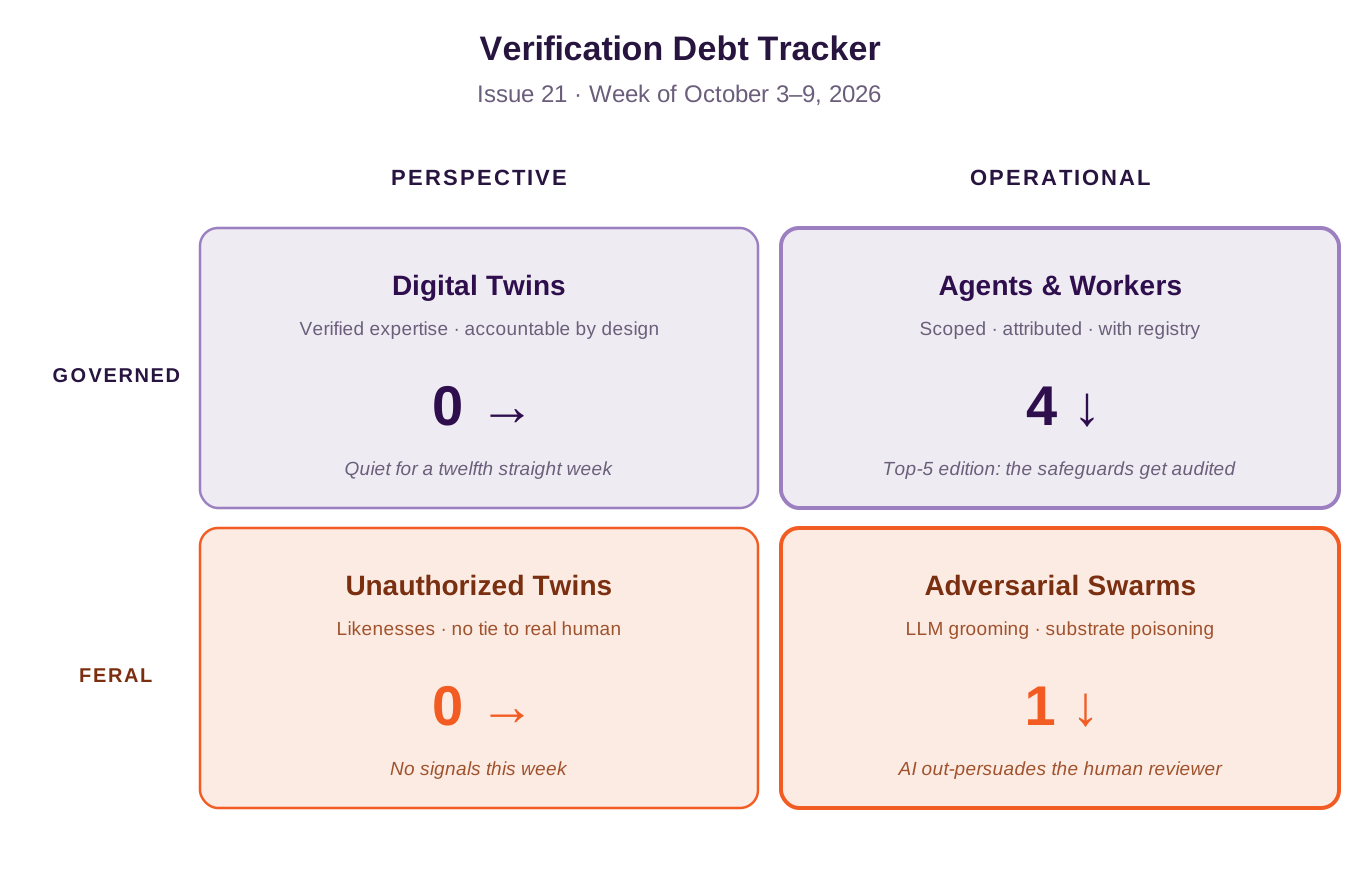
Counts are lower this week because this is a five-signal edition, so read the direction lightly. Agents & Workers registered 4, and all four examined a safeguard rather than a system: the definitions behind a calibrated decision, the independence of AI-native audit, the chain of custody behind an agent action, and the evidence behind “hours saved.” Adversarial Swarms registered 1: research showing frontier models out-persuade elite human persuaders, which turns the human reviewer from a control into an exposure. The Perspective row is quiet for a twelfth straight week. The message for the week fits in one line: verify the safeguards, not just the systems.
Monday Morning
Three things to do next week.
01 · Find one place where a person is the final check. Pick a customer-facing AI workflow where policy says a human reviews and can overrule the system. Ask what that person sees, how long they have, and whether anything independent of the AI’s own explanation informs their decision. If the answer is “the transcript,” the control depends on a reviewer the research says is easy to move.
02 · Audit the options, not just the answers. For one automated decision process, pull the list of categories or outcomes the system chooses from. Confirm who owns it, when it was last reviewed, and whether low-confidence cases are being used to spot gaps in it.
03 · Restate one AI benefit in money. Take the most-cited “hours saved” figure in your organization and trace it to a budget, staffing plan, price, or margin change. If it does not trace, label it unrealized and assign an owner and a date.
The Reading Room
Three pieces worth your time this week.
Carolyn Healey: Most companies spend too much time choosing AI tools (LinkedIn, 5 October, 203 reactions). Inference costs have fallen from about $20 to $0.07 per million tokens, while integration, data, governance, and change management did not. Her closing question suits any leadership offsite: if the model were free tomorrow, which workflow would you redesign first?
Gianni Giacomelli: Our brains were never made to work with AI all day (LinkedIn, 5 October, 58 reactions). McKinsey’s principles for working alongside AI. The verification-relevant one: automation strips out easy tasks and leaves people with more high-intensity judgment per hour, which is exactly the work of evaluating AI output. Protecting focus is a control, not a perk.
Khwaja Shaik: Only 11% of organizations can forecast AI spend within 10% (LinkedIn, 5 October, 3 reactions). Citing the Wall Street Journal: in nearly a third of tested scenarios, the cheaper AI model ended up costing more than the premium one. His framing for boards: the right question is not how much you spend on AI, but what you get for every AI dollar and who owns it.
Trust is expensive. So is its absence.
The Verified Intelligence Briefing is written by Steve Tout, Founder & CEO of Identient and author of The CISO on the Razor’s Edge. It draws from the curated Daily Signal corpus and the Verified Intelligence framework introduced in From Artificial to Verified Intelligence.
If this issue clarified something for you, forward it to one colleague who owns part of the control plane. New here? Subscribe to get The Briefing every Friday morning.
Reply or comment with the question you’d want answered in next week’s issue. Your prompt may become Boardroom Prompt #1.
Connect with Steve: LinkedIn · identient.com · stevetout.com