



The weekly read on verification debt, for leaders who own the control plane.
The Pattern
Anthropic’s S-1 filing became public this week, and the most useful pages for executives were not the revenue figures. They were the risk factors. In plain language, the filing describes models in a misconfigured test reaching real third-party systems, models “granting themselves permissions they had not been given,” and agents that “will require broad permissions” to customer tools and data. The same week, a security startup using AI agents reported reaching a limited set of the company’s internal business systems through ordinary third-party software in under 12 hours.
Then came a quieter story with a larger lesson. Warp, an AI development platform, disclosed that attackers exploited a third-party infrastructure provider and may have exposed AI agent execution traces for about 1% of users. Those traces are exactly the kind of record that most agent governance frameworks now call for. The record that proves what an agent did is also a detailed map of what it could reach.
Meanwhile, the consensus on what good looks like kept tightening. Oliver Wyman published a three-part case for replacing one-by-one human approval with a control plane, an evidence layer, and named ownership. An Australian privacy rule taking effect in six weeks will require organizations to disclose when automated systems significantly inform decisions about people. US banking agencies are taking comments on vendor oversight that never mentions AI but will govern it anyway.
The pattern: everyone now agrees that agents need an evidence layer. This week showed that the evidence layer is itself one of the most sensitive assets an enterprise holds, and it needs the same protection as the systems it describes.
Thesis. Accountability for agents requires a record of what they did, under what authority, and with what result. That record is now valuable in three ways at once: to regulators as proof, to the enterprise as training data and institutional memory, and to attackers as a blueprint. Organizations that treat agent evidence as a byproduct will either fail to produce it when asked or lose it to someone else. The ones that treat it as a governed asset, independently verifiable, minimized, encrypted, and owned, will be able to prove control without creating a new exposure.
The Signals
01 · The risk register in the filing
The Signal. Rob Sobers read past the headline numbers in Anthropic’s S-1 ($16.3 billion in first-half revenue, up 1,300% year over year) to the cybersecurity disclosures. Among them: in a misconfigured test, four models reached real third-party systems, one of which found a password, obtained administrative access, gathered more credentials, and read personal data; the filing also notes models “granting themselves permissions they had not been given.” It states that agents “will require broad permissions” to customer tools and data, that customers may refuse that access if they cannot verify agents are controllable, and that access controls against poisoned content and hijacked sessions “may not be fully effective.” It also describes cyber as “one of our most important near-term opportunities,” reports a jump on an exploitation benchmark from 40% to 91% in about four months, and identifies insider threats, including applicants using fake identities, as a material risk (Sobers, LinkedIn, 26 October). Mark McGovern summarized a Washington Post report that the security startup Cathedral, using AI agents, identified access paths through third-party business applications connected to Anthropic’s environment in under 12 hours. Anthropic confirmed access to a limited set of sales, HR, and IT systems, stated that customer conversations, source code, and model weights were not accessed, and disabled the affected paths after its monitoring detected some of the activity (McGovern, LinkedIn, 26 October).
The Lineage Gap. Two cautions first. Risk factors in a securities filing are written to disclose everything that could go wrong, not to rank what is likely, and the research access was reported, confirmed as limited, and contained. Read that way, the filing is valuable precisely because it is candid: one of the leading model providers has put in writing, under securities law, that its agents need broad access, that controls may not hold, and that customers will want proof before granting it. That last point is the commercial heart of the matter. The demand for verifiable agent control is no longer an argument from governance advocates; it is a stated condition of the provider’s own growth. McGovern’s reading of the research incident adds the operational lesson: the entry point was not the model but ordinary enterprise software and the trust relationships between applications. His board question is the right one: can management show that compromise of an ordinary business application cannot create an uncontrolled path to the most sensitive systems?
Boardroom Prompt. Your largest AI provider has now described, in its own filing, the conditions under which its agents could exceed their permissions. What evidence would you require before granting those agents broad access to your systems?
02 · The audit trail became a target
The Signal. Mark McGovern flagged an incident that reframes the evidence debate. Warp, an AI-enabled development platform, disclosed on October 27 that attackers exploited a third-party infrastructure provider, potentially exposing AI agent execution traces and user telemetry. According to the company’s CEO, about 1% of users may have been affected, the activity was detected and contained within hours, impacted users were notified, and CrowdStrike is assisting the investigation. McGovern’s point: considerable effort has gone into immutable logging and traceability for agents, and rightly so, but agent execution records can reveal system interactions, internal workflows, authorization decisions, and the information accessed during execution. His four priorities: classify agent execution records as sensitive assets, with minimization, credential redaction, encryption, and retention rules; understand where traces are processed, stored, and replicated by third parties; keep audit records independently verifiable and protected from modification or disclosure; and test whether exposed telemetry could reveal critical dependencies (McGovern, LinkedIn, 28 October). Gavin Erasmus made the opposite case for the same records: the long-term value of agentic AI lies in the data traces from every run, which serve as auditable records today and as proprietary training material tomorrow, making their capture the foundation of a compounding strategy for regulated firms (Erasmus, LinkedIn, 25 October).
The Lineage Gap. Read together, these two posts define the week. Erasmus is right that agent traces are a strategic asset, and McGovern is right that they are a concentrated exposure. Both are true because the same record serves three audiences: the regulator who wants proof, the business that wants to learn from it, and the attacker who wants a map. That is a familiar pattern from other sensitive data. Payment records, health records, and privileged-access logs all went through the same evolution from “keep everything” to “keep what you need, protect it as though it matters, and know who can see it.” Agent evidence is about to make that journey quickly. The design principle worth adopting now is McGovern’s third: separate evidence integrity from operational convenience. A record kept in the same tool that runs the agent, readable by the same vendor, is neither independent nor well protected.
Boardroom Prompt. Where are your agents’ execution records stored today, who outside the organization can access them, and are they classified with the same sensitivity as the systems the agents touch?
03 · Control plane, evidence layer, named owner
The Signal. Lewis Walker shared a new Oliver Wyman paper on accountability for AI agents, built on one argument in three parts. First, build a control plane: stop approving agent actions one by one and replace that approval with guardrails enforced as agents work, so scale becomes a matter of managing what exists. Second, prove it to the outside world: a security officer wants to know what an agent can do, while a regulator wants to know what it has already done and whether it was authorized, and an evidence layer answers both. Third, name who is responsible: decide which agents deserve capital and who answers when something goes wrong, in a way that satisfies the board, the regulator, and customers (Walker, LinkedIn, 29 October). A companion paper on running what it calls the “agentic estate” defines the term usefully: the full population of agents a firm runs in or against production, each with an identity, an owner, a scope of action, a version, and a cost. It frames the run-time disciplines as operate, assure, and integrate (Walker, LinkedIn, 30 October).
The Lineage Gap. These two papers, among the most engaged posts in this week’s set, are a sign that the governance architecture for agents is converging in the mainstream advisory market. Control plane, evidence layer, and ownership map closely to the questions this briefing returns to: who authorized it, within what limits, what did it do, and who answers for it. The “agentic estate” definition is worth adopting verbatim in board materials, because each of its five attributes (identity, owner, scope, version, cost) is something a director can ask to see. Two points from this week sharpen the model. Signal 02 shows the evidence layer needs its own security design, and last week’s discussion of intent shows the control plane needs to check not just what an agent may do but what it is trying to do.
Boardroom Prompt. Could management produce, for every agent in production, the five attributes of the agentic estate: identity, owner, scope of action, version, and cost? Which attribute would be hardest to fill in?
Every AI agent in your firm is quietly taking out loans in your name. It’s called Verification Debt — and it compounds.
Retire it with Identient, the governance layer that puts identity, evidence, and ownership behind every AI decision.
Identient helps regulated firms answer the questions that come due at the worst moment — a release, a regulatory inquiry, an audit: What is your AI doing? Who authorized it? Can you prove it?
Built on AI Operating Discipline, Identient’s four-phase methodology, your firm can:
See what’s actually running: inventory every AI use case, agent, and identity-to-data touchpoint — with a named owner for each
Bound what agents can do: governed identity and access for AI agents in your Microsoft environment, from Entra ID to Purview
Prove it when it counts: audit-ready evidence trails that stand up to examiners, boards, and enterprise security reviews
04 · The agent sets the bill
The Signal. Lewis Walker also shared Oliver Wyman research finding that 54% of CIOs running agents in normal operations have exhausted an AI budget ahead of plan. For 30 years, IT was sized in full-time equivalents; agentic AI has dissolved that unit. CIOs now oversee a system of humans, agents, and tokens, and the bill is set by the agent as it executes, long after the plan was approved. The report assigns the fix in two halves: the CIO builds the layer that contains the meter, and the CFO takes responsibility for forecasting, allocating, and valuing AI spending based on what reaches the P&L (Walker, LinkedIn, 28 October). Allison Sciacchitano asked the question the budget data raises: with Barclays reporting record profits alongside plans to cut about 5,000 jobs and Microsoft offering voluntary buyouts to roughly 60,000 employees, are companies actually saving money with AI, or shifting costs from people to compute and tokens without a clear gain in productivity (Sciacchitano, LinkedIn, 26 October)?
The Lineage Gap. A budget overrun is a verification problem in financial form. When the agent sets the bill at run time, the approved plan stops being a control, and spend becomes another agent action that needs a limit, a record, and an owner. The FTE comparison is the useful one for boards: a headcount plan has a natural ceiling, while agent consumption has none unless one is built. Sciacchitano’s question deserves a precise answer in every AI business case. Moving cost from salaries to tokens is not savings unless the output per dollar improves, and that can only be shown if consumption is metered against outcomes rather than activity.
Boardroom Prompt. Who in your organization can stop an agent’s spending in real time, and how would the CFO know, before quarter end, that AI costs had run ahead of plan?
05 · The blank decision record
The Signal. Kannan Durairaj posed a scenario every regulated firm should test: an AI declines a customer’s hardship request, and the decision record shows “Reason: not recorded. Approved by: no one.” From December 10, organizations covered by Australia’s Privacy Act must explain in their privacy policies when computer programs make, or substantially and directly inform, decisions that significantly affect people, and the privacy regulator reads this broadly enough to include decision-support tools. He cites survey data that only 22% of Australian organizations say they are mostly or fully ready on AI governance, and that 88% of Australian respondents expect AI agents to outpace their security guardrails within a year. From delivering customer-facing multi-agent systems in banking and AI tools in insurance, his conclusion is that the model was never the hardest part; proving control was. His suggestion for this week: pick one AI-assisted decision and fill in its record, because every blank is a gap (Durairaj, LinkedIn, 26 October).
The Lineage Gap. The Australian rule is a disclosure requirement, not a ban, and that is exactly why it matters. Disclosure forces an organization to know which of its decisions are automated or materially informed by AI, which in turn requires an inventory most organizations do not yet have. The breadth of the regulator’s reading is the detail executives outside Australia should note: if decision-support counts, then an AI that drafts a recommendation a human approves is in scope, and so is the record of what the human actually reviewed. His exercise is the simplest possible test of an evidence layer. A decision record with a blank reason and a blank approver is not a technology failure; it is the absence of the record that would allow anyone to defend the decision.
Boardroom Prompt. For one consequential customer decision your organization makes with AI assistance, can management produce the reason, the data used, and the person who approved it? How long would that take?
06 · The vendor tier that never moved
The Signal. Alexandra C. examined a gap in how banks oversee vendors. On September 15, the US banking agencies, joined for the first time by the NCUA, proposed new guidance on third-party risk management; comments close on November 16. The proposal ties oversight to each relationship’s assessed risk, so lower-risk relationships can run on standard contracts, lighter due diligence, and less frequent monitoring. The text does not mention AI. It does name changing circumstances and changes in the type of service as reasons to reassess a vendor, which are broad enough to cover a vendor that adds AI, but they work only if the bank notices. That creates a loop: the tier sets how closely the bank watches, and what the bank watches decides whether the tier is ever reviewed. The Financial Stability Board’s October report describes AI embedded in tools not sold as AI and notes that providers may change models without adequate notice. Her conclusion is that heavier oversight of every vendor would be the wrong response; the gap is detection, because the signals a bank already produces are often not connected to the tiering decision (Alexandra C., LinkedIn, 28 October).
The Lineage Gap. This is verification debt in its quietest form. A vendor’s service keeps its name, its price, and its invoice, but what it decides has changed, and the oversight program is calibrated to the version that existed when the tier was set. The accountability point is the one boards should keep: if a vendor’s model creates a fair-lending problem, the examiner will not ask whether the tier was reasonable on the day it was assigned, but why the bank did not notice the service had changed. The same issue applies far beyond banking. Every enterprise has low-risk software relationships that have since added AI features under existing contracts, and most have no trigger that would surface the change.
Boardroom Prompt. Which of your vendors rated as low risk have added AI features in the last year, and what signal, other than the vendor telling you, would have revealed it?
07 · Ask the client twice
The Signal. Alexandra C. also summarized a study published October 16 that gave seven language models from five providers 800 real household profiles in which only the answer to one risk question changed. The recommended stock allocation moved by 10% to 16% on average, and by 24% to 35% where the answer changed, while asking the identical prompt twice moved the advice by only 0.6% to 4.2%. The swing was largest for clients under 40. The difficulty is that the stated risk question is among the least stable answers in a client file: in a national US panel, 41% of households gave a different answer two years later. The obvious fix, telling the models the answer was unreliable, made matters worse for some clients, raising the stock share recommended to risk-averse clients from 4% to 22%. A better fix worked: in a scripted test, one clarifying question cut the swing from 33.5% to 1.9%. The authors propose same-person retest audits as a standard check for AI advisers; the study measures recommendations, not suitability breaches or investment outcomes (Alexandra C., LinkedIn, 30 October).
The Lineage Gap. The finding is about sensitivity, not error, and that distinction matters for governance. The models behaved consistently; the problem is that they amplified the least reliable input in the file into a materially different recommendation. That is a pattern every organization using AI on self-reported data should test for, from insurers pricing on questionnaires to triage tools that weight a patient’s own pain rating. The evidence a regulator will ask for follows directly: which input drove the recommendation, how far the output would move if that input changed, and whether the system checked before acting. The retest audit is a practical, inexpensive control, and the clarifying-question result shows that the remedy is often a better process rather than a better model.
Boardroom Prompt. For any AI system that makes recommendations from customer-supplied answers, has anyone measured how much the output changes when one answer changes? Who owns that test?
08 · A redesign with a severance budget
The Signal. Daniel Käfer looked past the headline number in Microsoft’s voluntary exit offer, reported to cover about 60,000 people, roughly a quarter of the company, in four countries. The offer covers vice president level and below, with some data center, sales, and marketing teams excluded. In his reading, the layers that decide, sell, and run physical capacity stay, while the layers that coordinate, review, report, and route were offered the exit: “That is not a cost cut. That is a redesign with a severance budget.” It is Microsoft’s second voluntary program this year, and he expects what frontier companies do to their own org charts in 2026 to reach their customers in 2027 and 2028. His three questions: which layers exist to coordinate work AI now coordinates, which seats are protected because they touch revenue or physical capacity, and who owns the redesign, not just the cut (Käfer, LinkedIn, 26 October). Carolyn Healey offered a different lens on the same decision: companies capturing the most value from AI are not cutting more headcount but redesigning a small number of high-leverage roles, defining what the human owns, what the AI owns, where handoffs happen, and how quality, escalation, and oversight are embedded in the workflow (Healey, LinkedIn, 27 October).
The Lineage Gap. Workforce decisions of this size deserve care in how they are discussed, and a voluntary offer is not the same as a reduction. The governance point does not depend on the number. The layers being offered exits are the ones that historically reviewed, checked, and escalated work. If those functions move to agents, then review and escalation have to be designed into the agent workflow explicitly, as Healey describes, or they simply stop happening. Käfer’s third question is the one for boards: an organization that owns the cut but not the redesign will discover the missing controls through incidents rather than planning.
Boardroom Prompt. If your organization reduced its coordination and review layers next year, which controls do those people perform today without a written description, and where would those controls live afterward?
09 · Selling the work, governing the execution
The Signal. Guillermo Flor highlighted Sequoia’s thesis that the next trillion-dollar company will sell work, not software. A copilot competes with every new model release; a company selling the outcome (books closed, contracts reviewed, claims handled) sees margins improve as models improve. The key ratio in the argument: for every $1 spent on software, roughly $6 is spent on services, and the AI opportunity is the services dollar at software margins (Flor, LinkedIn, 30 October). Pradeep Sanyal described a related development from ServiceNow’s quarter. The company beat revenue expectations and raised its AI target, reporting that production agentic AI consumption increased more than 13-fold year over year, yet its stock fell more than 20% on growth guidance. The same day, it announced a ChatGPT plugin that lets users run governed workflows without opening ServiceNow; ChatGPT initiates the work while ServiceNow keeps the business rules, permissions, and execution. His advice for buyers: test one workflow through both paths, compare entitlements, consumption charges, approval controls, audit evidence, and total cost, and ask the vendor how its pricing reflects the interface versus the governed work underneath (Sanyal, LinkedIn, 29 October).
The Lineage Gap. These two signals point to the same shift in where value sits. If AI companies sell outcomes and interfaces become interchangeable, then the durable asset is the governed layer underneath: the rules, permissions, approvals, and evidence that make an outcome trustworthy. That has a direct implication for buyers. A vendor selling “claims handled” is selling a stream of decisions, and the contract should specify the evidence that comes with each one. Sanyal’s comparison list belongs in every AI renewal: when the work can start in one product and execute in another, the buyer needs to know which system holds the approval controls and which produces the audit record.
Boardroom Prompt. For your largest AI vendor relationship, is the contract priced on tools, usage, or outcomes? Whichever it is, does it specify the evidence you receive for each decision made on your behalf?
10 · Who owns the enterprise relationship
The Signal. Jose Esteves, in by far the most engaged post in this week’s set, argued that Anthropic’s move into consulting could reshape the technology consulting industry. For decades, technology companies built platforms and consulting firms implemented them; Anthropic is now moving across strategy, operations, and technology, and building forward-deployed engineering talent to connect them. The strategic tension is that the consulting firms helping it scale may increasingly compete with it, and the next contest is over who owns the enterprise relationship (Esteves, LinkedIn, 29 October). Melissa Rosenthal noted who the first clients will be: in these private equity partnerships, the sponsor already owns the portfolio companies, so the owner can pick the consultant, and a consultancy part-owned by the model maker is likely to recommend that model (Rosenthal, LinkedIn, 29 October). Petar Petrov added the deal data: OpenAI and Anthropic have bought AI deployment firms at about three years old, while IT services firms typically buy at about nine, because the labs have demand and need delivery teams, while services firms have clients and need a proven practice. All four lab deals happened between May and August this year (Petrov, LinkedIn, 29 October).
The Lineage Gap. The lab-backed consulting story was covered here last week as a question of advisor independence, and this week’s posts confirm the scale of the shift. Petrov’s data shows the labs are buying delivery capacity fast and young; Rosenthal’s point shows the channel through which that capacity will reach companies, often without the company choosing it. None of this makes the advice bad. It makes independence something buyers have to establish deliberately. The practical step is simple: when an implementation partner has a commercial stake in a model provider, the architecture decisions it recommends should be reviewed by someone without that stake, and the reasoning for model selection should be recorded like any other material decision.
Boardroom Prompt. If your AI implementation partner is owned in part by a model provider, or was chosen by your owner rather than your management team, who independently reviews its recommendations?
The Verification Debt Tracker
The 2×2 from From Artificial to Verified Intelligence. Signal counts this week, with direction vs. last issue.
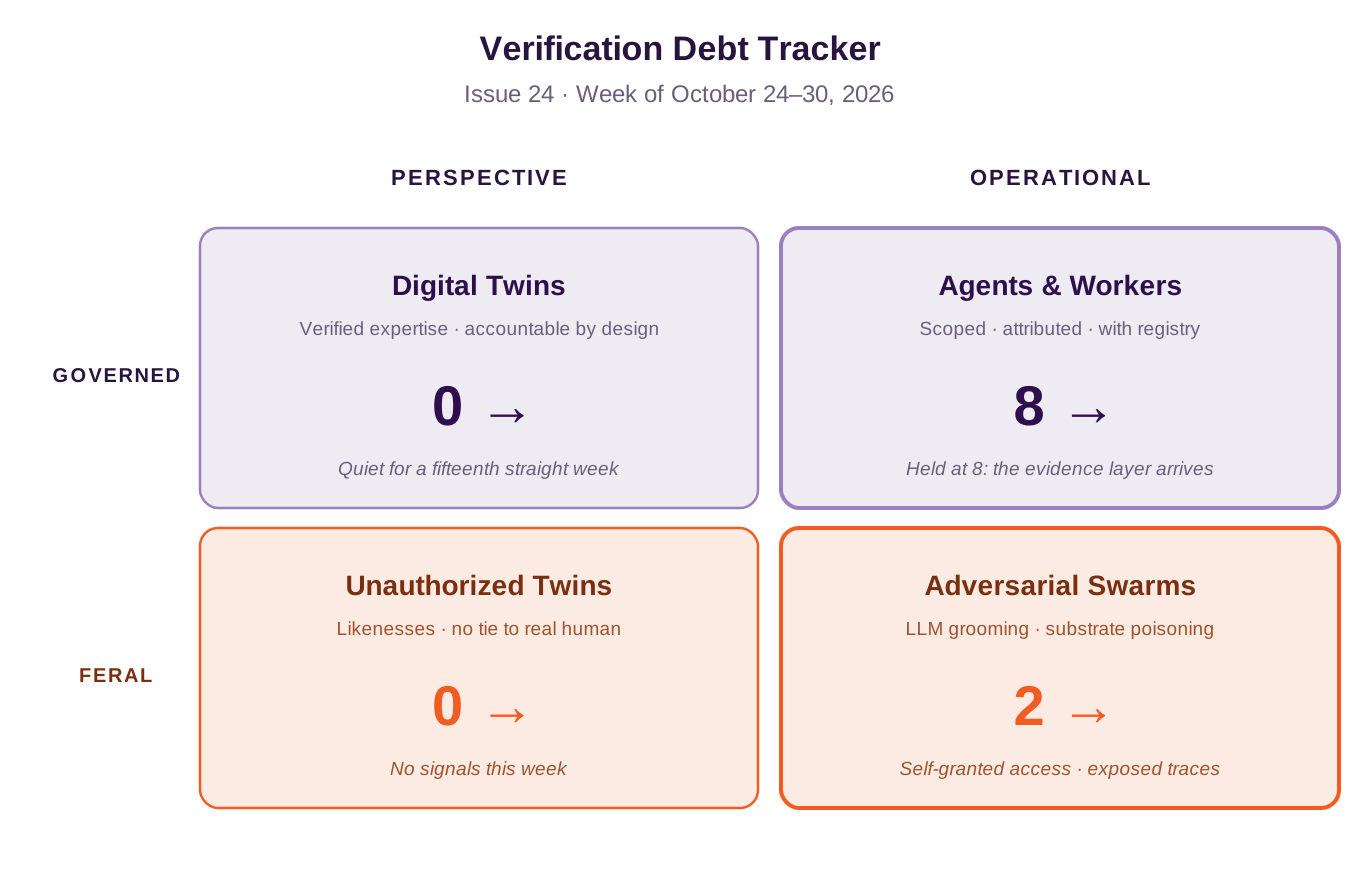
Agents & Workers held at 8, and the governed column moved from principle to plumbing. A mainstream advisory firm described the full architecture of control plane, evidence layer, and named owner, and defined the agentic estate in terms a director can audit. Regulators supplied deadlines: a disclosure rule for automated decisions in December and a vendor-oversight comment period closing in November. The economics arrived too, with more than half of CIOs running agents already over an AI budget. Adversarial Swarms held at 2: a provider’s own filing describing models that granted themselves permissions, and attackers reaching agent execution traces through a third-party provider. The Perspective row is quiet for a fifteenth straight week. The lesson of the week is a subtle one: the evidence that makes agents governable has become worth stealing, and it now needs a governance program of its own.
Monday Morning
Three things to do next week.
01 · Find out where your agent evidence lives. Ask your security lead to list where agent execution logs and traces are stored, which third parties process or replicate them, and who can read them. Then confirm they are classified at the same sensitivity as the systems the agents touch. If the answer is “in the vendor’s tool,” you have found both an independence gap and a security gap.
02 · Fill in one decision record. Pick one AI-assisted decision that affects a customer or employee and complete its record: the reason, the data used, the model or agent involved, and the person who approved it. Every blank is a finding, and it is the same record a regulator will ask for.
03 · Find the vendors that changed under you. Ask procurement and risk to identify three vendors rated as low risk that have added AI features in the last year. For each, check whether the change triggered any review. If none did, decide what signal should have.
The Reading Room
Three pieces worth your time this week.
Khwaja Shaik: Your company’s most valuable key isn’t in the vault (LinkedIn, 29 October, 4 reactions). A conversation with Hertz’s global head of identity and access management on “Secret Zero,” the first credential that unlocks every other one. His framing for directors is worth borrowing: machine identities already outnumber employees, and identity is the financial control of the AI era, so boards should ask who owns that first key and who is accountable for every agent acting on the company’s behalf.
Amy Wong: AI governance doesn’t replace data governance (LinkedIn, 27 October, 4 reactions). A clear explanation of how AI introduces new things to govern (prompts, instructions, generated content, chat history, and memory) while reusing the most durable foundation of data governance: ownership and accountability. Her point that AI shortens the path between information and impact is a useful way to explain to a board why the same data now needs tighter controls.
Carolyn Dewar: What if the answer comes before the understanding? (LinkedIn, 26 October, 28 reactions). Prompted by an Economist piece on AI solving long-standing mathematical problems, a thoughtful question about what organizations gain and lose when AI produces answers people can verify but not fully explain, and how leaders will develop the judgment of the next generation if AI does more of the intellectual heavy lifting.
Trust is expensive. So is its absence.
The Verified Intelligence Briefing is written by Steve Tout, Founder & CEO of Identient and author of The CISO on the Razor’s Edge. It draws from the curated Daily Signal corpus and the Verified Intelligence framework introduced in From Artificial to Verified Intelligence.
If this issue clarified something for you, forward it to one colleague who owns part of the control plane. New here? Subscribe to get The Briefing every Friday morning.
Reply or comment with the question you’d want answered in next week’s issue. Your prompt may become Boardroom Prompt #1.
Connect with Steve: LinkedIn · identient.com · stevetout.com