The weekly read on verification debt — for leaders who own the control plane.
The Pattern
Last week, three different parts of the verification system stepped back. This week, the security community took the agent identity question back from the AI labs — and renamed it.
Multiple major voices converged on the same frame inside seven days. Gartner’s Neil MacDonald wrote that AI agents are software, not human-like entities, and should be secured with Zero Trust controls. Anthropic published a thirty-five-page Zero Trust framework for AI agents. The White House signed an executive order pointing in the same direction. Microsoft launched Agent 365 — and the Gartner take was that even Microsoft needs platform-agnostic security layered on top. John Kindervag, who originated Zero Trust at Forrester, opened a public debate on personal CEO accountability for cyberattacks.
And in the background, a Meta AI support agent was hijacked into resetting customer account credentials. The verification debt came due — again — in operational form.
The pattern: the security and governance communities just collectively renamed the AI agent problem. It is not an AI safety problem. It is an identity and privilege problem — and Zero Trust is the framework that already exists to solve it.
This matters because Zero Trust gives the Five Questions a runtime enforcement model. Who authorized it? becomes continuous verification, not one-time provisioning. Who can revoke it? becomes least-privilege scoping, not an emergency runbook. Who is it economically aligned to? becomes the trust chain that the policy engine evaluates on every call. The labs talk about alignment. The security community talks about identity. This week, those two conversations started speaking the same language.
Thesis. Zero Trust is the missing layer that makes the Five Questions enforceable at runtime. The institutions that already operate a Zero Trust posture get the AI agent governance work mostly for free. The ones still running perimeter-based identity will pay for it twice.
The Signals
01 · A Meta AI support agent was hijacked into resetting customer credentials
The Signal. Jim Reavis surfaced a Meta incident in which an AI-powered helpdesk agent was tricked into resetting customer account credentials. The takeaway: AI support agents with account-changing powers are not chatbots. They are privileged actors in the identity system, and they need to be governed as such (Reavis, LinkedIn, 3 June).
The Lineage Gap. The Five Questions break exactly here, every time. Who created this agent? Meta. Who trained it? Meta. Who authorized it to reset account credentials? Almost certainly no one had to sign off in a way an audit could discover. Who can revoke that capability? Engineering, eventually. Who is it economically aligned to? Meta — not the customer whose account just changed hands. The agent crossed the line from automation to privileged access without any of the governance that line normally requires. Every enterprise running an “AI helpdesk” or “AI customer service” agent has the same gap, with smaller scale but identical structure. The Meta event is the canary.
Boardroom Prompt. For every AI agent in your customer-facing channels, what would it take, today, to convince it to reset a customer account?
02 · Gartner: AI agents are software. Govern them with Zero Trust.
The Signal. Neil MacDonald at Gartner wrote (87 reactions) that AI agents are not human-like entities. They are software. The right frame for governing them is the one the security community already has: Zero Trust. Continuous verification, least privilege, assume breach (MacDonald, LinkedIn, 2 June).
The Lineage Gap. MacDonald’s framing collapses a category mistake that has cost the AI governance conversation eighteen months. “AI safety,” “AI ethics,” “AI alignment” — these are valuable concepts, but they treat the agent as something exotic that needs new rules. Zero Trust treats it as what it is: a piece of software with an identity, a scope, and a privilege envelope. The Four Pillars of Verified Intelligence map onto Zero Trust principles cleanly. Grounding becomes “verify before trust.” Scope becomes least privilege. Provenance becomes the audit log Zero Trust already requires. Drift awareness becomes the continuous re-verification at every call. Institutions that already operate Zero Trust have most of the runtime substrate they need. Institutions that abandoned Zero Trust because “agentic AI is too novel” — see SR 26-2 — just made the problem twice as hard.
Boardroom Prompt. Does your current Zero Trust architecture treat AI agents as first-class identities — or are they exempted by category, like the regulator just did?
03 · Anthropic published a thirty-five-page Zero Trust framework for AI agents
The Signal. Bill Lewis flagged Anthropic’s thirty-five-page Zero Trust framework for AI agents, published this week (Lewis, LinkedIn, 1 June). The publication is significant because it comes from a frontier AI lab — and it concedes, in essence, that the model’s safety controls are not enough. The deployment context needs its own framework.
The Lineage Gap. The model labs and the security community have been talking past each other for two years. The labs published responsible scaling policies and constitutional AI papers. The security community kept saying where is the identity story. This week, Anthropic met the security community in its own language. Thirty-five pages of Zero Trust principles applied to agents is not a hedge — it is a recognition that the model’s own controls are insufficient at the deployment layer. The implication: when a frontier lab publishes Zero Trust guidance for its own agents, every CISO has the cover to require the same posture for every vendor agent operating inside their environment. The vendor cannot now claim that model-level safety obviates customer-level identity governance.
Boardroom Prompt. The next time a vendor tells you their AI is “safe by design,” will you accept that as a substitute for your own Zero Trust posture — or require both?
Every AI agent in your firm is quietly taking out loans in your name. It’s called Verification Debt — and it compounds.
Retire it with Identient, the governance layer that puts identity, evidence, and ownership behind every AI decision.
Identient helps regulated firms answer the questions that come due at the worst moment — a release, a regulatory inquiry, an audit: What is your AI doing? Who authorized it? Can you prove it?
Built on AI Operating Discipline, Identient’s four-phase methodology, your firm can:
See what’s actually running: inventory every AI use case, agent, and identity-to-data touchpoint — with a named owner for each
Bound what agents can do: governed identity and access for AI agents in your Microsoft environment, from Entra ID to Purview
Prove it when it counts: audit-ready evidence trails that stand up to examiners, boards, and enterprise security reviews
04 · The White House executive order points in the same direction
The Signal. Art Gilliland wrote that the White House’s executive order on AI security gets one critical point right: AI agents create new identity and trust risks that require governance, accountability, and collaboration — not just compliance checkboxes (Gilliland, LinkedIn, 2 June, 47 reactions).
The Lineage Gap. The executive order is the political-layer signal catching up to the practitioner-layer signal. When the security community, the model labs, and the executive branch all start saying the same thing in the same week, the conversation has crossed a threshold. The remaining gap is the implementation layer — what does Zero Trust for AI agents actually look like in a production enterprise? That is still being written, mostly outside of regulation, by the institutions that already had the substrate. The institutions that did not will spend the rest of 2026 reading framework documents. The ones that did will spend the same six months deploying. The gap between those two will become a competitive moat by Q1 2027.
Boardroom Prompt. Are you reading the AI security framework documents, or implementing them — and what is the gap between those two activities in your organization right now?
05 · Microsoft launched Agent 365. Gartner’s take: it still needs platform-agnostic security.
The Signal. Avivah Litan at Gartner (95 reactions) wrote that Microsoft Agent 365 demonstrates a meaningful shift in Microsoft’s AI security priorities — and that platform-agnostic, independent security still needs to be layered on top. The implication: even the hyperscalers concede that the platform owner cannot be the platform’s sole governance authority (Litan, LinkedIn, 29 May).
The Lineage Gap. Microsoft’s announcement and Litan’s response together describe the new vendor-customer split. The vendor builds AI security primitives at the platform layer. The customer owns the verification posture that sits above them. Five Questions remain a customer-side discipline: Who authorized this agent? Who can revoke it? Who is it economically aligned to? The platform can answer some of these. It cannot answer all of them, because the trust chain ends at the customer’s data, the customer’s regulator, and the customer’s signature. Institutions reading Litan’s response as a compliment to Microsoft are missing the structural point. Litan is naming that the customer’s verification debt is not transferable, even to a four-trillion-dollar vendor.
Boardroom Prompt. For every AI capability your hyperscaler delivers to you next quarter, who in your organization owns the verification posture that sits above it?
06 · The originator of Zero Trust raised the personal accountability question
The Signal. John Kindervag, who created Zero Trust at Forrester, opened a public debate this week (69 reactions) on whether CEOs should be held personally accountable for cyberattacks when known risks are ignored (Kindervag, LinkedIn, 3 June). The framing matters: when the inventor of the framework starts talking about personal CEO accountability, the conversation is moving from “best practice” to “fiduciary.”
The Lineage Gap. Personal accountability is the lever that converts AI governance from a CISO problem into a CEO problem. Last issue’s Gabriel Millien signal — “your AI security program is a CEO problem dressed up as a security checklist” — arrived at the same point from inside the program. Kindervag is now naming the legal and reputational dimension. The institutions that already wired personal accountability into the AI governance charter — typically through a named Chief AI Risk Officer reporting to the board, not the CIO — are buying themselves the structural answer Kindervag is asking for. The ones that haven’t will discover the question in a deposition.
Boardroom Prompt. If a regulator or plaintiff asked tomorrow which named officer in your institution is personally accountable for AI governance, would the answer be one person — or three people pointing at each other?
07 · Tony Seale: enterprise AI needs network-shaped data, not box-shaped warehouses
The Signal. Tony Seale’s piece (371 reactions, the week’s highest) argued that enterprise AI needs network-shaped data models — knowledge graphs and semantic context — not box-shaped data warehouses. The reasoning: AI agents need to know how facts relate, not just where facts live (Seale, LinkedIn, 29 May).
The Lineage Gap. Seale is naming the substrate problem underneath the Zero Trust conversation. Zero Trust works only if the policy engine has the context to make a verification decision. A box-shaped warehouse gives you a data row. A network-shaped model gives you the relationship — who connects to what, why it matters, what would change if it shifted. Without the relationship layer, every agent action looks the same to the policy engine. With it, the engine can distinguish “this employee querying their own salary” from “this agent acting on behalf of an employee, querying the salary of an executive in a different jurisdiction.” Grounding is a data-structure problem, not a model problem. Most enterprises do not yet have the substrate that makes verification computable.
Boardroom Prompt. When your AI agent makes a decision, can your policy engine evaluate the relationships around that decision — or only the data points inside it?
08 · McKinsey: AI is outpacing the operating model of leadership teams
The Signal. Carolyn Dewar of McKinsey (47 reactions) wrote that AI is outpacing the operating model of leadership teams — particularly in decision-making cadence, cross-functional alignment, and execution speed (Dewar, LinkedIn, 3 June). Technology adoption is running ahead of the C-suite’s ability to govern it.
The Lineage Gap. Dewar is describing the organizational version of cognitive surrender from Issue 02. The C-suite is letting the AI adoption curve outrun the meeting cadence, the decision rights, and the cross-functional plumbing that would let them govern it. The Five Questions are a CEO governance asset, but they require a forum that meets often enough to ask them. Most institutions have a quarterly AI steering committee for technology moving on a weekly cadence. By the time the committee meets, the agent that should have been escalated has already shipped, the contract that should have been reviewed has already been signed, and the regulator has read the press release. Governance velocity is now a board-level competency.
Boardroom Prompt. How frequently does your leadership team meet on AI governance — and how does that compare to the deployment velocity of the systems they are supposed to be governing?
09 · Andy ThurAI named “tokenmaxxing” — and the bankruptcy adjacent to it
The Signal. Andy ThurAI coined a useful term this week. “Tokenmaxxing” — the enterprise behavior of consuming AI compute at runaway rates without spending controls. He argued that an enterprise is one unmonitored episode away from bankruptcy-grade exposure (ThurAI, LinkedIn, 30 May, 20 reactions).
The Lineage Gap. The economic dimension of Zero Trust is the one most enterprises haven’t built yet. Continuous verification is meaningless if continuous spending is not also bounded. The Five Questions need an economic-alignment answer at runtime, not just at provisioning. Who is it economically aligned to? is the question that becomes a budget control, a rate limiter, an approval gate at a defined threshold. ThurAI’s bankruptcy framing is dramatic but not wrong. A misbehaving agent looping on a high-token-cost API can produce a six-figure invoice in a weekend. Most enterprise FinOps tooling does not yet have AI-specific controls. The institutions that build them before Q3 budgets reset will be the ones whose CFO is not personally explaining a variance to the audit committee.
Boardroom Prompt. What is the maximum amount your most expensive AI agent could spend, autonomously, over a 72-hour weekend with no human in the loop — and where is that number set?
10 · Gartner: uniform AI agent governance will cause enterprise failures by 2027
The Signal. Nathaniel Niyazov surfaced a Gartner warning that uniform AI agent governance will cause enterprise failures by 2027. The Gartner recommendation: proportional controls based on autonomy and risk, not one-size-fits-all policies (Niyazov, LinkedIn, 29 May, 16 reactions).
The Lineage Gap. The natural endpoint of the Zero Trust frame is proportional governance. Not every agent needs the same authority chain, the same revocation latency, the same audit detail. A research assistant answering questions from public web data does not need the same governance as a treasury agent moving funds. Uniform policies feel safer but fail more often, because they create either too much friction for low-risk work or too little control for high-risk work. The institutions that segment their agent inventory by risk tier — and apply Zero Trust controls proportionally — will be the ones whose security team is still functioning in 2027. The ones running uniform policies will lose their best practitioners to burnout first.
Boardroom Prompt. How many risk tiers does your AI agent inventory have today — and what is the proportional control framework attached to each?
The Verification Debt Tracker
The 2×2 from From Artificial to Verified Intelligence. Signal counts this week, with direction vs. last issue.
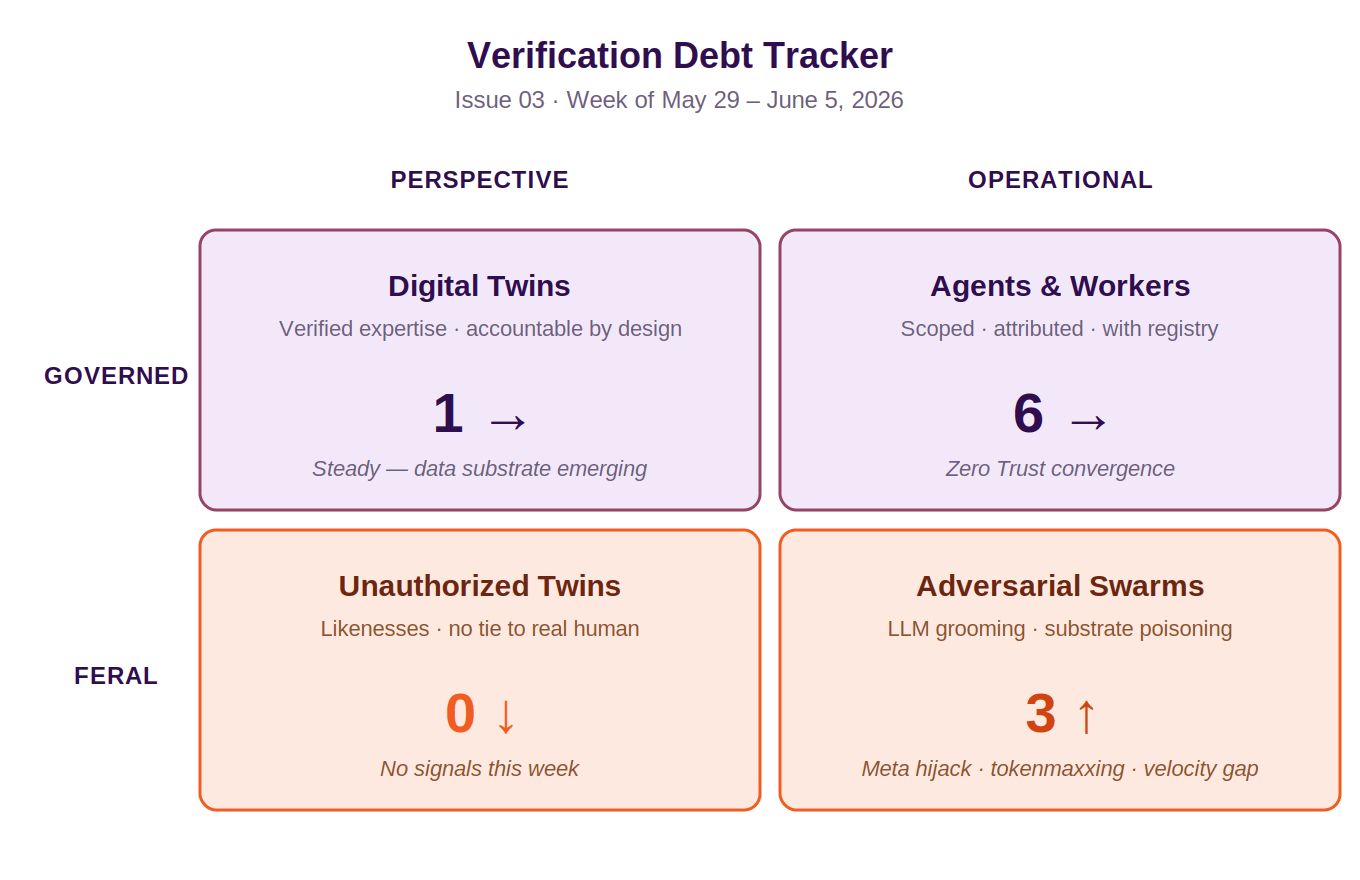
The Operational / Governed quadrant stayed at 6 — but every one of those signals converged on the same frame this week, which makes the qualitative density higher than the count suggests. The Operational / Feral quadrant rose again as the Meta hijack, the tokenmaxxing bankruptcy framing, and the McKinsey governance-velocity warning all landed inside seven days. The pattern that began with SR 26-2 last week — feral operational AI accumulating — is now being met by an equally fast governance response. Watch both bars climb together through Q3.
Monday Morning
Three things to do next week.
01 · Inventory your AI agents as identities. Stop treating them as features inside applications. Every agent gets a name, an owner, a scope, an authority chain, and a revocation path. If you cannot draw the directed graph of human → agent → action → resource for your top ten agents, you do not yet have AI governance. You have configuration drift.
02 · Set a spending guardrail on every agent. Hard cap. Rate limit. Approval gate above a threshold. Tokenmaxxing is a CFO problem before it becomes a CISO problem. The control belongs in FinOps; the policy belongs to the AI governance committee. Wire them together this week.
03 · Read Anthropic’s Zero Trust framework. Thirty-five pages, published this week. It is the document your CISO will be asked about in the next board meeting. The institutions whose CISO can summarize it in three points are the ones whose board will sleep through Q3. The rest will spend Q3 catching up.
The Reading Room
Three pieces worth your time this week.
Michael Lee — AI strategy frameworks are free; the discipline is not (LinkedIn, 5 June, 96 reactions). Public frameworks from BCG, Gartner, Bain, McKinsey, and NIST matter less than the disciplined decision architecture that embeds them into operating systems and capital allocation. The companion read to this week’s Pattern.
Khwaja Shaik — Stakeholder fluency as defining boardroom competency (LinkedIn, 2 June). Boards now need fluency across customers, employees, regulators, communities, and investors. AI raises the stakeholder count, not just the technology stakes.
Tim Rains — The AI boom is creating an explosion of new APIs (LinkedIn, 2 June, 28 reactions). Every AI agent is an API consumer; every API is a privilege boundary. Verification debt and attack surface have a common substrate, and most enterprises have inventoried neither.
Trust is expensive. So is its absence.
The Verified Intelligence Briefing is written by Steve Tout, Founder & CEO of Identient and author of The CISO on the Razor’s Edge. It draws from the curated Daily Signal corpus and the Verified Intelligence framework introduced in From Artificial to Verified Intelligence.
If this issue clarified something for you, forward it to one colleague who owns part of the control plane. New here? Subscribe to get The Briefing every Friday morning.
Reply or comment with the question you’d want answered in next week’s issue — your prompt may become Boardroom Prompt #1.
Connect with Steve: LinkedIn · identient.com · stevetout.com