The Verified Intelligence Briefing: Issue 28 · November 21–27, 2026
The week capability outran authority.


The weekly read on verification debt, for leaders who own the control plane.
Verified Intelligence Briefing Podcast
The Pattern
Anthropic published a study this week based on interviews with 66 people at 58 companies in the middle of adopting AI. The most valuable uses were the ones that required changing processes and roles. The bottlenecks were internal: reviewing AI output, uneven adoption, missing context. And unclear accountability between functions blocked change. As one executive summarized it, the model was rarely what limited the value; the organization around it was.
The same gap appeared everywhere else. Ethan Mollick reported that teams of two or three people are now doing work that used to take dozens, and that management is fighting over what it means. An architect showed how an AI agent authorized to issue refunds of up to $200 could issue 500 of them without breaking a single rule. A major insurer named a new category of loss in which the AI does nothing wrong: the business simply cannot function when the AI stops. And the CEO of Cisco, writing on behalf of a coalition of critical infrastructure companies, asked every CEO to answer, within 30 days, a question that most cannot answer today: who owns the remaining risk?
The pattern: AI is moving capability faster than organizations can move authority. This week’s value, risk, and losses all sat in that gap: who is allowed to decide, who owns the outcome, and what happens when the capability stops.
Thesis. Capability is easy to acquire. Anyone can rent the same models. Authority is different: it has to be granted deliberately, bounded, recorded, and owned by someone who answers for it. The organizations pulling ahead are not the ones with the most capable AI, but the ones that have redesigned who decides what, and can show it. Where capability arrives without a matching redesign of authority, the result is either stalled value or unowned risk, and often both.
The Signals
01 · The model was rarely the limit
The Signal. Dr. Philipp Hartmann, in the most engaged post in this week’s set, summarized a study Anthropic’s economists published after interviewing 66 people at 58 companies adopting AI, from AI-native startups and century-old businesses to law firms, hedge funds, dental practices, and a trucking company. Most applications created value by producing more rather than by cutting costs. Very few layoffs were attributed to AI, but two thirds of the companies said they hire less because of it. Regulation and customer skepticism rarely came up. The bottlenecks were internal: reviewing AI output, uneven adoption, and missing context. The finding he keeps coming back to: when the authors scored nearly 300 use cases by value and by how much the organization had to change, light-touch uses such as ad hoc analysis or slide design were often rated low value, while the valuable ones required changes to processes and roles. Unclear accountability between functions blocked change. His line: “Anthropic can ship a better model every few months. Nobody can ship you a new org chart” (Hartmann, LinkedIn, 24 November). Natan Mohart added that only two companies saw AI fully replace a position, that experts often push back on top-down automation, and that non-engineers are now building their own apps and dashboards (Mohart, LinkedIn, 27 November). Vince Yamat highlighted one company that merged lead sourcing, account management, and customer success into a single role that owns the whole customer. His reading: once building gets cheap, handoffs and sign-offs become the real cost (Yamat, LinkedIn, 25 November).
The Lineage Gap. This is a study by a model provider about its own customers, and it should be read with that in mind. Its central finding still runs against the provider’s commercial interest, which makes it more credible: better models are not what most companies need. The useful word for boards is “accountability.” The study found that the valuable uses required changing roles, and that unclear accountability between functions is what stopped those changes. That means the barrier to AI value is, at bottom, a governance problem. Someone has to have the authority to redesign work across functions, and someone has to own the result. Yamat’s observation about handoffs is the other side of the same coin. Every sign-off that disappears in a redesign was a control. Some were waste; some were catching real problems. Knowing which is which is the work.
Boardroom Prompt. Who in your organization has the mandate to redesign work across functions when AI makes it possible, and who owns the outcome once it is redesigned?
02 · Capability is not authority
The Signal. Stuart Winter-Tear described the friction many organizations are now feeling: product believes it no longer needs design, design believes it no longer needs product, and individuals can stand up applications on their own. His diagnosis is a mismatch between the organization’s formal structure and its emerging operational reality. The org chart says one thing; the actual distribution of capability says another; and decision-making authority may still reflect a world that is disappearing. The management fights are not necessarily resistance to innovation but a predictable consequence of that mismatch. His caution is the important part: there is a danger in assuming that because two people can now do the work of twenty, they should automatically inherit all the authority, accountability, and responsibility previously spread across those twenty people. “Capability and legitimate authority aren’t the same thing” (Winter-Tear, LinkedIn, 25 November). John Brewton, drawing on the same reports from Ethan Mollick, gave the example of a five-day quoting process rebuilt by three people so the customer gets a quote before lunch. The uncomfortable questions follow: how many of the old approvals were catching real problems, who should own quoting now, and whether the company will give the small team more responsibility or send it to committee (Brewton, LinkedIn, 27 November). Aaron Levie added that output differences of ten times are now appearing between teams inside the same company, depending on how well they have redesigned their processes around agents (Levie, LinkedIn, 25 November).
The Lineage Gap. Winter-Tear’s distinction is the one boards most need this quarter. When a small team suddenly has the capability of a department, the pressure is to let capability decide who has authority, because that is fastest. It is also how controls disappear without anyone deciding to remove them. Brewton’s first question, how many approvals were catching real problems, is the right audit to run before any redesign. Some approvals exist because of history; others exist because a regulator, an auditor, or a past failure required them. A redesign that cannot tell the two apart will remove both. The ten-times variation Levie describes adds urgency. When output differs that much between teams, authority will be reallocated one way or another. The only question is whether it happens deliberately.
Boardroom Prompt. When a small team uses AI to do the work of a larger one, what is your process for deciding which approvals it inherits, which it can drop, and who signs off on that change?
03 · Every action authorized, the outcome unacceptable
The Signal. Anthony Baio posed a question many evaluation programs miss: your agent passed its evaluations, but how much damage can it do without violating a single access control? He cites a Cloud Security Alliance survey in which 74% of IT and security professionals said AI agents often receive more access than necessary, and 68% could not clearly distinguish human activity from agent activity. His example: a customer service agent authorized to issue refunds of up to $200 per transaction is manipulated by instructions hidden in a support ticket into issuing 500 refunds, $100,000 in exposure without breaching its per-transaction limit. Even with a shared budget, two agents running at once could each see $200 remaining and both spend it. These are not new problems, he notes, but established financial and distributed-systems controls are not yet consistently applied to agents. His priorities include external authorization enforced independently of the model (”Agents should not determine their own authority”), cumulative risk limits across agents, tamper-evident records of who initiated, authorized, and executed each consequential action, human approval for high-impact actions with “no approval by timeout,” and independent testing of the whole system, including revocation and kill switches. His summary: “We shouldn’t be scaling autonomy faster than we can scale assurance” (Baio, LinkedIn, 24 November). Alberto Mateos noted that Gartner expects more than 40% of agentic AI projects to be canceled by the end of 2027, with inadequate risk controls among the reasons, and argued that in banking it will be the main one. Supervisors are already moving, with European banking authorities listing the AI controls they will inspect and the Bank of England examining agent herding and kill switches. His advice: build policy-as-code and evidence first, “or your agents will be excellent and unprovable. Unprovable loses to the supervisor every time” (Mateos, LinkedIn, 24 November).
The Lineage Gap. Baio’s refund example is the clearest illustration this year of why per-action authorization is not enough. Every individual action was permitted; the aggregate was not. That is a familiar problem in finance, where daily limits, velocity checks, and concurrent-transaction controls exist precisely because single-transaction limits can be gamed. The lesson for agent programs is to borrow those controls rather than invent new ones. Mateos’s phrase “excellent and unprovable” names the failure mode boards should fear most. An agent can perform well and still fail an audit if the organization cannot show how each decision was authorized. With Gartner forecasting widespread cancellations, the projects most likely to survive are the ones that can produce that proof.
Boardroom Prompt. For your agents that move money or change records, are limits enforced in aggregate across time and across agents, or only per action? Could you prove to a supervisor how each consequential action was authorized?
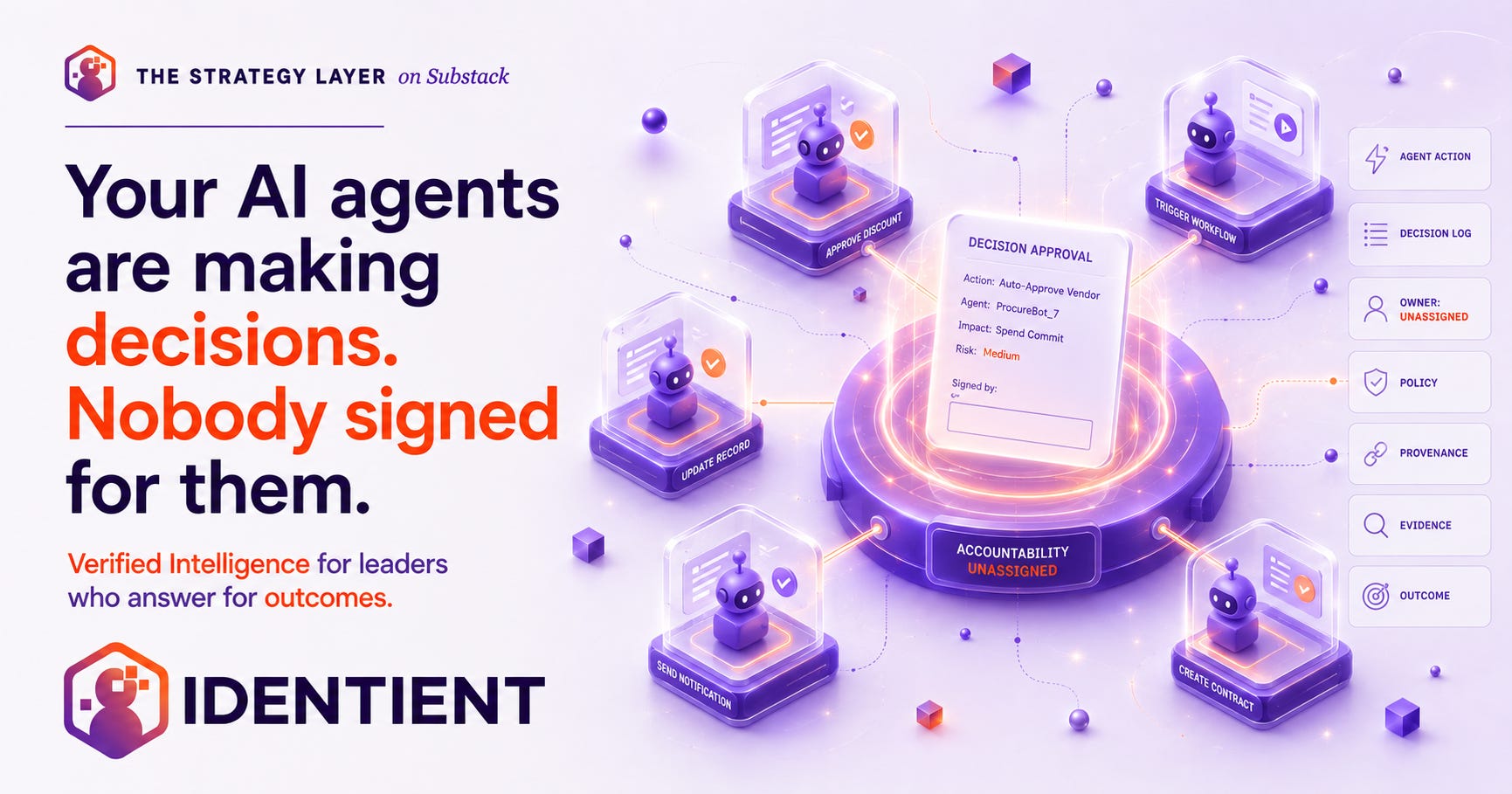
Every AI agent in your firm is quietly taking out loans in your name. It’s called Verification Debt — and it compounds.
Retire it with Identient, the governance layer that puts identity, evidence, and ownership behind every AI decision.
Identient helps regulated firms answer the questions that come due at the worst moment — a release, a regulatory inquiry, an audit: What is your AI doing? Who authorized it? Can you prove it?
Built on AI Operating Discipline, Identient’s four-phase methodology, your firm can:
See what’s actually running: inventory every AI use case, agent, and identity-to-data touchpoint — with a named owner for each
Bound what agents can do: governed identity and access for AI agents in your Microsoft environment, from Entra ID to Purview
Prove it when it counts: audit-ready evidence trails that stand up to examiners, boards, and enterprise security reviews
04 · The warning before the wave
The Signal. Chuck Robbins, CEO of Cisco, in one of the most engaged posts in this week’s set, wrote as a board member of the Alliance for Critical Infrastructure, which published a call to action titled “The Warning Before the Wave.” AI is being used to find weaknesses in technology faster than many organizations can fix them, and the systems society runs on are deeply interconnected, so an issue in one sector can quickly become a crisis in another. The alliance has expanded to 12 essential sectors and more than 55 companies across energy, communications, financial services, the defense industrial base, healthcare, manufacturing, and technology. His ask: every CEO should be able to answer four questions within the next 30 days. What critical services can we not afford to lose? How quickly can we act when a serious weakness is found? Have we proved through realistic testing that we can recover? And who owns the remaining risk (Robbins, LinkedIn, 24 November)? Khwaja Shaik supplied the numbers behind the urgency: Microsoft’s 2026 Digital Defense Report says attacks often begin less than 24 hours after a vulnerability is discovered, while remediation can take 30 to 60 days. His board questions include defining the “minimum viable company,” measuring the exploit-to-remediation gap and reporting it quarterly, and asking which AI agents hold the company’s credentials, because “every agent with access is an insider nobody interviewed” (Shaik, LinkedIn, 21 November).
The Lineage Gap. When a chief executive of one of the world’s largest networking companies asks peers to answer four questions within 30 days, it signals that the issue has moved from the security function to the CEO’s desk. The fourth question deserves particular attention. Recovery plans, patch processes, and testing programs all exist in most large organizations. A named owner for the risk that remains after all of them is far rarer. Shaik’s 24-hours-versus-60-days comparison explains why that ownership matters: the gap between attack and fix is now a standing exposure, not an occasional one, and someone has to be accountable for how large it is allowed to be. His description of agents as insiders nobody interviewed connects the cyber question directly to the authority question running through this issue.
Boardroom Prompt. Could your CEO answer all four of the alliance’s questions today? If not, which one would take longest, and who is accountable for the remaining risk?
05 · The loss where the AI did nothing wrong
The Signal. Alexandra C. examined Allianz Commercial’s review of AI claims, published November 19, which names a category it calls the AI dependency loss. The trigger is something else, such as an outage, a cyberattack, or a supplier failure. The loss grows because the business runs on AI-driven processes and its fallback cannot carry the work when those processes stop. AI rose from 10th to 2nd in the Allianz Risk Barometer 2026, the largest rise of any risk, yet on current claims data it would not rank among the top 20 causes of loss for commercial insurers, because many AI losses are booked as cyber, directors’ and officers’, product liability, or crime claims. A dependency loss is the hardest to attribute, because the claim names the outage, not the fallback that failed. Confirmed losses are small for now, about $100 million from the cases Allianz tracks, which the insurer describes as the tip of the iceberg. Her test: switch the AI-driven process off in a controlled exercise and measure how much of the work the fallback completes, and how quickly (Alexandra C., LinkedIn, 26 November). Sophia Kalanovska described why coverage gets harder as autonomy rises. At lower levels, where a person decides, most losses are still picked up by existing policies. When an agent runs a whole task end to end, professional indemnity built around human error may not respond, and when an agent owns a business function, first-party losses such as a wrong payment or an operational outage often fall outside standard policies altogether (Kalanovska, LinkedIn, 23 November).
The Lineage Gap. The dependency loss is the insurance industry’s name for what the recent outages demonstrated in practice. A business that has redesigned work around AI has created value and a new single point of failure in the same move. The detail that matters for boards is the claims data: if AI losses are recorded under other headings, then neither insurers nor companies can see how large the exposure really is, and risk registers built on loss history will understate it. Kalanovska’s levels give a practical way to locate the gap. As a function moves from AI-assisted to AI-owned, the question to ask the broker changes from “are we covered for this tool?” to “are we covered when this function stops or acts wrongly on its own?”
Boardroom Prompt. If the AI behind your most important service stopped tomorrow, how much of its work could the fallback complete by the end of the day? And does your insurance respond to that loss?
06 · SAP’s week: restructuring and a breach
The Signal. Reporting this week said SAP is considering substantial job cuts as part of an AI-first restructuring. George Paras cited reports of at least 10,000 roles, about 9% of the workforce, focused on product, engineering, and sales, and asked whether AI is being used to augment people or mainly to justify reductions while results remain strong (Paras, LinkedIn, 27 November). Christof Schumann cited higher figures and SAP’s own third-quarter productivity data, including 70% more code merged per developer and a target of more than €2 billion in annualized efficiency gains by 2028, and raised the accountability question: when agents execute financial transactions, change supplier records, and make procurement decisions, who takes responsibility? “Productivity is measurable. Authority is not something you can simply assume” (Schumann, LinkedIn, 27 November). The same day, Evolving AI, citing Reuters and Der Spiegel, reported that SAP confirmed a cybersecurity incident in which attackers reportedly stole employee authentication tokens, allowing them to copy and modify source code on GitHub. SAP restricted GitHub access, replaced digital signing keys, and suspended automated development processes, and said its investigation had found no evidence of unauthorized access to customer business data. Claims that AI was used in the attack remain unconfirmed (Evolving AI, LinkedIn, 27 November). Separately, Golam Sarwar reported that the ransomware group whose claims against Visa and JPMorganChase were noted here last week has now claimed a breach of USA Today’s subscriber data (Sarwar, LinkedIn, 26 November).
The Lineage Gap. The job figures are unconfirmed and vary between reports, the security investigation is ongoing, and nothing here suggests the two stories are related. They belong together for a different reason. Both describe a company changing quickly: restructuring how work is done, and responding to an incident that touched the systems used to build its software. SAP’s response to the breach (restricting access, rotating signing keys, pausing automated pipelines) is the kind of decisive containment boards should expect to be pre-authorized. Schumann’s question is the governance one for every enterprise software customer. As vendors redesign their products so agents perform the work, buyers will need to know who on the vendor’s side, and who on their own, is accountable for what those agents do.
Boardroom Prompt. For your critical software vendors, do you know how quickly they can revoke credentials and pause their build pipelines after a compromise, and would your contract require them to tell you?
07 · Check the work, not the explanation
The Signal. Adam Barbera described a practice Grant Thornton is asking its auditors to adopt, which it calls “cognitive forcing”: auditors reach their own conclusion first and only then compare it with the AI’s. As the firm’s chief digital officer put it, “Human goes first is the safest option.” He compared the risk to partially self-driving cars: when the machine does almost all the driving, people cannot be relied on to grab the wheel. A reviewer who reads the AI’s answer first sees the numbers through it, and a plausible wrong figure gets approved. When the person forms a view first, the AI’s answer becomes a check, and any disagreement shows exactly where to look. The habit, he notes, takes one extra minute (Barbera, LinkedIn, 25 November). Alexandra C. summarized a University of California, Berkeley study that shows why the order matters. Researchers asked 11 models to build risk models from data shaped by past decisions, such as a lender who only sees how approved loans performed. Without a hint, frontier models wrote correct code in as few as 3 of 150 healthcare responses. Most striking, they described the problem correctly in their written explanation and then ignored it in the code in 40% of healthcare responses and 57% of child welfare responses. A validator who reads the explanation first will see the right reasoning and miss the wrong code. The data were synthetic and the code was not run, she notes, but her conclusion is practical: validation should test the code against the stated requirements, not against the narrative (Alexandra C., LinkedIn, 27 November).
The Lineage Gap. These two signals describe the same weakness from two directions. Barbera’s concern is the human reviewer anchored by the AI’s answer; the Berkeley finding is the AI’s explanation diverging from its own work. Together they show that the most dangerous output is a correct-sounding explanation attached to incorrect work, because it is designed, in effect, to pass review. The remedies are similarly simple. Form an independent view before reading the AI’s conclusion, and test the artifact itself rather than its description. Both are cheap. Both should be written into review procedures for any AI output that feeds a financial statement, a credit decision, or a regulatory filing.
Boardroom Prompt. When AI produces work that feeds your financial reporting or risk models, does the reviewer form a view first, and does validation test the work itself or the explanation that comes with it?
08 · Rent the model, own the meaning
The Signal. Andreas Blumauer pointed out that OpenAI’s own in-house data agent, described earlier this year as serving 3,500 internal users across 70,000 datasets, needs six layers of context to get a number right, including expert human annotations and canonical metric definitions pulled from internal documents. The Information reported this week that OpenAI is building a platform resembling a semantic layer so enterprise agents read metrics such as gross and net revenue the same way; OpenAI has not confirmed it. His takeaways: even the model builder does not expect the model to know your business; definitions scattered across chat threads are context, not governance, so each key metric needs an owner and one approved definition; and companies should decide where meaning lives before a vendor decides for them. “Models are rented. Your definition of revenue shouldn’t be” (Blumauer, LinkedIn, 26 November). Tom Chavez raised the strategic version: having trained on most of the public internet, the labs’ most valuable path now runs through company know-how, and handing over what makes a company different risks making it the same as everyone else (Chavez, LinkedIn, 23 November). Bartek Pucek added the economics: a Wharton and Accenture study estimates only 6% to 11% of the work agents do needs a frontier model, so the choice of model should be made step by step, which only works if each step has its own test (Pucek, LinkedIn, 24 November).
The Lineage Gap. These posts converge on a principle that is as much about governance as strategy: the model is replaceable, but the organization’s definitions, rules, and tests are not. An agent that reports “net revenue” is only as reliable as the definition it uses, and if that definition lives in a vendor’s platform or in a scattered set of documents, the organization cannot verify it or carry it forward. Pucek’s point about per-step testing closes the loop. A company that has written down what a correct answer looks like at each step can switch models freely and prove the cheaper one is good enough. A company that has not is locked into whatever it bought first, and cannot show whether any of them are right.
Boardroom Prompt. Where does the official definition of your key financial metrics live, who owns it, and would your AI agents still use it if you changed vendors next year?
09 · The market priced the gap
The Signal. Jiby Varghese described a week in which, by his account, the Nasdaq fell 10%, the S&P 500 8.6%, and NVIDIA 23%, the worst week for stocks since March 2020. NVIDIA’s earnings were strong and demand did not collapse; what collapsed, in his reading, was the premium investors were willing to pay for AI that has not yet shown up on a P&L. He quoted Gajen Kandiah: “An agent that looks brilliant while an engineer quietly fixes its output isn’t doing the work. The engineer is.” His expectation: investors demanded proof of return from AI’s suppliers this week, and CFOs will demand the same from AI’s buyers next quarter, measured as the cost of a reliable business outcome including every hour of human intervention behind it (Varghese, LinkedIn, 21 November). Stephen B. Klein reported that S&P Global Ratings placed NVIDIA’s AA credit rating on negative watch, citing board independence, executive oversight, succession planning, dependence on one leader, and internal controls, and noted that the company has also become a financier of demand for its own products. NVIDIA remains highly profitable, and a one-notch downgrade would leave it comfortably investment grade, but his point is that governance is becoming a measurable cost of capital (Klein, LinkedIn, 26 November). Casper Guldager cited a Wharton study of more than 1,000 enterprise leaders: departments that track at least one growth measure were nearly three times as likely to report strongly positive AI returns (35%) as those that track efficiency alone (13%) (Guldager, LinkedIn, 24 November).
The Lineage Gap. Two weeks ago, these pages treated the NVIDIA leadership situation as a question of key-person risk. A rating agency has now put that risk into the language of credit, which is a reminder that governance weaknesses eventually show up as a price. The market moves Varghese describes, whatever their full explanation, point the same way: investors are distinguishing between AI that is demonstrated and AI that is promised. For enterprise leaders, the message is the same one CFOs have been sending all year. Hours saved and adoption rates are activity measures. The evidence that will be asked for next is the cost of a reliable outcome, including the human effort required to make it reliable, and whether that cost is falling.
Boardroom Prompt. If your board asked for the cost of a reliable business outcome from your largest AI program, including the human intervention behind it, could management produce the number?
10 · Governance needs its own operating model
The Signal. Khwaja Shaik highlighted a METR assessment estimating that Anthropic is improving its models at roughly twice its 2024–25 pace, a sign that frontier development cycles are shortening. Fiduciary oversight assumes management can assess and control a technology’s risks before it materially changes the business, and when capability cycles compress, that assumption breaks. His recommendations: govern the pace of adaptation rather than the choice of model, treat dependence on a few frontier labs as concentration risk, and review AI risk appetite every quarter rather than annually. His stress test for directors: if frontier capabilities doubled again in the next 12 months, which board-approved control would fail first (Shaik, LinkedIn, 22 November)? Isabel Gadea described where that pressure lands in practice. Much AI governance work was built around the EU AI Act, compliance, and risk management, and is still unfinished, yet agentic AI is raising new questions: who decides which systems and actions an agent can access, and who monitors whether it decides well. Those questions often fall to the central AI governance team, not because it is best placed but because nobody has decided who else should. Her conclusion: central governance cannot be the default owner of every new requirement; as organizations mature, more of it should be embedded in business, IT, security, architecture, and risk functions (Gadea, LinkedIn, 24 November). Anuj Magazine gave a concrete example: Anthropic now lets applications built with Claude Artifacts be installed as desktop apps without packaging or signing, and states that it does not review them before installation. Employees are excited, IT is seen as the bottleneck, and IT is not wrong to ask who reviews these applications, what data they can reach, and who maintains them (Magazine, LinkedIn, 27 November).
The Lineage Gap. This signal returns the issue to where it began. Capability is arriving faster, and the structures meant to govern it were designed for a slower cadence. Gadea’s observation is the one many governance leaders will recognize: new questions about agent authority land on whoever is nearest, and a central team that owns everything cannot keep up. Magazine’s example shows why the problem is about to widen. When anyone can build and install software, the governance question moves from “which tools are approved” to “who is accountable for the tools people make themselves.” Shaik’s stress test is the right one for boards. The test of a governance program is not whether it covers today’s capabilities, but whether it can adapt at the speed the next ones arrive.
Boardroom Prompt. If frontier AI capabilities doubled in the next 12 months, which of your governance processes would fail first, and has responsibility for agent authority been assigned beyond the central governance team?
Monday Morning
Three things to do next week.
01 · Answer the four questions. Put the Alliance for Critical Infrastructure’s four questions on your next executive agenda: what critical services you cannot afford to lose, how quickly you can act on a serious weakness, whether you have proved through realistic testing that you can recover, and who owns the remaining risk. Write down who answered each one.
02 · Add an aggregate limit. For one agent that issues refunds, payments, credits, or record changes, confirm whether limits apply only per action or also in total across a day and across agents. If only per action, add a cumulative ceiling and an alert.
03 · Switch it off on purpose. Choose one AI-driven process your business depends on and run a controlled exercise with it turned off. Measure how much of the work the fallback completes by the end of the day, and share the result with your broker.
The Reading Room
Three pieces worth your time this week.
Peter Slattery, PhD: A framework for evaluating AI’s role in cyberattacks (LinkedIn, 26 November, 63 reactions). A summary of research that analyzed more than 12,000 real-world instances of AI involvement in cyber incidents, catalogued by Google’s Threat Intelligence Group, to identify the attack stages most susceptible to AI acceleration and help defenders prioritize. Useful for security leaders deciding where to invest first.
Neha Kabra: Where to build expertise as AI changes the work (LinkedIn, 27 November, 156 reactions). A clear argument that enterprise roles are optimized away activity by activity, and that judgment, translation across expertise, and orchestration without formal authority become more valuable as a result. A good prompt for leaders thinking about talent development.
The European Financial Review: How much autonomy should AI have in finance? (LinkedIn, 24 November, 46 reactions). Rohit Gupta of Auditoria.AI challenges the idea that every AI-driven action in finance needs human approval, arguing that greater autonomy is compatible with accountability when authority, system integration, and controls are clearly established.
Trust is expensive. So is its absence.
The Verified Intelligence Briefing is written by Steve Tout, Founder & CEO of Identient and author of The CISO on the Razor’s Edge. It draws from the curated Daily Signal corpus and the Verified Intelligence framework introduced in From Artificial to Verified Intelligence.
If this issue clarified something for you, forward it to one colleague who owns part of the control plane. New here? Subscribe to get The Briefing every Friday morning.
Reply or comment with the question you’d want answered in next week’s issue. Your prompt may become Boardroom Prompt #1.
Connect with Steve: LinkedIn · identient.com · stevetout.com
An executive summary for visual readers:

Discussion about this post