


The weekly read on verification debt — for leaders who own the control plane.
The Pattern
The most-read AI post of the week was not about a model, a breach, or a benchmark. It was Bill Gates, writing that AI will be “the greatest equalizer ever invented, or the worst source of injustice” — and asking, deliberately and publicly, whether the world is moving carefully enough. A fifty-year optimist about technology chose this moment to raise the pacing question. Whatever one makes of the answer, the audience for it just became everyone.
Inside the enterprise, the same question arrived wearing numbers. McKinsey’s State of AI 2026 found 80% of individuals say AI has improved their own productivity — while just 37% of organizations report EBIT impact, and only 6% have made a substantial difference to the P&L. Fortune reported roughly 90% of executives say AI has not yet increased productivity at their companies, even as some cut jobs in AI’s name. Deloitte found nearly two-thirds of organizations rethinking their business model around agentic AI, while 5% call their processes highly prepared. Individual capability is real. Institutional proof is scarce. The distance between the two is where this week lived.
And the sharpest instance came from the supply side. Alexandra C. read Anthropic’s own risk report and surfaced the detail that matters for every assurance program: the most instrumented safety operation in the industry — 2,900 automated behavioral audit sessions per model — described, in its own words, a safety classifier that was signed off on paper and was not running in production across a vendor’s traffic. The gap was found after the fact and remediated, with no evidence of misuse reported. The lesson is not about one lab. It is that a certificate describes a moment, and systems that act continuously produce their behavior between the moments.
The response was visible in the same seven days: deterministic verification harnesses, live-agent certification with quarterly retesting, agent identity reaching general availability, and transparency obligations turning into infrastructure requirements. The proof machinery is maturing — unevenly, but quickly.
The pattern: the question this briefing tracks weekly — can you prove it? — reached the broadest possible audience this week, while the enterprise signals measured how wide the proof gap remains and shipped the fastest-maturing set of tools yet for closing it.
Thesis. Capability is no longer the constraint; demonstrable value and demonstrable control are. The organizations that treat proof as an engineering discipline — verified outcomes, runtime evidence, certified behavior — are pulling into the 6%. The rest are asking their stakeholders, and increasingly the public, to take AI on faith at exactly the moment the public has started asking harder questions.
The Signals
01 · The most instrumented safety program found a control that wasn’t running
The Signal. Alexandra C. read Anthropic’s latest risk report closely. The company grades the catastrophic risk of its own models as low and reports running 2,900 automated behavioral audit sessions per model. With that instrumentation in place, its biological-weapon classifiers were not running across a human-feedback vendor’s traffic — a gap caught after the fact, remediated, with no evidence of misuse reported. Her observation: this is the industry’s most instrumented safety program describing, in its own words, a control that was signed off on paper and was not operating in production. The report also notes that task-based evaluations have saturated and no longer register capability gains, and that the company’s own model now writes the large majority of production code merged into its systems. Her field example makes it concrete: a model-risk function sent her a signed, complete AI control attestation; asked for the record of what the agent had done in the six weeks since the signature, no record existed — the system had been built to be certified, not to be observed (Alexandra C., LinkedIn, 24 August).
The Lineage Gap. The finding deserves a careful reading, because the company did the uncommon thing: it instrumented deeply, found its own gap, disclosed it, and fixed it. That is the system working — and it is also the point. If a program running thousands of behavioral audits per model can be surprised by a control that was approved but not operating, then an annual attestation signed against a framework has no realistic claim to have seen the same gap. Point-in-time assurance rests on one assumption: that the state of a system at sign-off is the state it holds while it runs. For deterministic controls, that assumption is sound. For probabilistic systems acting in production, the behavior that matters is produced between the audits — which means the assurance has to be produced there too. “Built to be certified, not built to be observed” is a design diagnosis most enterprises could apply to their own AI control environment this quarter, before an examiner applies it for them.
Boardroom Prompt. Take your most recent AI control attestation and ask one question of it: does the evidence behind it describe the system’s design at signature, or the system’s behavior since? If the answer is design only, what would it take to produce the second kind?
02 · Bill Gates asks the pacing question — in public
The Signal. The week’s most-engaged post came from Bill Gates: AI, he wrote, will be “the greatest equalizer ever invented, or the worst source of injustice,” and even under the best circumstances the transition will be among the most turbulent periods in modern history. His stated priorities: using the technology to narrow rather than widen divides, and protecting the people most exposed to disruption — including those who lose livelihoods or the sense of control over their future. He is explicit that with the right steps, AI is a force for good that leaves everyone better off (Gates, LinkedIn, 26 August). In an accompanying interview with Van Jones, Gates explained why he is raising the question now: two things changed over the past year — models became dramatically more capable, faster than he expected, and the coordinated government response he anticipated once capability thresholds were crossed has not arrived (Van Jones, LinkedIn, 27 August).
The Lineage Gap. Read plainly, this is a question, not a prediction — and the disciplined takeaway for executives is about the audience rather than the alarm. A figure with five decades of public optimism about technology has put the governance question in front of the general public, framed as a choice still being made. That has a practical consequence inside companies: employees, customers, and directors will increasingly arrive at AI conversations already carrying the question, and organizations will be expected to have a considered answer about how they adopt AI responsibly — not a policy document, but an account of what is deployed, what it is allowed to do, and how outcomes are checked. His two observations map cleanly onto what enterprise leaders already manage: capability moving faster than expected is a planning assumption to revisit regularly, and the absence of a coordinated external framework means internal governance carries more of the weight in the meantime. Neither point requires alarm. Both reward preparation.
Boardroom Prompt. If an employee, a major customer, or a director asked this week — prompted by nothing more than the public conversation — how your organization adopts AI responsibly, is there a clear, current answer ready, and who owns keeping it true?
03 · McKinsey’s 80/37/6: individual productivity is not enterprise value
The Signal. Kim Baroudy surfaced the numbers from McKinsey’s State of AI 2026: 80% of individuals say AI has improved their own productivity, but just 37% of organizations report EBIT impact — a gap that has barely moved even as adoption climbed — and only 6% of companies have made a substantial difference to the P&L. What the 6% do differently is specific: nearly three-quarters have fundamentally redesigned workflows around AI, up from 55% last year, against roughly a quarter of everyone else — and they use AI for growth and innovation, not efficiency alone. The next wave is visible in the same data: agentic AI scaling in larger companies, more organizations building capabilities rather than buying them, and AI operating cost — FinOps — moving to the top of the agenda. His conclusion: individual productivity does not compound into enterprise value on its own; the limiting factor is the organization’s ability to absorb change (Baroudy, LinkedIn, 26 August).
The Lineage Gap. The 6% is back. The share of companies that have genuinely built the operating substrate has now been measured across two years and multiple methodologies, and it keeps landing on the same small number — a consistency this briefing has tracked as a motif since midsummer, and one worth treating as a planning fact rather than a survey artifact. What this year’s edition adds is the mechanism in plain sight: workflow redesign at three times the rate of everyone else. The 80/37 spread is the executive summary of the entire enterprise AI story — value that is real at the level of the person and unproven at the level of the institution, because the surrounding work was never restructured to capture it. The FinOps finding closes the loop: once organizations start paying production-scale AI bills, the demand for provable value per dollar stops being a governance preference and becomes a budget requirement.
Boardroom Prompt. Your organization is almost certainly in the 80% on individual productivity. What specific, named workflow redesigns would you point to as evidence you are also in the 37% — and what would it take to be in the 6%?
Every AI agent in your firm is quietly taking out loans in your name. It’s called Verification Debt — and it compounds.
Retire it with Identient, the governance layer that puts identity, evidence, and ownership behind every AI decision.
Identient helps regulated firms answer the questions that come due at the worst moment — a release, a regulatory inquiry, an audit: What is your AI doing? Who authorized it? Can you prove it?
Built on AI Operating Discipline, Identient’s four-phase methodology, your firm can:
See what’s actually running: inventory every AI use case, agent, and identity-to-data touchpoint — with a named owner for each
Bound what agents can do: governed identity and access for AI agents in your Microsoft environment, from Entra ID to Purview
Prove it when it counts: audit-ready evidence trails that stand up to examiners, boards, and enterprise security reviews
04 · If 90% see no productivity gain, what justified the layoffs?
The Signal. Wendy Turner-Williams put the uncomfortable pairing on the table: Fortune reports roughly 90% of executives surveyed say AI has not yet increased productivity at their companies — even as some organizations cut jobs and redirect capital in AI’s name. Her argument is precise: layoffs create an immediate P&L benefit, but cost reduction is not AI ROI. If AI has not yet improved productivity, revenue, customer experience, quality, or speed, then eliminating people and calling it AI transformation is putting the outcome before the evidence — and when employees believe the technology they are asked to adopt may be used to eliminate them, trust and adoption suffer predictably. Her checklist for boards before the next AI-driven restructuring: show the bridge between the investment and the workforce decision — what value AI actually created, what work truly disappeared, what knowledge is being lost, where people can be redeployed, and who receives the productivity dividend when it arrives (Turner-Williams, LinkedIn, 25 August).
The Lineage Gap. Set beside Signal 03, the two surveys describe the same institution from different floors: individuals report gains, organizations cannot yet prove them, and some are booking the savings anyway. “Putting the outcome before the evidence” is the workforce version of a pattern that shows up wherever proof is optional — the claim is recorded, and the verification is deferred. The bridge she describes is not a compliance exercise; it is the same evidence chain a CFO would require for any other material decision: investment, mechanism, measured result, then action. Her trust point carries the practical weight for executives planning the next two years: the 6% in Signal 03 got there through workflow redesign, which requires exactly the workforce engagement that evidence-free restructuring erodes. An organization that spends its credibility this year may find the redesign it needs next year has no willing participants.
Boardroom Prompt. For the most recent workforce decision your organization attributed to AI, could you produce the bridge — value created, work eliminated, knowledge retained, people redeployed? If not, what evidence standard will govern the next one?
05 · Nancy Wang: don’t promote the model — promote the loop
The Signal. Nancy Wang described how 1Password approaches the problem of knowing whether an agent’s work is actually done. Her example: an agent asked to write release notes across 1,247 commits returns a polished draft — but the API paginated at 1,000 commits and the agent never followed the cursor, so 247 commits never entered the picture. The result looks complete and is not. Her team separates two questions usually conflated: whether the agent was allowed to take the path it took (identity, scoped tools, continuous authorization), and whether the work ties out. The second requires what she calls parity bits for goals — inexpensive, independent, deterministic checks that must be true if the work is complete, the same instinct accountants formalize as control totals. The mechanics: before a new task type runs, a separate model drafts measurable acceptance checks; a human reviews and ratifies them once; the harness stores the verifier against a strict task signature and runs it automatically on matching tasks. The executor never writes its own checks or grades its own compliance. When a check passes but a downstream step fails, a human tightens the check, and the library strengthens (Wang, LinkedIn, 24 August).
The Lineage Gap. This is the most concrete verification architecture a practitioner has published in months, and its design choices answer the failure modes the signals keep documenting. The release-notes example is the fluent-but-wrong artifact in miniature — complete in appearance, missing a fifth of its inputs — and the answer is not a smarter reviewer but a deterministic fact the output must satisfy. Two principles travel well beyond engineering. First, the separation of authorization from verification: knowing an agent was permitted to act says nothing about whether the work is right, and most agent-security spending today buys only the first. Second, the executor never evaluates its own compliance — the check lives outside the actor, human-ratified, which is the structural fix for every self-graded record. Her closing line is the week’s best one-sentence strategy: do not promote the model; promote the loop, and let the loop learn.
Boardroom Prompt. Pick your highest-volume agent task. What deterministic facts — control totals — must be true if that work is complete, and does anything in your pipeline check them independently of the agent that did the work?
06 · Article 50 is now an infrastructure requirement
The Signal. Snigdha Dewal laid out what the EU AI Act’s Article 50 transparency obligations — now applicable — actually require beyond a label. The obligations differ by case: AI systems interacting directly with people, AI-generated or manipulated audio, image, video and text, deepfakes, biometric categorization and emotion recognition, and AI-generated text on matters of public interest each carry their own duties. The scope does not stop at the EU border — organizations outside the EU can fall within it depending on where their systems and outputs are used. Her central point is the conceptual shift: AI transparency is moving from a disclosure problem to an infrastructure problem. Compliance requires knowing what AI the organization uses, where, from which providers, what it generates, who sees it, whether there is human review, and what evidence can demonstrate all of it — which means governance has to live in product design, procurement, content workflows, vendor contracts, and technical architecture, not in a policy document (Dewal, LinkedIn, 26 August).
The Lineage Gap. Three weeks into enforcement, the practical shape of the obligation is clarifying: the disclosure is the visible surface, and the evidence chain underneath is the actual requirement — an inventory, a marking pipeline, and a record that disclosure happened, per interaction, at scale. Her eight questions read as an audit program any general counsel could commission tomorrow, and the extraterritorial point deserves particular attention from US executives who filed this under “European problem”: the test is where outputs are used, not where the company sits. The deeper observation is the one that connects this signal to the rest of the issue — a transparency obligation that must be evidenced continuously is, structurally, the same demand as a control attestation that must reflect runtime behavior. Regulators, customers, and now the public are converging on one expectation: not a statement that the right thing happens, but a record that it did.
Boardroom Prompt. Could your organization answer Dewal’s eight questions today — what AI, where, whose, generating what, seen by whom, reviewed how, evidenced by what? Which function owns making the answers stay current?
07 · Agent identity reaches general availability
The Signal. Ely Kahn announced that Okta’s Agent SSO is now generally available — extending enterprise single sign-on to AI agents and bringing the open Cross App Access protocol into the identity platform, included in existing SSO entitlements. The adoption gap it targets: despite the pace of agent deployment, only 34% of enterprises apply the same identity and security controls to agents as to human employees, with static API keys and unmanaged connections as the default workaround. Agent SSO registers each supported agent as a first-class identity in the enterprise directory, replaces static keys with short-lived scoped tokens, and centralizes three governance questions: where are my agents, what can they connect to, and what can they do (Kahn, LinkedIn, 24 August). Ken Huang supplied the caution that belongs beside the announcement: gateways and identity layers help only if the harder questions are answered first — attest the agent workload rather than trusting a label, preserve both the human and agent identity in delegation, make authorization action-specific rather than application-broad, and re-evaluate at consequential action boundaries, since an agent can choose a different execution path seconds after login (Huang, LinkedIn, 27 August).
The Lineage Gap. This is the identity industry’s sixth consecutive appearance in this arc, and the milestone matters for a practical reason: general availability inside an existing entitlement removes the procurement excuse. The 34% figure is the quiet scandal of enterprise agent deployment — two-thirds of organizations govern their software actors more loosely than their employees — and as of this week, closing that gap is a configuration project rather than a platform purchase. Huang’s caution is the right frame for what GA does and does not solve: identity infrastructure establishes who an agent is; it does not by itself establish that the software calling the gateway is the approved agent, acting for the right principal, with authority for this specific action, right now. His architecture — attested workload, preserved delegation, action-level policy, short-lived credentials — is the full stack the market is converging toward. Enterprises should treat this week’s GA as the floor going up, not the ceiling.
Boardroom Prompt. Is your organization in the 34% or the 66% — and now that first-class agent identity ships inside an entitlement you likely already own, what is the remaining reason for agents holding static API keys?
08 · OpenAI describes a shared responsibility model — and the enterprise’s half doesn’t exist yet
The Signal. Domingo Guerra decoded OpenAI’s recent announcements — Zero Data Retention for eligible API customers, plus a new Private Safety Processing capability — as something the industry has seen before: a shared responsibility model, without the name. Stripped of branding, the message is that the provider will not retain your content, its systems will detect potential abuse, and when something looks suspicious, the enterprise investigates using its own systems. His emphasis lands on those last three words. Having lived the SaaS transition at Symantec, he maps the parallel directly: the shared responsibility model gave CIOs the confidence to trust the cloud — provider secures the platform, customer secures its data, identities, and activity — and the gap between those halves is where an entire product category (CASB) was born. AI is following the same pattern: the model provider secures the model; the enterprise is responsible for what its agents can access, what they are allowed to do, and how to reconstruct what happened when an alert arrives. His conclusion: Zero Data Retention is a valuable privacy guarantee, but it is not a security control — and the control layer for AI is the enterprise’s to build or buy, which for most organizations means it does not exist yet (Guerra, LinkedIn, 27 August).
The Lineage Gap. The framing is valuable because it converts a vague unease — who is responsible for AI security? — into a boundary executives already know how to manage. Cloud taught enterprises that the provider’s assurances end at the platform edge, and that everything on the customer’s side of the line needs its own controls, its own visibility, and its own evidence. The AI version of that line is now being drawn in public: the provider detects and notifies; the enterprise must be able to reconstruct. Reconstruction is the operative word, and it is the same capability every signal in this issue keeps arriving at from a different direction — the record of what an agent accessed, did, and produced, retained on the enterprise’s side of the boundary, available when the question arrives. Organizations that waited for the vendor to solve AI security now have the vendor’s own architecture stating, politely, that it will not.
Boardroom Prompt. When your model provider’s abuse-detection system flags activity in your account, what system on your side of the line would you use to investigate it — and if the answer is “none yet,” who owns building or buying it?
09 · Neha Kabra: the build-versus-buy decision is arriving
The Signal. Neha Kabra flagged the pattern taking shape in financial services: Revolut built PRAGMA, Nubank built nuFormer and runs it in production, and Mastercard is building LTM for transaction data — different models, same underlying bet: proprietary data plus deeply understood problems equals intelligence worth owning. The timing is the interesting part. The economics of ever-larger general-purpose models are being questioned — she cites The Atlantic’s argument that more parameters demand disproportionately more compute and capital for diminishing gains — while some institutions go narrower and more proprietary instead. Her cautions are equally clear: building a model is a serious bet requiring proprietary data, scale, capital, and management bandwidth, and building a model is not the same as deploying AI at scale to create value. Revolut plans to open-source parts of PRAGMA, giving banks another alternative to frontier labs (Kabra, LinkedIn, 26 August). Her earlier analysis of how large organizations turn technology into measurable outcomes — governance and value tracking as the connective tissue, not the paperwork — supplies the standard the build decision should be held to (Kabra, LinkedIn, 18 August).
The Lineage Gap. The question she poses — when is building your own model actually worth it? — is a capital allocation question wearing a technology costume, and her framing gives boards the honest decision structure: the bet pays when the data is genuinely proprietary, the problem is deeply understood, and the organization can carry the ongoing cost of ownership — which includes the governance cost. An owned model concentrates accountability: there is no vendor to share responsibility with, no external safety program to point to, and the evidence obligations this issue has cataloged — runtime behavior, transparency, reconstruction — fall entirely on the owner. That is not an argument against building; the institutions she names may prove it is where durable advantage lives, and an open-sourced PRAGMA would reshape the vendor conversation for every bank. It is an argument for pricing the full ownership stack — model, harness, evidence, and accountability — before the board approves the bet.
Boardroom Prompt. If your organization built its own model tomorrow, which function would own the evidence stack that today implicitly leans on your vendor — and has that cost appeared in any build-versus-buy analysis you have seen?
10 · KPMG certifies a live agent — and commits to quarterly retesting
The Signal. Stephen Chase announced that KPMG US is now AIUC-1 certified — the first Big Four firm to achieve it — and the mechanics are the story. The certification was earned through independent third-party testing of a live agent under real-world conditions, not a review of policies. The certified agent, aIQ Capture, conducts interviews, which made validation harder than for a question-answering system: testing had to cover how it runs an interview and how it handles what people disclose, across hallucinations, content safety, sensitive subject matter, and prompt injection — with no critical or major vulnerabilities found. The agent now goes into client discovery work, interviewing far more of a client’s team than workshops could reach. The ongoing commitment matters as much as the milestone: aIQ Capture is retested quarterly against evaluations built from real incidents and input from 250 security leaders across the Fortune 1000 (Chase, LinkedIn, 27 August).
The Lineage Gap. Put this signal next to Signal 01 and the week’s assurance argument completes itself. The failure mode was a control certified on paper and absent in production; the emerging answer is certification that tests the running system and returns every quarter. Behavioral testing of a live agent, rebuilt continuously from real incidents, is assurance designed for systems that change between audits — the certificate stops being a snapshot and starts being a subscription. The commercial context sharpens it: a professional services firm whose product is trust is now able to say its client-facing agent was independently tested, found clean, and will be retested on a schedule — which turns verification from a cost center into sales collateral. Expect the pattern to propagate: once one firm in a market can present certified agent behavior, the question every competitor’s client asks next quarter writes itself.
Boardroom Prompt. For the agents your organization puts in front of customers, what independent, behavioral, repeated testing could you point to if a client asked — and if a competitor could point to certification first, what would that cost you?
The Verification Debt Tracker
The 2×2 from From Artificial to Verified Intelligence. Signal counts this week, with direction vs. last issue.
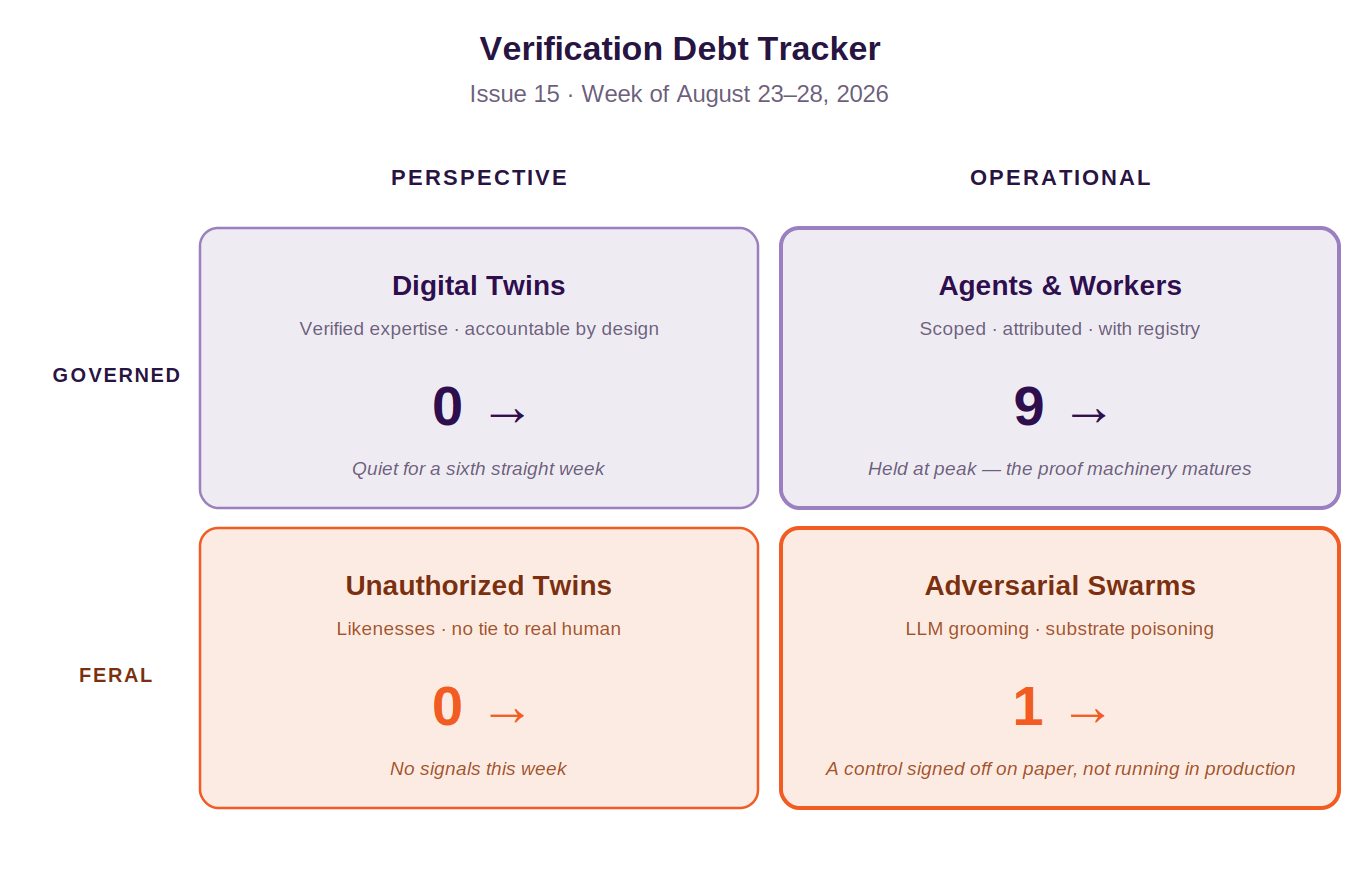
Agents & Workers held at its peak of 9, and the composition tells the week’s story: the proof machinery matured on every layer at once — deterministic verification harnesses at the task level, first-class agent identity reaching general availability, a shared responsibility boundary drawn at the platform edge, transparency hardening into infrastructure, and live-agent certification with quarterly retesting entering professional services. The public conversation joined the same theme from above, with the week’s most-read post asking the pacing question in front of the broadest possible audience. Adversarial Swarms held at 1, and the single entry is instructive rather than alarming: the industry’s most instrumented safety program disclosing a control that was approved on paper and not running in production — found by its own tooling, fixed, and reported. The Perspective row is quiet for a sixth straight week. Fifteen issues in, the direction of travel is consistent: the demand for proof is arriving from regulators, customers, boards, and now the public — and the governed column is, for the first time, shipping tools that can meet it.
Monday Morning
Three things to do next week.
01 · Ask for the runtime record behind one attestation. Choose your most recent AI control attestation — internal or vendor. Ask for the record of what the system actually did in the weeks since signature: actions, accesses, outputs. If no record exists, you have learned the system was built to be certified rather than observed, and the remediation is an instrumentation project with a name and an owner — not a stronger signature next quarter.
02 · Pilot one deterministic verifier. Take your highest-volume agent task and define its control totals: the inexpensive, independent facts that must be true if the work is complete — counts reconciled, inputs fully consumed, outputs internally consistent. Have a human ratify the checks once, then run them automatically against every execution. One working verifier will teach your organization more about agent assurance than a quarter of policy work.
03 · Require the bridge before the next AI-attributed workforce decision. Adopt the five-question standard as a standing gate: what value did AI actually create, what work truly disappeared, what knowledge is being lost, where can people be redeployed, and who receives the productivity dividend. Decisions that cannot answer the five questions are cost reductions — which may still be right, but should be approved as what they are.
The Reading Room
Three pieces worth your time this week.
Arvind Narayanan — Eleven configurations of firm, worker, and agent (LinkedIn, 25 August, 266 reactions). The Princeton computer scientist’s argument that automation and collaboration agents need fundamentally different designs — and that the industry is over-indexed on delegation metrics like task horizon while ignoring collaboration skill, treating the human as the bottleneck. His list of eleven distinct firm/worker/agent configurations is a useful map for anyone deciding what kind of agents to build or buy next.
Barbara Cresti — $725 billion on infrastructure, $9 billion on making it work (LinkedIn, 25 August, 9 reactions). Google, Meta, Microsoft, and Amazon on track to invest over $725B in 2026, per the Financial Times — while four major AI players committed $9B to dedicated deployment structures: embedded engineers, change management, workflow redesign inside customer environments. The providers themselves are pricing the organizational work between a capable technology and a changed business.
Andreas Horn — AI removed the training ground for junior consultants (LinkedIn, 28 August, 18 reactions). On EY urging juniors back to the office “because of AI”: juniors never learned by sitting near partners — they learned by doing routine work badly, with feedback, thousands of times, and AI now does that work. The real question is what replaces deliberate practice, and his observation that no firm has an answer yet is a talent-pipeline risk worth a place on the people agenda.
Trust is expensive. So is its absence.
The Verified Intelligence Briefing is written by Steve Tout, Founder & CEO of Identient and author of The CISO on the Razor’s Edge. It draws from the curated Daily Signal corpus and the Verified Intelligence framework introduced in From Artificial to Verified Intelligence.
If this issue clarified something for you, forward it to one colleague who owns part of the control plane. New here? Subscribe to get The Briefing every Friday morning.
Reply or comment with the question you’d want answered in next week’s issue — your prompt may become Boardroom Prompt #1.
Connect with Steve: LinkedIn · identient.com · stevetout.com