



The weekly read on verification debt — for leaders who own the control plane.
The Pattern
For five weeks this briefing has argued that verification debt is real, accumulating, and unpaid. This week, two different forces started collecting it — a court and a vendor — and the market quietly conceded the point in the same breath.
A German court held a company liable for a wrong answer its chatbot gave a customer. Not the vendor. Not the model provider. The company that deployed it. The liability did not transfer; it landed exactly where this briefing said it would — on the institution whose name was on the interface.
Anthropic announced Claude will require identity verification — KYC for frontier AI. The model provider is now building the verification layer into the front door, because the deployment layer could not be trusted to do it. The lab is doing the identity work the enterprise was supposed to do.
And underneath both, the market stopped arguing about models. Perplexity’s CEO said the model is no longer the product. Genpact put a number on the trapped value — $18 trillion — and located it behind trust debt, not model capability. A widely shared statistic held that 95% of AI pilots deliver zero measurable P&L impact, and the 5% that succeed do so on governance, not benchmarks.
The pattern: verification debt stopped being a thesis this week and started being collected — by a courtroom, by a KYC form, and by a market that has decided the model was never the moat.
This is the week the briefing’s framework met the real world’s enforcement mechanisms. Liability found the deployer. The model provider, watching the same trend, decided it could no longer wait for its customers to build the identity layer. And the value conversation moved decisively from capability to control. Every one of these is the verification debt coming due — not as a metaphor, but as a legal judgment, a product requirement, and a repriced market.
Thesis. The grace period is over. Verification debt is now being collected by courts and vendors — and the institution that deployed the AI is the one holding the bill.
The Signals
01 · A German court held a company liable for its chatbot’s answer
The Signal. A German court held a company liable for a misleading answer its customer-facing chatbot gave a user. Olivier Cohen surfaced the ruling (34 reactions) with the implication spelled out: AI accountability now has case law, and the liability sits with the deploying company — not the model provider, not the chatbot vendor (Cohen, LinkedIn, 24 June).
The Lineage Gap. This is the signal the entire briefing has been pointing toward. For five issues the argument has been structural: when an AI produces a wrong output, the verification debt lands on whoever deployed it. A court just made that structural argument a legal one. The Five Questions are now discovery questions in a liability proceeding. Who created it? — names a defendant. Who authorized it? — establishes the duty of care. Who can revoke it? — measures the negligence. The institutions treating their customer-facing AI as a vendor’s product rather than their own liability just learned the price of that assumption. A chatbot is not a feature you bought. It is a representation you made, and the court treats it as your word.
Boardroom Prompt. For every customer-facing AI in your organization, would a court consider its answers to be your company’s official representations — and have you reviewed them as if they were?
02 · Agent identity infrastructure went mainstream — a naming service and a Wall Street role
The Signal. Nick Ris surfaced two agentic-identity developments in a single morning (20 reactions): the Linux Foundation launched the Agent Name Service (ANS) — a DNS-like naming and discovery layer for AI agents — and JPMorganChase created a dedicated agentic identity role on its security team. Infrastructure and org chart moved in the same week (Ris, LinkedIn, 23 June).
The Lineage Gap. These two signals are small in engagement and large in meaning. The Agent Name Service is the plumbing the Five Questions depend on — you cannot ask who created it, who authorized it, who can revoke it about an agent that has no canonical name and no discovery layer. ANS is the agent-era equivalent of DNS: the registry that makes attribution computable at internet scale. And JPMorganChase creating a named agentic-identity role is the org-chart correlate — the largest U.S. bank deciding that agent identity is a discipline that needs an owner, not a footnote in someone’s job description. When the standards body builds the naming layer and the systemically important bank builds the team in the same week, the category has stopped being speculative. The institutions still treating agent identity as a future problem are now demonstrably behind both the standard and the market leader.
Boardroom Prompt. Does any named person in your organization own agent identity as their explicit mandate — or is it still distributed across people who each assume someone else has it?
03 · Anthropic announced Claude will require identity verification
The Signal. Anthropic announced Claude will require identity verification — effectively KYC for frontier AI access. Fabio Ciucci’s post (256 reactions) framed the implications: privacy tradeoffs, jurisdictional questions, and competitive dynamics against models with no such requirement (Ciucci, LinkedIn, 21 June).
The Lineage Gap. The model provider is building the identity layer the enterprise was supposed to build. Read alongside last issue’s Identiverse convergence, the direction is unmistakable: identity verification is moving to the front of the AI stack, and the labs are not waiting for their customers to get there. The Five Questions start at the model boundary now. Who created it? and Who authorized it? begin with knowing who is on the other side of the prompt. Simon Taylor’s companion piece (Signal 08 below) named the limit: KYC adds friction for casual misuse but will not stop a determined adversary. Both things are true. KYC is not a security control; it is a trust-infrastructure signal. The lab is establishing that frontier AI is now a regulated-utility-shaped thing, with an identity gate at the entrance.
Boardroom Prompt. If your frontier AI provider now knows the identity of every user, does your institution have the same visibility into who inside your walls is using it — and for what?
Every AI agent in your firm is quietly taking out loans in your name. It’s called Verification Debt — and it compounds.
Retire it with Identient, the governance layer that puts identity, evidence, and ownership behind every AI decision.
Identient helps regulated firms answer the questions that come due at the worst moment — a release, a regulatory inquiry, an audit: What is your AI doing? Who authorized it? Can you prove it?
Built on AI Operating Discipline, Identient’s four-phase methodology, your firm can:
See what’s actually running: inventory every AI use case, agent, and identity-to-data touchpoint — with a named owner for each
Bound what agents can do: governed identity and access for AI agents in your Microsoft environment, from Entra ID to Purview
Prove it when it counts: audit-ready evidence trails that stand up to examiners, boards, and enterprise security reviews
04 · Genpact: $18 trillion in trapped AI value sits behind four forms of enterprise debt
The Signal. Lewis Walker surfaced Genpact research (203 reactions) quantifying nearly $18 trillion in trapped enterprise AI value, blocked by four forms of enterprise debt: data debt, process debt, talent debt, and trust debt. The argument: the value is real, but it is locked behind the foundational work most enterprises skipped (Walker, LinkedIn, 20 June).
The Lineage Gap. Verification debt is the fourth form — trust debt — given a dollar figure. The Genpact framing validates the entire premise of this briefing from a consulting-research angle: the gap between AI capability and AI value is governance work, not model work. The $18 trillion is not unlocked by a better model. It is unlocked by the unglamorous substrate — clean data, explicit process, skilled people, and a trust layer that lets the institution actually deploy AI into consequential decisions. The institutions paying down their trust debt now are the ones that will convert AI capability into AI value. The ones chasing the next model upgrade are optimizing the one variable that no longer differentiates them.
Boardroom Prompt. Of the four enterprise debts — data, process, talent, trust — which is the binding constraint on your AI value, and who owns paying it down?
05 · Guillermo Flor: the model is no longer the product
The Signal. Guillermo Flor (893 reactions, the week’s highest) summarized Perplexity CEO Aravind Srinivas’s argument that AI models are commoditizing — and the durable value is moving to memory, distribution, and outcomes. The model is no longer the product. The system around it is (Flor, LinkedIn, 23 June).
The Lineage Gap. Two consecutive issues now open with a commoditization signal — Michael Lee last week, Srinivas via Flor this week — and the engagement is climbing. When the CEO of a $20B AI company says the model is not the product, the market consensus is no longer emerging; it is settled. The strategic consequence for the institution is the same one the briefing has been building toward: stop evaluating AI by benchmark, start evaluating it by control. The Five Questions are properties of the system — memory, distribution, outcomes, governance — not the model. The institution that builds the system owns the value. The institution that keeps shopping for the best model is renting capability while its competitors build moats.
Boardroom Prompt. If the model is now a commodity, what is the durable, defensible system your institution is building around it — and would a competitor recognize it as a moat?
06 · Jonny Tooze: 95% of AI pilots deliver zero measurable P&L impact
The Signal. Jonny Tooze (92 reactions) surfaced the statistic that should reframe every AI steering committee: 95% of AI pilots deliver zero measurable P&L impact. His argument: the 5% that work are not the ones with the best models — they are the ones with the infrastructure, workflows, governance, and operating model underneath the visible adoption (Tooze, LinkedIn, 23 June).
The Lineage Gap. The 95% failure rate is verification debt expressed as a portfolio outcome. Pilots fail to reach P&L impact because they never cross the threshold from demo to governed deployment — and that threshold is exactly the substrate the briefing keeps naming. The 5% that succeed paid the trust debt before they ran the pilot. The Four Pillars are the difference between a pilot that demos well and a deployment that survives contact with a regulator, an auditor, or a customer. Most pilots optimize the demo. The institutions that optimize the deployment substrate — grounding, scope, provenance, drift — are the 5%. The rest are accumulating sunk cost and calling it innovation.
Boardroom Prompt. Of your AI pilots in the last year, what percentage reached measurable P&L impact — and for the ones that didn’t, was the gap the model or the operating model?
07 · Carolyn Healey: AI accuracy is becoming the wrong metric
The Signal. Carolyn Healey (116 reactions) argued that AI accuracy is becoming the wrong metric. The real risk is not the errors you can measure — it is the undetected failures, the governance gaps, and the missing exception-handling paths. A 95%-accurate system with no path to catch the 5% is more dangerous than a less accurate one that flags its own uncertainty (Healey, LinkedIn, 23 June).
The Lineage Gap. Healey is naming drift awareness — the fourth pillar — as the metric that should replace accuracy. Accuracy measures the average case. Verification debt lives in the tail — the undetected failure, the silent exception, the confident wrong answer that no control caught. The German court case from Signal 01 is exactly this: a single wrong answer, undetected, became a legal liability. The institutions measuring their AI on accuracy are measuring the wrong thing. The right metric is detection — what percentage of failures does the system catch and escalate before they reach a customer, a regulator, or a courtroom? An AI that knows when it does not know is worth more than one that is right slightly more often and silent about the rest.
Boardroom Prompt. For your most consequential AI system, what percentage of its failures does it detect and escalate before they reach a human — and how do you know that number is real?
08 · Simon Taylor: Claude is adopting KYC
The Signal. Simon Taylor (35 reactions) analyzed the Claude identity-verification move through a financial-infrastructure lens. KYC for AI adds friction for casual misuse and signals the maturing of trust infrastructure — but it will not stop a serious adversary, and it raises real questions about who holds the verified identity data (Taylor, LinkedIn, 21 June).
The Lineage Gap. Taylor’s framing matters because it separates the signal from the security theater. KYC for AI is not a control that stops attacks; it is a trust-infrastructure primitive that makes attribution possible. The Five Questions need an identity anchor at the model boundary, and KYC provides it — who is on the other side of this prompt? But identity verification at the front door creates its own verification debt: who holds the data, in what jurisdiction, under whose authority, revocable by whom. The lab solved one lineage problem and created another. The institutions consuming frontier AI now inherit a new question — not just whether their provider knows their users, but where that knowledge lives and who else can reach it.
Boardroom Prompt. When your AI provider verifies the identity of your employees using its tools, where does that identity data live, and what is your contractual right to it?
09 · Okta expanded Cross App Access for agent token governance
The Signal. Ely Kahn (95 reactions) detailed Okta’s expansion of its Cross App Access ecosystem — enabling identity-based token governance for agents acting across enterprise applications. The expansion builds directly on the Anthropic integration announced earlier, extending agent identity governance across the application estate (Kahn, LinkedIn, 23 June).
The Lineage Gap. This is the identity industry continuing to build the permission layer in public, week over week. Last issue: SailPoint acquired Entro. This issue: Okta extends Cross App Access, and the Linux Foundation ships the Agent Name Service. The pattern is sustained — the IAM ecosystem is racing to own agent token governance because it correctly reads it as the next decade’s identity market. Cross App Access is the runtime answer to Issue 04’s Miteiko thesis: a policy decision evaluated when an agent crosses from one application to another, carrying scoped authority rather than ambient access. The contrast with the German court case is direct — an agent whose every cross-application action is scoped and logged is one a deploying company can actually defend in front of a judge. The institutions adopting Cross App Access patterns now are buying the architecture that turns “we couldn’t have known what the agent did” into “here is the authorization trail.”
Boardroom Prompt. When an AI agent in your environment moves from one application to another, does it carry a fresh, scoped authorization — or the same ambient access it started with?
10 · Alexandra C.: data governance, AI governance, and agent governance are three different layers
The Signal. Alexandra C. (37 reactions) drew the distinction most enterprises are still blurring: data governance, AI governance, and agent governance are three separate layers with different accountability owners and different control requirements. Treating them as one program is why so many AI governance efforts stall (Alexandra C., LinkedIn, 21 June).
The Lineage Gap. The three-layer distinction is the organizing structure underneath this entire briefing. Data governance answers what is true and who owns it — the grounding pillar. AI governance answers what is the model allowed to do — the scope pillar. Agent governance answers what is this specific agent doing right now, on whose authority — the runtime provenance pillar. Most institutions have one committee trying to own all three, which is why the German court ruling, the pilot failure rate, and the scramble to stand up agent-identity teams all surfaced in the same week. They are pressures at three different layers, and an organization with one undifferentiated governance program cannot see which layer is failing. The institutions that separate the three layers — with distinct owners, controls, and audit trails — are the ones that can actually answer the Five Questions when the court, the auditor, or the regulator asks.
Boardroom Prompt. In your organization, are data governance, AI governance, and agent governance three distinct programs with three accountable owners — or one committee hoping to cover all three?
The Verification Debt Tracker
The 2×2 from From Artificial to Verified Intelligence. Signal counts this week, with direction vs. last issue.
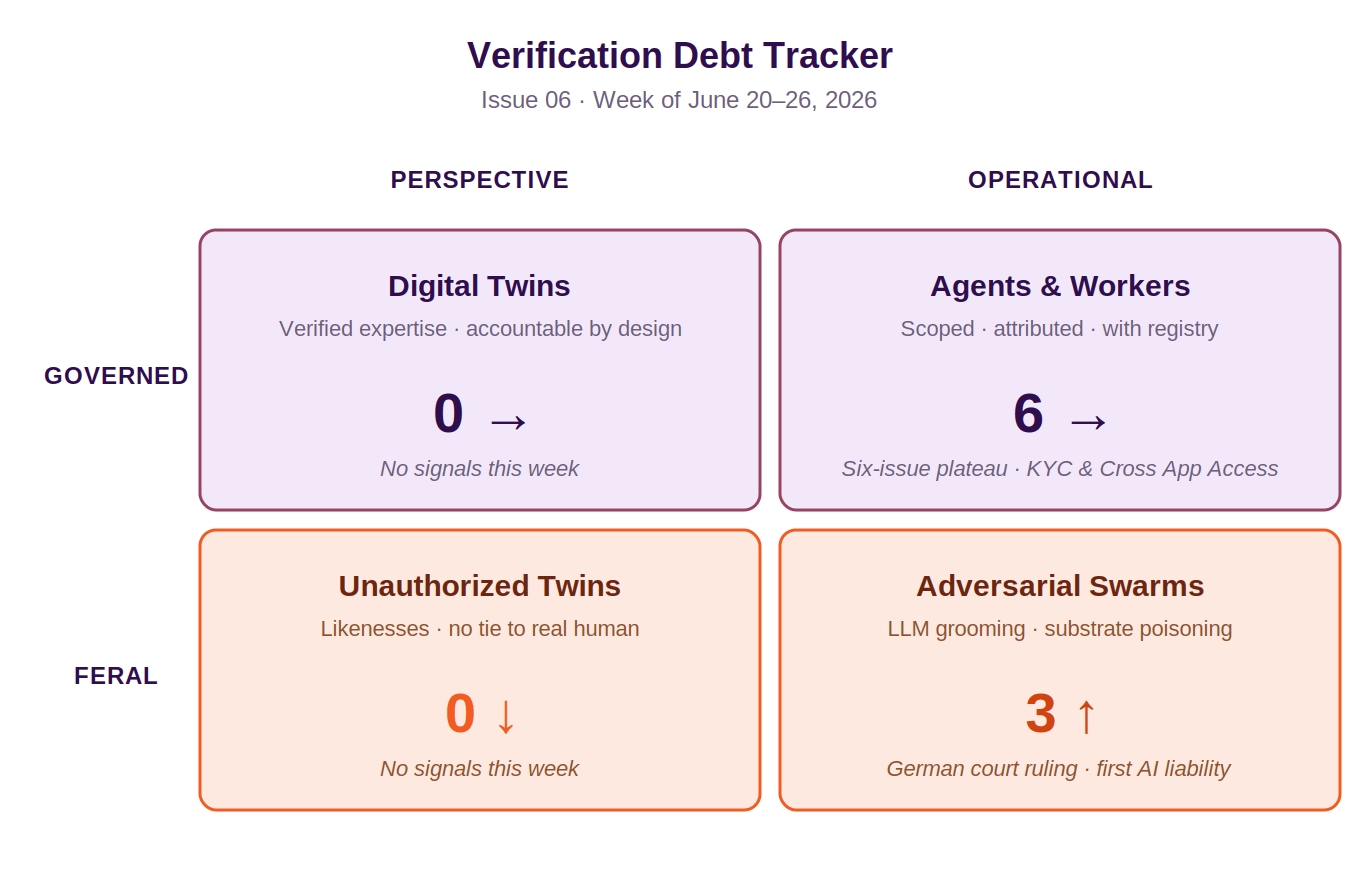
The Agents & Workers quadrant held at 6 — six consecutive issues at the plateau, now an established baseline, this week carrying the KYC requirement, Okta’s Cross App Access expansion, and the Linux Foundation’s Agent Name Service. The story is Adversarial Swarms, which rose to 3 and ran hot on the single event that matters most across six issues: a German court holding a deploying company liable for its chatbot’s answer. This is the first issue where the feral-operational quadrant filled with a consequence rather than a warning — an actual legal judgment, not a predicted one. The conceptual debt the briefing has been tracking for five weeks produced its first courtroom this week. When the feral quadrant moves from “predicted” to “occurred,” the tracker has done its job.
Monday Morning
Three things to do next week.
01 · Review your customer-facing AI as legal representations. The German court treated a chatbot’s answer as the company’s word. Have your legal team review every customer-facing AI as if its outputs were official statements — because a court just confirmed they are. Start with the highest-traffic agent and the highest-stakes answer it can give.
02 · Give agent identity a named owner. JPMorganChase created a dedicated agentic-identity role this week, and the Linux Foundation shipped the naming layer underneath it. Name the person in your organization accountable for agent identity — discovery, naming, authorization, revocation — before the next planning cycle. If the answer today is “several people assume someone else has it,” that gap is your exposure. Close it with an org-chart line, not a committee.
03 · Separate your three governance layers. Data governance, AI governance, agent governance — three layers, three owners, three control sets. If one committee owns all three in your organization, it cannot tell you which layer failed when something goes wrong. Draw the boundary now, before the incident makes you draw it under pressure.
The Reading Room
Three pieces worth your time this week.
Amit Zavery — The AI Pacesetters pull ahead (LinkedIn, 25 June, 153 reactions). Research on the cohort of enterprises outperforming on AI maturity, ROI, and productivity — and the five strategies separating them from the field. A useful benchmark for the board deck and an honest mirror for the strategy team.
Jim Reavis — AI agents need runtime guardrails, not just model guardrails (LinkedIn, 22 June, 27 reactions). Citing the AutoJack research and the Cloud Security Alliance’s agentic-trust work, Reavis makes the case that delegated-access agents need controls at runtime, not just at the model. The technical companion to this issue’s Pattern.
Dhanasekhar D. — 12 Practices, 3 Pillars: the FSB’s new AI governance framework (LinkedIn, 21 June, 13 reactions). The Financial Stability Board’s enterprise AI governance framework, mapped to twelve practices across three pillars. For the regulated-industry reader, this is the structure your examiner will eventually reference.
Trust is expensive. So is its absence.
The Verified Intelligence Briefing is written by Steve Tout, Founder & CEO of Identient and author of The CISO on the Razor’s Edge. It draws from the curated Daily Signal corpus and the Verified Intelligence framework introduced in From Artificial to Verified Intelligence.
If this issue clarified something for you, forward it to one colleague who owns part of the control plane. New here? Subscribe to get The Briefing every Friday morning.
Reply or comment with the question you’d want answered in next week’s issue — your prompt may become Boardroom Prompt #1.
Connect with Steve: LinkedIn · identient.com · stevetout.com