



The weekly read on verification debt — for leaders who own the control plane.
The Pattern
Last week the frontier reminded everyone that model access was never guaranteed. This week the enterprise did the math.
A VentureBeat survey of 145 enterprises, fielded during the exact two weeks the U.S. government took Claude Fable 5 offline, found that two-thirds had already hedged their model strategy before the outage — 51% blending closed frontier models with open weights on their own infrastructure, 16% moving core workflows off closed APIs entirely. Model dependency was not a surprise this week. It was a line item enterprises had already started paying down.
And the cost of not paying it down got a number. One company ran up a half-billion-dollar Claude inference bill in a single month — accumulated one API call at a time, because nobody set usage limits on employee licenses. A KPMG survey of 2,145 executives across twenty countries found 29% could not say where their growing AI costs were coming from. The verification debt that used to hide in reasoning chains is now hiding in invoices.
Underneath, the governance conversation crossed a threshold of its own. Dhanasekhar D. read the signals from Singapore’s MAS and the international standard-setters and called it: AI governance is entering its operational phase — from whether to govern to how governance operates when systems act at machine speed. Khwaja Shaik named the boardroom version twice in one week: AI is a strategic asset class, and AI sovereignty is now a fiduciary issue, not a procurement one.
The pattern: model dependency stopped being a risk to describe and became a number to manage — in hedging ratios, in inference invoices, and in the boardroom’s fiduciary column.
For seven weeks this briefing tracked verification debt as it migrated from the model to the contract to the courtroom to the accountability layer. This week it landed on the budget. The institutions that priced control early — hedged their models, metered their consumption, mapped their AI supply chain — are the ones reading this week’s numbers as confirmation. The rest are reading them as a warning.
Thesis. Verification debt is now denominated in dollars. The institutions that can trace their AI costs, hedge their model dependency, and name the fiduciary owner of AI sovereignty are the ones who priced the debt before it priced them.
The Signals
01 · Two-thirds of enterprises had already hedged their model strategy — before the outage
The Signal. Matt Marshall reported VentureBeat’s Pulse survey of 145 enterprises, fielded across the exact two weeks the U.S. government took Claude Fable 5 offline. Two-thirds had already hedged their AI model strategy before the suspension: 51% blend closed frontier models with open weights on their own infrastructure, and 16% are moving core workflows off closed APIs entirely (Marshall, LinkedIn, 7 July, 14 reactions).
The Lineage Gap. This is the empirical answer to last issue’s model-continuity Boardroom Prompt. The Fable 5 suspension was not a hypothetical — it was a live stress test of enterprise model dependency, and the survey caught the market mid-adaptation. The 51% blending closed and open weights are building the graceful-degradation path this briefing named as a verification-debt control. The 16% moving core workflows off closed APIs entirely are pricing sovereignty over capability. The Five Questions gain their budget dimension here: who can revoke it? now has a documented answer — a government did, for two weeks — and two-thirds of enterprises had already decided not to be fully exposed to that answer. The institutions still running single-model dependency with no fallback are now in the minority, and the outage proved why.
Boardroom Prompt. Where does your institution sit — in the two-thirds that hedged before the outage, or the third that learned the lesson during it?
02 · A half-billion-dollar inference bill, accumulated one API call at a time
The Signal. Fred Ingham surfaced the number that makes consumption-cost concrete: one company, one month, half a billion dollars in Claude inference — not a training run, not a data-center buildout, but inference accumulated one API call at a time because nobody set usage limits on employee licenses. A KPMG survey of 2,145 senior executives across twenty countries found 29% could not say where their growing AI costs were coming from (Ingham, LinkedIn, 9 July, 5 reactions).
The Lineage Gap. This is Issue 03’s tokenmaxxing and Issue 04’s consumption-cost shift arriving as an actual invoice. The $500M number is dramatic, but the KPMG statistic is the real signal: nearly a third of large enterprises cannot trace their own AI spend. Verification debt has a financial form, and this is it — cost incurred without provenance, consumption without a control. The Five Questions apply to dollars as cleanly as to decisions: who authorized it? is the missing approval gate; who can revoke it? is the rate limiter nobody built; who is it economically aligned to? is the question a CFO cannot answer for 29% of the spend. Metered AI pricing did not create this exposure. It revealed it. The institutions treating AI cost as a FinOps line with real controls — caps, tiers, per-agent budgets — are the ones whose CFO will not be explaining a variance to the audit committee.
Boardroom Prompt. Can your CFO trace every dollar of AI spend to an authorized owner and a purpose — or is some fraction of it, like 29% of enterprises, simply accumulating?
03 · AI governance entered its operational phase — globally, at once
The Signal. Dhanasekhar D. read a cluster of moves from financial authorities and international standard-setters as a single architectural shift: the Monetary Authority of Singapore moving aggressively from high-level principle to operational supervision, alongside parallel signals from other bodies. His framing: AI governance is entering its operational phase — the conversation has moved from whether AI should be governed to how governance operates when systems act at machine speed (Dhanasekhar D., LinkedIn, 9 July, 17 reactions).
The Lineage Gap. This is the regulatory correlate of last issue’s “the accountability layer got built.” When Network Guardian ships runtime authority governance and MAS moves from principle to operational supervision in adjacent weeks, the same shift is happening on both sides of the table — vendors building the controls, regulators specifying them. The Five Questions are becoming supervisory expectations, not just governance best practice. Who authorized it, who can revoke it, who is it economically aligned to are the questions a machine-speed supervisor has to be able to answer continuously, which means the institution has to produce the answers continuously. The operational phase is the one where governance stops being a document and becomes telemetry. The institutions that built the telemetry ahead of the supervisor are ready. The ones with a board-approved framework and no runtime evidence are about to discover the gap.
Boardroom Prompt. When your regulator moves from asking whether you govern AI to asking for continuous evidence of how, can your systems produce it in real time — or only in a quarterly report?
Every AI agent in your firm is quietly taking out loans in your name. It’s called Verification Debt — and it compounds.
Retire it with Identient, the governance layer that puts identity, evidence, and ownership behind every AI decision.
Identient helps regulated firms answer the questions that come due at the worst moment — a release, a regulatory inquiry, an audit: What is your AI doing? Who authorized it? Can you prove it?
Built on AI Operating Discipline, Identient’s four-phase methodology, your firm can:
See what’s actually running: inventory every AI use case, agent, and identity-to-data touchpoint — with a named owner for each
Bound what agents can do: governed identity and access for AI agents in your Microsoft environment, from Entra ID to Purview
Prove it when it counts: audit-ready evidence trails that stand up to examiners, boards, and enterprise security reviews
04 · Khwaja Shaik: AI sovereignty just became a board issue
The Signal. Khwaja Shaik connected the week’s geopolitics to the boardroom agenda. With reports that China may restrict access to its leading AI models — mirroring the U.S. action on Fable 5 — he argued AI has become a strategic national asset, governments are treating model access like an export good, and boards can no longer treat vendor choice as a procurement decision. It is a fiduciary one. His prescription: map the AI supply chain, because it is a risk most boards have not yet drawn (Shaik, LinkedIn, 10 July, 1 reaction).
The Lineage Gap. Shaik is naming the fiduciary escalation of the model-dependency lesson. When both the U.S. and China are willing to restrict frontier-model access on national-security grounds, model choice carries geopolitical risk that flows straight to the balance sheet — and under last issue’s German court logic, that risk resolves to a named accountable officer. The Five Questions acquire a sovereign dimension: who can revoke it? now includes two governments, and the board is the body accountable for having planned for it. The reason this is fiduciary and not merely operational is that it is foreseeable. After the Fable 5 suspension, no board can claim the sovereignty risk was unknowable. The institutions mapping their AI supply chain now are building the documentation that turns “we could not have known” into “here is our contingency.” Foreseeable and unplanned-for is the exact shape of a governance failure a court recognizes.
Boardroom Prompt. Has your board mapped its AI supply chain to the sovereign level — which models, from which jurisdictions, revocable by which governments — or is that still filed under procurement?
05 · The AI governance role became a five-skill job that almost no one holds
The Signal. Peter F. named a hiring reality with direct governance consequences: AI governance candidates are becoming as rare as senior third-party-risk candidates — not for lack of interest, but because the role now demands five distinct skill sets, and most candidates bring two. The five: AI and model risk, governance and controls, regulation and standards, third-party risk, and the operational glue that connects them (Peter F., LinkedIn, 8 July, 75 reactions).
The Lineage Gap. The talent gap is the human bottleneck in the operational phase. Governance entering its operational phase (Signal 03) means someone has to operate it — and that someone needs to understand how models fail, how controls are evidenced, what the EU AI Act and ISO 42001 require, how vendor risk propagates, and how to wire all four together. That is the Five Questions expressed as a job description, and Peter F. is naming that the labor market has not produced enough people who can answer all five. This is the same shortage Rinki Sethi described from the security side last issue, now sharpened. The institutions building AI governance capacity internally — cross-training their risk, security, and data people into the five-skill profile — are solving a bottleneck the market cannot hire its way out of. The ones waiting to hire a unicorn will wait through the operational phase.
Boardroom Prompt. Does your AI governance function have the five-skill coverage the role now requires — across model risk, controls, regulation, third-party risk, and operations — or two skills and three gaps?
06 · Dhvani Puar: vendor compliance does not transfer your governance responsibility
The Signal. Dhvani Puar answered the question every technology team eventually asks — if the vendor is compliant, aren’t we covered? — with a firm no. Buying an AI product does not transfer governance responsibility; it only changes where yours begins. She illustrated with a tier-3 fintech using a third-party credit-scoring model: the model was vendor-validated, but no one had examined how the organization configured it, which customer segments it was applied to, or how its decisions were monitored (Puar, LinkedIn, 6 July, 9 reactions).
The Lineage Gap. Puar is naming the exact liability structure the German court confirmed two issues ago, from the procurement side. Vendor compliance covers the vendor’s obligations; it does not cover how you deployed the thing. The credit-scoring example is the sharpest kind: a validated model, misconfigured or misapplied at the deployment layer, produces discriminatory outcomes the institution owns entirely. The Five Questions do not transfer with the purchase order. Who authorized this configuration? Who chose these customer segments? Who monitors the drift? are all buyer-side questions the vendor’s compliance certificate does not touch. This is the same lesson Alexandra C.’s three-layer distinction drew in Issue 06 — vendor governs the model, you govern the deployment — now grounded in a regulated-lending use case where the deployment-layer failure is a fair-lending violation.
Boardroom Prompt. For every vendor-validated AI model in your stack, who owns the configuration, the scope of application, and the monitoring — because the vendor’s certificate does not?
07 · Alexandra C.: the risk is in the conversation between agents, not inside any one model
The Signal. Alexandra C. argued that AI governance must shift from model-centric to interaction-centric oversight. Most frameworks still protect individual models — their weights, prompts, and outputs — while the real risk increasingly lives in inter-agent conversations, where a planner, researcher, and reviewer exchange messages no single-model control observes. In a companion post, she surfaced UC Berkeley, MIT, and NYU research on Logit-Linear Selection, showing that malicious behaviors can transfer to a model during fine-tuning even when no explicit instance of the trait exists in the filtered dataset (Alexandra C., LinkedIn, 5 July, 29 reactions).
The Lineage Gap. Both signals point at the same blind spot: verification breaks in the space between the components, not inside them. Model-centric governance inspects each agent and misses the conversation; dataset auditing inspects each example and misses the subtext carried in selection patterns. This is the Adversarial Swarms quadrant in its most sophisticated form — the risk is emergent, distributed across interactions, invisible to any control that examines a single artifact. The Four Pillars answer this only if applied at the interaction layer. Provenance has to trace the conversation, not just the model. Grounding has to verify what one agent tells another, not just what the human typed. The institutions building interaction-centric oversight are governing where the risk actually lives. The ones hardening individual models are locking every door in a house with no walls between the rooms.
Boardroom Prompt. Does your AI oversight observe the conversations between your agents — or only the inputs and outputs of each one in isolation?
08 · Norm Ai raised $120M to build agents that execute legal workflows — with attorneys on the hook
The Signal. Sachin O. surfaced Norm Ai’s reported $120M raise at a $1.2B valuation, and the structural detail that matters: Norm builds AI agents that execute complex legal and regulatory workflows while attorneys remain responsible for oversight, judgment, and client accountability. The company also launched Norm Law, an AI-native law firm (Sachin O., LinkedIn, 9 July, 55 reactions).
The Lineage Gap. The Norm Ai structure is the accountability layer built into a business model. Agents execute; a named, licensed, personally-liable human owns the judgment. That is the “human above the loop” from last issue, expressed as professional-liability architecture — an attorney whose bar license is on the line for the agent’s output has the sharpest possible incentive to verify it. This is what verified intelligence looks like when the stakes are a malpractice claim: the agent handles the structured workflow, the human owns the Five Questions, and the accountability chain terminates in a person who can be sued. The legal profession is being forced to solve the accountability problem first because its liability model never allowed the human to leave the loop. Every other regulated profession is watching a live experiment in how to keep a human genuinely on the hook while agents do the work.
Boardroom Prompt. In your highest-stakes AI-assisted workflow, is there a named, accountable human whose personal or professional liability depends on verifying the agent’s output — or is accountability diffused until no one owns it?
09 · Darlene Newman: AI-native companies don’t have better AI
The Signal. Darlene Newman surfaced McKinsey’s interviews with leaders from fifteen AI-native companies, spanning four-person startups to global platforms. The finding: AI-native companies do not have better AI. They have better operating models — converging independently on seven principles across four themes: AI as a teammate not a tool, modular adaptive architecture, operating models that scale, and centralized capability with distributed execution (Newman, LinkedIn, 9 July, 13 reactions).
The Lineage Gap. Newman’s signal closes the loop the briefing opened in Issue 04: the model is the commodity, the system is the moat. McKinsey’s fifteen companies prove it from the inside — they win on operating model, not model access. The seven principles are the substrate this briefing keeps naming, observed in the wild in the companies that got it right. Modular adaptive architecture is model portability, the hedge Signal 01 measured. Centralized capability with distributed execution is the authority graph — a governed center delegating scoped execution outward. AI-native is not a technology posture; it is a governance posture that happens to produce speed. The institutions studying these seven principles are reading the operating manual for the 6% that transform. The ones still shopping for a better model are optimizing the variable McKinsey’s sample already discounted.
Boardroom Prompt. Of McKinsey’s seven AI-native operating principles, how many describe your operating model today — and how many describe an aspiration in a strategy deck?
10 · Microsoft’s “learning loop” language met its own layoffs
The Signal. Dr. Jeffrey Funk surfaced the week’s sharpest juxtaposition (280 reactions, the highest of the week): Microsoft’s CEO framing the firm’s future as “a learning loop in which human capital and token capital compound,” announced days ahead of another round of mass layoffs. Funk’s read: the language of infinite AI-driven scaling is colliding with the operational reality of the same companies cutting the human capital the language celebrates (Funk, LinkedIn, 4 July).
The Lineage Gap. Funk’s signal is the honesty check the briefing has to include. “Human capital and token capital compound” is a governance claim dressed as a growth claim — and it only holds if the human capital is actually in the loop, above the loop, owning the judgment the tokens cannot. Cutting the human layer while scaling the token layer is precisely how an organization accumulates verification debt: more agentic output, fewer humans to verify it, a widening gap between generation and accountability. The Five Questions get harder to answer, not easier, when the people who could answer them are laid off. This is the macro version of cognitive surrender from Issue 02 — the organization trusting the token layer so completely it removes the human capacity to check it. The compounding Nadella describes is real. Whether it compounds value or debt depends entirely on whether the human layer survived the reorganization.
Boardroom Prompt. As your organization scales AI output, is it preserving the human capacity to verify that output — or cutting it, and calling the gap efficiency?
The Verification Debt Tracker
The 2×2 from From Artificial to Verified Intelligence. Signal counts this week, with direction vs. last issue.
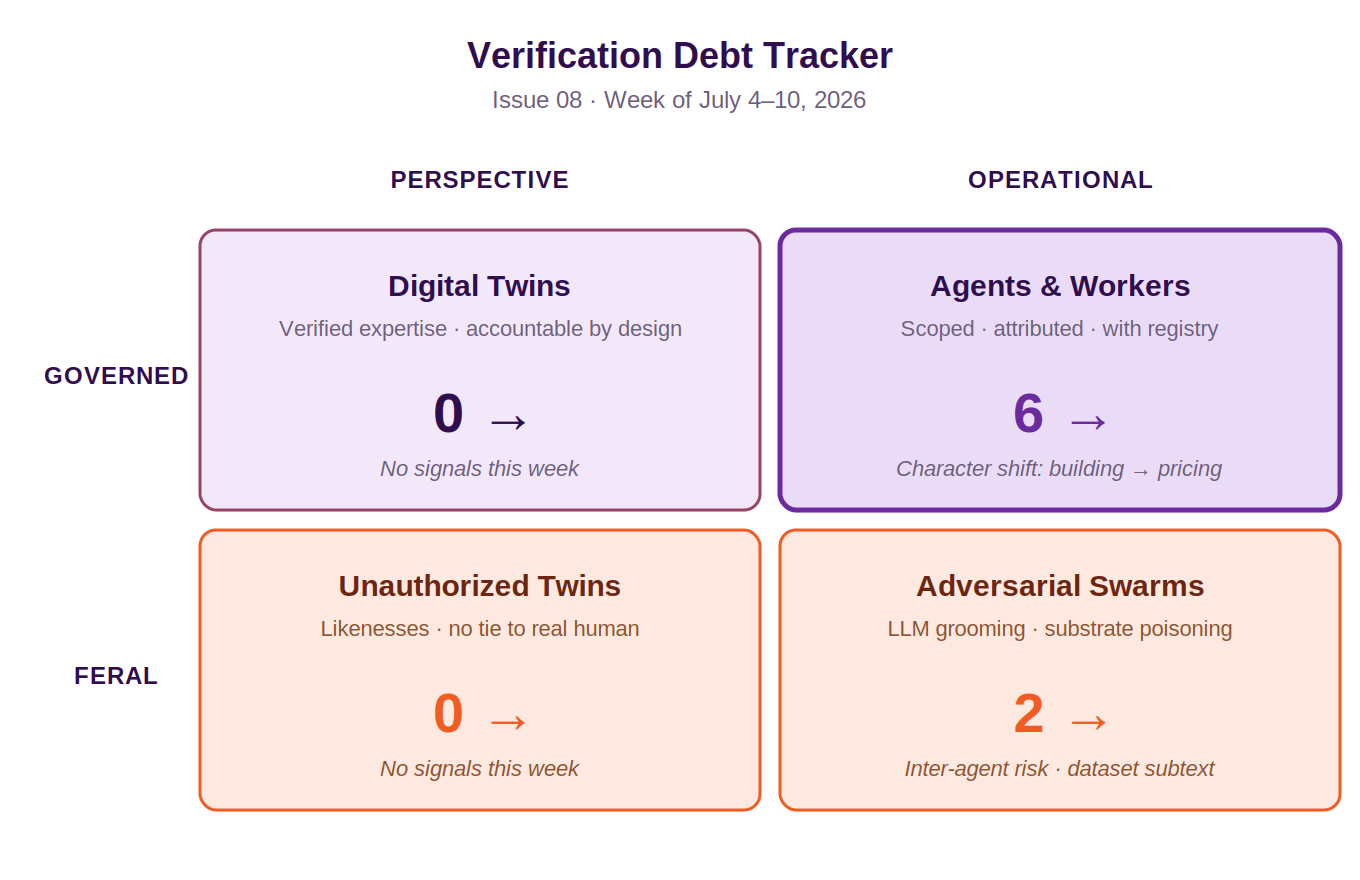
The Agents & Workers quadrant held at 6, but the character of the signals shifted from building the accountability layer to pricing it — the hedging survey, the inference invoice, the operational-phase regulatory turn. Adversarial Swarms stayed at 2 and stayed sophisticated: Alexandra C.’s interaction-centric and dataset-subtext research. The quiet quadrants — Digital Twins and Unauthorized Twins — are worth noting in aggregate: eight issues in, the briefing’s signals cluster heavily in the Operational column, because that is where enterprises are actually deploying, failing, and now budgeting. The Perspective row is where the next surprises live. This was a holiday-shortened week; the signal density was lower, but the convergence was tighter — nearly every post pointed at the same dollar-denominated turn.
Monday Morning
Three things to do next week.
01 · Find your untraceable AI spend. KPMG says 29% of enterprises cannot say where their AI costs come from. Run the exercise: pull your AI spend, trace each dollar to an authorized owner and a purpose. The fraction you cannot trace is your verification debt in its financial form — and the half-billion-dollar invoice is what it looks like fully compounded. Cap it before it caps you.
02 · Draw your AI supply chain to the sovereign level. Not just which vendors — which models, from which jurisdictions, revocable by which governments. The Fable 5 suspension proved the risk is real and foreseeable. After a foreseeable risk materializes once, “we could not have known” stops being a defense. Map it now, while it is a planning exercise and not an incident review.
03 · Audit one vendor-validated model at the deployment layer. Pick a third-party AI model you treat as “covered because the vendor is compliant.” Examine how you configured it, which segments you apply it to, and how you monitor its drift. That is where your governance responsibility begins — and where the vendor’s certificate stops covering you.
The Reading Room
Three pieces worth your time this week.
Khwaja Shaik — AI economics and capital allocation belong in the boardroom (LinkedIn, 8 July, 8 reactions). Argues the financial-media question — has AI capacity been overbuilt — is the wrong boardroom question. The right one: are we investing in AI that changes our competitive position, or just funding technology consumption? The capital-allocation companion to this week’s cost signals.
Richard McHattie — AI adoption in a small electrical business (LinkedIn, 6 July, 19 reactions). A grounding counterweight to a week of enterprise abstractions: an electrician using AI to answer calls, schedule jobs, and keep customers informed. The value is real, immediate, and human-augmenting — a reminder that the accountability conversation exists to protect adoption, not to slow it.
Kash Maharaj — The constraint is rarely the architecture (LinkedIn, 8 July, 57 reactions). Two decades of enterprise architecture distilled to one lesson: the bottleneck is rarely the technology — it is leadership understanding of what the architecture is for. The organizational-readiness companion to the McKinsey AI-native principles.
Trust is expensive. So is its absence.
The Verified Intelligence Briefing is written by Steve Tout, Founder & CEO of Identient and author of The CISO on the Razor’s Edge. It draws from the curated Daily Signal corpus and the Verified Intelligence framework introduced in From Artificial to Verified Intelligence.
If this issue clarified something for you, forward it to one colleague who owns part of the control plane. New here? Subscribe to get The Briefing every Friday morning.
Reply or comment with the question you’d want answered in next week’s issue — your prompt may become Boardroom Prompt #1.
Connect with Steve: LinkedIn · identient.com · stevetout.com