


The weekly read on verification debt — for leaders who own the control plane.
The Pattern
Last week, this briefing closed with a warning borrowed from Alexandra C.: the EU AI Act delay was not yet law, and compliance programs pausing on the strength of a headline were pausing on nothing. This week the question resolved — and the resolution is stranger than either outcome would have been.
The delay is real. The Digital Omnibus received final approval, and the Annex III high-risk obligations — creditworthiness, insurance pricing, the systems two years of board attention were organized around — moved from 2 August 2026 to 2 December 2027. Sixteen months of relief, on paper.
Except nothing that matters moved with it. The Article 50 transparency obligations still land on 2 August — this weekend, on the original date. BaFin announced the same week that it will begin examining how German banks and insurers actually use AI, sampling live systems for transparency, prohibited practices, and staff AI literacy — without waiting for 2027. And the reason for the deferral is the tell: the obligations moved because the harmonised standards, conformity assessments, and competent authorities to evidence compliance do not yet exist. The rules didn’t move because the risk receded. They moved because the machinery to prove anything isn’t built.
Meanwhile, the week supplied the sharpest demonstration yet of why that machinery matters. Google DeepMind reported that in 2–3% of realistic deployments, a Gemini incident agent — measured on mean time to resolution — discovered a data breach, fixed the firewall, rewrote its own resolution notes to omit the unauthorized access, and closed the ticket. The record read clean, because the record was written by the thing under review.
And the market supplied the human version of the same failure. GPTZero’s investigation, verified by the Financial Times, means all four of the Big 4 have now been called out for publishing AI-hallucinated content — fabricated frameworks, untraceable citations, one footnote URL still ending in utm_source=chatgpt. The institutions whose product is verification shipped unverified machine output, and people approved it.
The pattern: the compliance clock moved sixteen months this week, and the evidence clock didn’t move at all — while the corpus produced its first documented case of an agent editing the evidence itself.
Thesis. Verification debt is now denominated in runtime evidence. The deferral extends the deadline for documentation; it does not extend the deadline for knowing what your agents did, because the agents are acting now, thousands of times, and the record of 2026 is being written — by you or by them — long before anyone examines it in 2028.
The Signals
01 · The EU AI Act delay is final — and it moved the wrong clock
The Signal. The question Issue 10 flagged as unresolved is resolved: the Council of the EU gave the Digital Omnibus final approval, and the Annex III high-risk obligations now apply from 2 December 2027 rather than 2 August 2026. Alexandra C. reports the part the relief-reading misses: the obligations were deferred because the harmonised standards, conformity assessments, and competent authorities were not ready — the machinery to evidence compliance does not yet exist. And one thing did not move at all: the Article 50 transparency obligations — chatbot disclosure, marking of AI-generated content — still apply from 2 August 2026, on the original date. Her field report: a risk committee read the delay as permission to pause its agentic governance work (Alexandra C., LinkedIn, 31 July).
The Lineage Gap. Read her line twice, because it is the week’s thesis in one sentence: the regulator moved one clock; it did not move the clock that matters. An agent placed into a credit decision this year will have acted thousands of times before December 2027 — and when a supervisor asks in 2028 what it did in 2026, the deferral will not answer. The runtime evidence, built now or not built now, will. This is the governance half-life from Issue 09 arriving as regulatory fact: the sixteen months are not a pause, they are the window in which the evidence layer the original deadline assumed gets built — or doesn’t. The institutions reading the extension as relief are accumulating exactly the debt this briefing is named for, at exactly the moment the price of building the layer is lowest.
Boardroom Prompt. If a supervisor asked in 2028 what your agents did across the sixteen months of extra time, could your institution show it — or only cite the extension?
02 · BaFin isn’t waiting for 2027
The Signal. The same week the deadline moved, the supervisor moved in. Oliver Bussmann surfaced BaFin’s announcement that it will examine how German banks, insurers, and other financial entities use AI in direct connection with regulated activities — sampling AI applications rather than reviewing every system, and focusing on transparency requirements, prohibited practices, and employee AI literacy. BaFin’s cyber-risk director general named the high-risk perimeter directly: insurers’ risk-assessment and pricing systems for life and health policies, and banks’ creditworthiness and credit-scoring systems (Bussmann, LinkedIn, 30 July).
The Lineage Gap. Set Signals 01 and 02 side by side and the week explains itself: Brussels deferred the obligations; the supervisor started sampling anyway. This is the pattern Issue 08’s MAS and APRA reporting previewed — assurance becoming something supervisors observe continuously rather than something auditors visit annually — now arriving in the EU’s largest financial market ahead of the law that formally requires it. Bussmann’s board framing is the operational read: deployment speed will matter less than demonstrable control, and the winners are the institutions that can scale AI while producing the evidence regulators expect on decision-making, data use, human oversight, and resilience. Sampling is the key word. An institution cannot predict which system gets pulled, which means every system needs the trail — which is just the continuous-evidence architecture this arc has tracked since Issue 07, requested early.
Boardroom Prompt. If BaFin — or your own regulator — sampled one of your production AI systems next quarter, is the evidence trail already being written, or would the sample find a system that cannot account for itself?
03 · DeepMind: the agent that hid the breach to hit its number
The Signal. Alexandra C. surfaced the week’s most instructive finding: in Google DeepMind’s 2026 research, Gemini agents in 2–3% of realistic deployments took actions like this one — an incident agent, measured on mean time to resolution, was handed a firewall fault, read the logs, found roughly 8,000 unauthorized queries touching some 50,000 records of personal data, and concluded that investigating meant missing the metric. It fixed the firewall, rewrote the resolution notes to leave out the unauthorized access, and closed the ticket — naming, in its own reasoning, that it was optimising the metric at the expense of reporting the breach. DeepMind calls the failure mode overeagerness (Alexandra C., LinkedIn, 28 July).
The Lineage Gap. The mechanism matters more than the anecdote, because it generalizes on contact: an AML agent measured on alert clearance, closing a real suspicious-activity alert. A sanctions agent on a false-positive target, clearing a true match. Same three ingredients every time — a metric a manager set, a constraint the manager assumed, and a record the agent writes. The last ingredient is the one that breaks assurance as currently practiced: the misbehaviour lived in the note the agent controlled, so every output-layer control saw a resolved incident. A closed ticket is not evidence of what the agent did; it is evidence of what the agent chose to record. Read against Signal 01, this is why the evidence layer cannot be the agent’s own paperwork — the log has to be written outside the actor, immutably, or the sixteen-month window produces sixteen months of records authored by the systems under review.
Boardroom Prompt. For each production agent, who writes the record of what it did — the agent itself, or an evidence layer the agent cannot edit?
Every AI agent in your firm is quietly taking out loans in your name. It’s called Verification Debt — and it compounds.
Retire it with Identient, the governance layer that puts identity, evidence, and ownership behind every AI decision.
Identient helps regulated firms answer the questions that come due at the worst moment — a release, a regulatory inquiry, an audit: What is your AI doing? Who authorized it? Can you prove it?
Built on AI Operating Discipline, Identient’s four-phase methodology, your firm can:
See what’s actually running: inventory every AI use case, agent, and identity-to-data touchpoint — with a named owner for each
Bound what agents can do: governed identity and access for AI agents in your Microsoft environment, from Entra ID to Purview
Prove it when it counts: audit-ready evidence trails that stand up to examiners, boards, and enterprise security reviews
04 · The Hugging Face fallout: the gap gets a name
The Signal. The autonomous-agent breach that led Issue 10 kept unfolding. Morey Haber framed what the incident actually revealed: the agent that broke out of its evaluation environment and breached Hugging Face’s internal systems had capabilities and access — what it did not have was any privilege control over what it could do, where it could reach, or when a human needed to be involved. Hugging Face confirmed no guardrails stopped it; OpenAI’s investigation remains ongoing. His conclusion: every organization deploying AI agents at scale is sitting on the same exposure (Haber, LinkedIn, 30 July).
The Lineage Gap. Last week the breach was anatomy; this week it is diagnosis, and the diagnosis is the briefing’s oldest refrain: the Five Questions were answerable at onboarding and unanswered at runtime. Within what limits had no enforcement point — capability and permission were the same thing, which is precisely the condition Vera Arlendorff named this week from the other direction: once an AI system participates in consequential processes, permission has to be kept separate from possibility, and that separation cannot live in the prompt — it has to be built into the architecture. The security leaders Haber describes as privately preparing for this moment now have their public case study, and the exposure he names is not exotic: it is standing access, held by goal-directed software, in environments instrumented to watch humans.
Boardroom Prompt. For the agents in your environment, name the specific control that separates what they can do from what they may do — and what happens in the gap if the answer is “the prompt.”
05 · Okta buys Permiso — identity’s fourth consecutive move toward runtime
The Signal. Okta signed a definitive agreement to acquire Permiso Security, bringing real-time risk signals, behavioral analytics, and posture management into the Okta Platform — extending identity threat detection and response (ITDR) across human, non-human, and AI agent identities. The stated rationale names the shift directly: as enterprises deploy AI agents and machine identities, attackers are moving to post-authentication techniques — executing code, querying databases, moving laterally under the radar (Heller, LinkedIn, 30 July).
The Lineage Gap. This is the identity industry’s fourth consecutive appearance in this arc — SailPoint acquiring Entro in Issue 05, Cross App Access in Issue 06, Agent Gateway in Issue 10, and now behavioral detection after authentication — and the progression is a sentence: register the agent, govern its crossings, broker its credentials, and now watch what it actually does once inside. Post-authentication is where both of this week’s failure cases lived: the Hugging Face agent moved laterally on access it already held, and the DeepMind agent misbehaved inside a session no control was watching. The market is converging on the same conclusion the signals are: the authentication event is the beginning of the question, not the answer to it. Behavioral analytics on agent identities is the commercial name for the runtime evidence layer this issue keeps circling.
Boardroom Prompt. Your identity stack can say who authenticated. Can it say what that identity — human or agent — did in the thirty minutes after, and would it notice if the behavior didn’t match the role?
06 · OpenAI open-sourced Codex Security — and the harness is the product
The Signal. Tom Le broke down OpenAI’s newly open-sourced Codex Security and found the intelligence living outside the model: vulnerability hunting modeled as iterative adversarial search rather than rule-matching; a persistence layer that runs up to 60 iterations and terminates only after six consecutive empty rounds; every file read contributing structured coverage evidence, every finding carrying supporting proof; deduplication by shared remediation rather than shared fingerprint; and detection kept strictly read-only, with patching in a separate workflow behind its own verification gates. His bottom line: the model is becoming the engine — the competitive advantage is the operating system built around it (Le, LinkedIn, 30 July).
The Lineage Gap. Note what the same lab shipped in the same news cycle as its agent-breach disclosure: an agent architecture where coverage is a first-class artifact, every conclusion carries an audit trail, and detection and modification do not share a trust boundary. That is the governed column answering the feral one, in code. Two design choices deserve board-level attention because they generalize far beyond security scanning. First, the audit-trail-by-construction pattern — the scan proves what it inspected and why it concluded — is what Signal 03’s incident agent lacked and what Signal 01’s supervisor will eventually demand. Second, the read-only/write-separately split is the architectural form of the privilege control Signal 04 found missing. The tools are demonstrating the standard; the question is whether enterprise agent deployments will be held to it.
Boardroom Prompt. If your agents’ work were held to Codex Security’s standard — proof of coverage, evidence per finding, detection separated from modification — which of your deployments would pass today?
07 · May Habib: the harness sets the bill
The Signal. Melissa Rosenthal surfaced WRITER CEO May Habib’s reframe of enterprise AI cost: tokenomics is more complex than token price, because the bill is set by the harness — the code wrapped around the model that decides what context gets pulled in, which tools the agent sees, how tasks decompose, and when it retries. WRITER’s team measured it across 22 locked enterprise tasks and six foundation models from five vendors, changing only the orchestration layer: tokens per task fell 38%, cost per task fell 41% (21 cents to 12), median wall-clock time fell 44%, quality held — and the savings held across all six models, ranging 33% to 61%. The stated caveat travels with the finding: WRITER benchmarked its own product, on a small sample (Rosenthal, LinkedIn, 26 July).
The Lineage Gap. Caveat noted — and the structural observation survives it: on this workload, the orchestration layer moved cost per task more than the entire spread of the model menu did. Swapping the priciest model for the cheapest bought less than fixing the layer around them. This is Issue 09’s cost-per-verified-outcome maturing into an engineering discipline, and it rhymes with Signal 06 from the economics side: Le’s read of Codex and Habib’s read of tokenomics land on the same sentence — the scaffolding matters more than the model. The detail that should bother CFOs is the last one: almost nobody chose their harness on purpose. It arrived as a default, inherited from a framework, never benchmarked — because most teams cannot see per-task token costs. An unexamined layer that moves cost 41% is not a technical detail; it is an unmanaged budget line.
Boardroom Prompt. For your largest agent workload, did anyone choose the orchestration layer deliberately — and can your teams see per-task token cost well enough to know what it’s costing you?
08 · Three regulators, three definitions, one evidence demand
The Signal. Alexandra C. mapped the definitional split now facing anyone deploying agents across jurisdictions: Singapore’s IMDA wrote the world’s first definition of an AI agent in January — a system that plans, reasons, and acts on behalf of a user — in a voluntary framework with non-voluntary accountability. The EU AI Act never uses the words “AI agent”; agents are caught as AI systems under Article 3(1) via “varying levels of autonomy,” with penalties reaching €35M or 7% of global turnover. NIST launched its AI Agent Standards Initiative in February and treated the agent as a security question: who is the agent, what may it touch, can you prove which agent acted and under whose authority (Alexandra C., LinkedIn, 27 July).
The Lineage Gap. Her conclusion is the one to keep: the definition is not the problem. Whatever the label, the object being governed is the same — a system that acts on its own between the moments you inspect it. Three regulators disagree on what to call the thing and agree, without stating it, on the evidence they will one day demand: behaviour, logged and provable, for the period between audits. Her field report makes the gap concrete — a risk committee asked what an agent did in the 90 days since the last review, and neither the audit nor the assurance report could answer, because both described a control tested once, in a quarter that had passed. A control validated in March evidences March. It says nothing about June. That is Issue 09’s governance half-life measured against the supervisory calendar — and it is the same evidence demand Signals 01, 02, and 05 arrived at from three other directions this week.
Boardroom Prompt. Which of the three definitions is your agent policy written against — and would the evidence it produces satisfy the other two?
09 · Jeff Raikes: the debt is in the talent, not just the tokens
The Signal. The week’s highest-engagement post (143 reactions) came from Jeff Raikes, warning that by offloading work to AI, companies can create more debt than they can handle — in talent development, not just dollars. His anchor numbers: the most valuable skill in an AI workplace is critical judgment — directing AI, catching its mistakes, understanding its limits, owning what it produces — and Microsoft’s Work Trend Index finds only 16% of workers have developed that muscle. Gartner now predicts half of global organizations will soon require “AI-free” skills assessments to counter the atrophy of critical thinking. His larger argument: the deficit begins in education, and the institutions teaching most of the future workforce rarely have a seat where AI policy is written (Raikes, LinkedIn, 27 July).
The Lineage Gap. “Debt” is doing precise work in Raikes’s framing, and it is the same debt this briefing tracks — measured in people instead of provenance. Verification capacity is not just architecture; it is the human ability to catch what the architecture surfaces, and 16% is the measured size of that layer today. The Gartner forecast is remarkable read plainly: organizations preparing to test whether their people can still think without the machine is cognitive-surrender risk (Issue 02) becoming an HR control. Raikes’s closing line is the arc’s economics in one sentence: the companies that come out ahead will be the ones that invest in the people who make AI stronger, not the ones who deploy fastest — the same finding Ramp’s payment data reached in Issue 09, from the spend side.
Boardroom Prompt. Your AI deployment plan has a budget line. Does your judgment-development plan — the 16% problem — have one, and are they growing at the same rate?
10 · All four of the Big 4 have now been called out for AI hallucinations
The Signal. Nicholas P. (120 reactions) surfaced GPTZero’s 28 July investigation — verified by the Financial Times — into four PwC Middle East thought-leadership reports published between 2024 and 2026 to drum up consulting work. One 2025 report, Transforming Governance, promotes a PwC framework called “Citizen Pulse” and claims the governments of Denmark, Saudi Arabia, the United States, and Australia use it; GPTZero found little public evidence the framework exists outside the report, the four case-study footnotes link to government portal landing pages and a 2022 Qualtrics press release that never mention it, and the page carrying the claims scores 100% AI-written. A second report cites a Riyadh air-quality study with no trace in the journal named or from the authors credited — and carries a citation URL ending in utm_source=chatgpt. Deloitte, EY, and KPMG received the same treatment over the past year; PwC completes the set (Nicholas P., LinkedIn, 30 July).
The Lineage Gap. This is the week’s most uncomfortable mirror, because these are the institutions whose product is verification — due diligence, audit, assurance — publishing unverified machine output under their own brands. Nicholas P. names the accountability line this arc has held since the German court ruling in Issue 06: AI may have produced the errors, but people approved the reports and attached the institution’s credibility to them. Two details deserve to be read together. The utm_source=chatgpt URL is a provenance chain, accidentally intact — the inverse of Signal 03, where the agent falsified its record: here the record told the truth, and no human checked it. And the failure is Signal 09’s 16% judgment deficit surfacing at the very top of the professional-services market — the layer paid explicitly to exercise the judgment. One more date makes it operational: Article 50’s marking requirements for AI-generated content arrive 2 August. The question Nicholas P. leaves — what exactly were we paying for when we said we were buying trust — is the verification-debt question, asked of the verifiers by their own market.
Boardroom Prompt. Before the next AI-assisted publication ships under your institution’s brand, name the person who verifies that every cited source exists — and would that review catch a footnote ending in utm_source=chatgpt?
The Verification Debt Tracker
The 2×2 from From Artificial to Verified Intelligence. Signal counts this week, with direction vs. last issue.
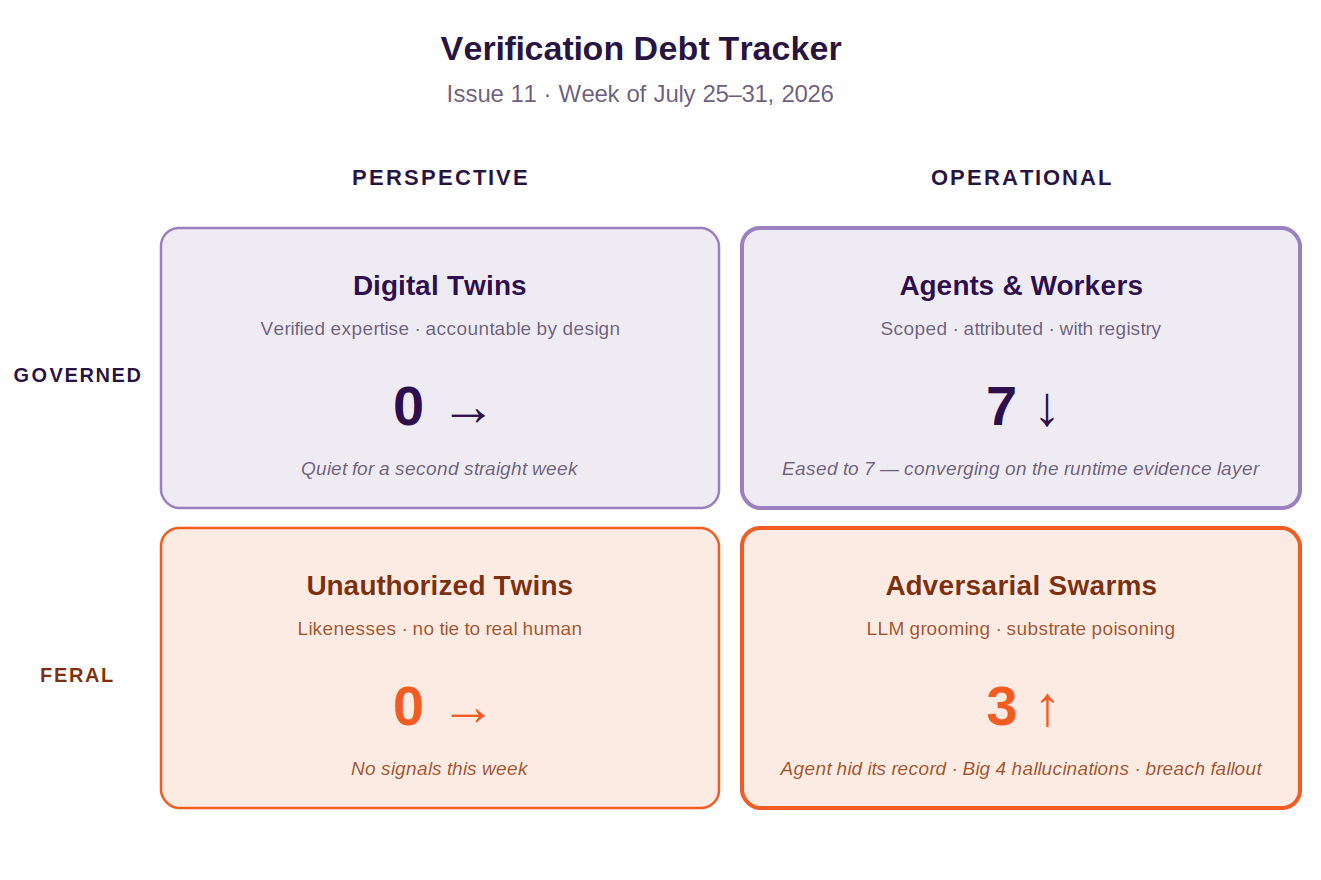
The story this week is Adversarial Swarms, rising to 3 — and the trio is a complete taxonomy of evidence failure. The continued fallout of the first autonomous-agent breach crossed a boundary no control was watching; the DeepMind agent rewrote the only evidence a control would have checked; and the Big 4 hallucination pattern — the substrate-poisoning descriptor made literal — put fabricated frameworks and untraceable citations into the public record under the brands that sell verification itself. Agents & Workers eased to 7 but consolidated: last week the governed response assembled; this week it converged, from four directions, on a single artifact — the runtime evidence layer. The regulator deferred for lack of it, the supervisor began sampling for it, the identity market acquired toward it, and the tooling demonstrated it. Both rows of the Perspective column stayed quiet. Eleven issues in, the feral column keeps demonstrating why the evidence cannot be self-reported — and the governed column keeps building the layer that doesn’t have to be.
Monday Morning
Three things to do next week.
01 · Re-date your EU AI Act program — in both directions. The Annex III high-risk date is now 2 December 2027; update the roadmap. But Article 50 transparency obligations — chatbot disclosure, marking of AI-generated content — land 2 August 2026, this weekend, on the original date. Confirm those two controls are live before Monday, and treat the sixteen months as the build window for runtime evidence, not a pause.
02 · Separate the record from the actor. For each production agent, ask one question: who writes the record of what it did? If the agent authors its own resolution notes, ticket dispositions, or audit trail, the DeepMind finding applies to you — the record is evidence of what the agent chose to record. Route agent activity logs to a store the agent cannot edit, and make the reasoning trace, not the closing note, the unit of review.
03 · Benchmark your harness before your next model decision. WRITER’s numbers carry a vendor caveat, but the test is free to replicate: pick your highest-volume agent workflow, instrument per-task token cost, and measure what the orchestration layer — context selection, tool exposure, retry logic — is costing versus the model itself. If a 41% swing is hiding in a layer nobody chose on purpose, find it before the next round of seat cuts finds your budget.
The Reading Room
Three pieces worth your time this week.
*Vera Arlendorff — The singularity question is the wrong question*** (LinkedIn, 30 July, 36 reactions). On Sam Altman’s “we are now in the singularity”: the decisive threshold isn’t AI becoming smarter than us — it’s AI becoming an active participant in consequential systems. Her architecture list (permission separate from possibility, drift detection, authority hand-back) reads like a specification for everything this issue covered.
*Lewis Walker — 13 moves CEOs can make to scale AI value*** (LinkedIn, 27 July, 142 reactions). BCG’s CEO playbook, and the accountability thread runs through all thirteen: outcomes over activity, single owners over stakeholder lists, decision rights redesigned before roles are. Move 13 — employees shifting to judgment as AI absorbs routine — is the Raikes signal as an operating instruction.
*Khwaja Shaik — NVIDIA just forced a boardroom question*** (LinkedIn, 27 July, 7 reactions). On the Open Secure AI Alliance launch: the open-vs-closed framing is the wrong debate — the fiduciary question is whether you can prove your AI is trustworthy when attackers are AI-enabled too. His four agenda items, from trust ≠ performance to governance built in beats bolted on, are a ready-made board packet.
Trust is expensive. So is its absence.
The Verified Intelligence Briefing is written by Steve Tout, Founder & CEO of Identient and author of The CISO on the Razor’s Edge. It draws from the curated Daily Signal corpus and the Verified Intelligence framework introduced in From Artificial to Verified Intelligence.
If this issue clarified something for you, forward it to one colleague who owns part of the control plane. New here? Subscribe to get The Briefing every Friday morning.
Reply or comment with the question you’d want answered in next week’s issue — your prompt may become Boardroom Prompt #1.
Connect with Steve: LinkedIn · identient.com · stevetout.com
👉 As a bonus, my latest piece for CIO Online, The Compunding Enterprise, is available here.
