


The weekly read on verification debt — for leaders who own the control plane.
The Pattern
Last week, a court sent the bill for verification debt to the company that deployed the AI. This week, the market started building the thing that would have prevented the invoice.
The question ran through the whole corpus in the same words: who is watching the agents? Network Guardian asked it directly and then answered it — shipping the first agentic development environment to implement runtime authority governance in a live system. Jonny Tooze named the four foundations that separate the 6% of agentic transformations that work from the 94% that stall, and the second foundation was human roles above the loop. Caroline Wong drew the ownership boundary — which AI signals belong to security, which to product, which to governance. Rinki Sethi described the security team five years out, reorganized around judgment rather than task execution.
Underneath the governance thread, the frontier itself moved. Governments restricted access to advanced models, and the enterprise reading — from Pradeep Sanyal and Pat Gelsinger both — was that model access is now an operating risk, not a regulation footnote. On July 1, Anthropic restored access to its Mythos-class models after a brief export-control suspension. The lesson landed regardless of the resolution: the model you built your workflow on can become unavailable by policy, overnight, for reasons that have nothing to do with your architecture.
The pattern: the market stopped asking who watches the agents and started building the layer that does — while the frontier reminded everyone that access to the model was never guaranteed in the first place.
For six weeks this briefing has described a control layer that does not yet exist in most enterprises — a place where authority is delegated, scoped, logged, and revoked at runtime. This week that layer stopped being a description. It got an implementation, a confidence index measuring where agents can be trusted, and a national-security reminder that the substrate underneath it all is contested.
Thesis. The accountability layer is no longer theoretical. The institutions that build it into the program and protocol layer — before the court, the regulator, or the export-control order forces the question — are the ones who will still be operating when the others are explaining.
The Signals
01 · Network Guardian shipped the first agentic IDE to implement runtime authority governance
The Signal. Network Guardian announced that NeuroNest.cc is the first agentic development environment to implement AuthR — embedding authority governance, provenance, and drift awareness directly into its orchestration engine rather than bolting observability on afterward (Network Guardian, LinkedIn, 30 June, 164 reactions). A companion post framed the problem in one line: who is watching the agents? (Network Guardian, LinkedIn, 2 July).
The Lineage Gap. This is the week the control layer stopped being a description and became a product. For six issues the briefing has named the gap: traditional observability shows what happened, not who initiated it, under what intent, or how responsibility moved across agents. Network Guardian built exactly that missing layer — every agent treated as a process with a contract: declared inputs, outputs, side effects, and a place in a directed authority graph. The Five Questions become computable when authority is embedded in orchestration. Who authorized it? is a delegation record. Who can revoke it? is a live control. Who is it economically aligned to? is a scope boundary the engine enforces. The significance is not the vendor — it is the proof of existence. The accountability layer the briefing has been describing can be built, in a live system, today. That changes every conversation that used to end in “but nobody has actually implemented this.”
Boardroom Prompt. When an agent in your environment acts, can your system answer who initiated it, under what authority, and within what limits — or only that something happened?
02 · Jonny Tooze: four foundations separate the 6% of agentic transformations that work
The Signal. Jonny Tooze (118 reactions) laid out why agentic transformations fail — not because the models are wrong, but because the foundations are missing. The four: workflow redesign, human roles above the loop, governance, and trusted data. Most organizations get one or two. The 6% that transform get all four (Tooze, LinkedIn, 30 June).
The Lineage Gap. Tooze’s second foundation — human roles above the loop, not in it — is the same reframe that ran through last week’s reader response to the German court ruling. The loop implies passive review; above the loop implies an informed, empowered human owning the delegation chain with a name attached. This is the Five Questions expressed as an operating model. Workflow redesign is scope. Human roles above the loop is authority. Governance is provenance. Trusted data is grounding. The 94% that stall are not short a better model — they are short the substrate. The briefing has watched this statistic climb from Issue 06’s “95% of pilots deliver zero P&L impact” to this week’s structural explanation of why. The failure is architectural, and it is the same architecture every week.
Boardroom Prompt. Of Tooze’s four foundations — workflow redesign, human roles above the loop, governance, trusted data — how many does your most advanced agentic deployment actually have?
03 · Model access became an operating risk — restrictions, then restoration
The Signal. Pradeep Sanyal (14 reactions) reframed the frontier-model restrictions as an enterprise-continuity problem rather than a regulation story: model access is now an operating risk (Sanyal, LinkedIn, 27 June). Pat Gelsinger (22 reactions) placed the same events in the national-security frame — when a model becomes a strategic asset, access to it moves from a commercial decision to a policy one (Gelsinger, LinkedIn, 29 June). On July 1, Anthropic restored access to its Mythos-class models after a brief export-control suspension.
The Lineage Gap. The restoration does not erase the lesson. For two years enterprise AI architecture optimized one variable: capability. Which model is smartest, cheapest, fastest. That lens held while AI was experimentation. It breaks the moment a model sits inside a production workflow and its availability becomes a function of export-control policy rather than a service-level agreement. The Five Questions gain a new dimension — who can revoke it? now includes a government, not just a vendor. The institutions that built a single-model dependency with no fallback lived through a weeks-long continuity gap that happened to close on July 1. The next one may not. Model portability and graceful degradation are now verification-debt controls, not procurement preferences.
Boardroom Prompt. If access to your primary frontier model were suspended by policy tomorrow — as one was, for weeks, until access was restored on July 1 — what in your production stack keeps running, and what stops?
Every AI agent in your firm is quietly taking out loans in your name. It’s called Verification Debt — and it compounds.
Retire it with Identient, the governance layer that puts identity, evidence, and ownership behind every AI decision.
Identient helps regulated firms answer the questions that come due at the worst moment — a release, a regulatory inquiry, an audit: What is your AI doing? Who authorized it? Can you prove it?
Built on AI Operating Discipline, Identient’s four-phase methodology, your firm can:
See what’s actually running: inventory every AI use case, agent, and identity-to-data touchpoint — with a named owner for each
Bound what agents can do: governed identity and access for AI agents in your Microsoft environment, from Entra ID to Purview
Prove it when it counts: audit-ready evidence trails that stand up to examiners, boards, and enterprise security reviews
04 · Bain: seven AI decisions no CEO can delegate
The Signal. Lewis Walker surfaced a Bain framework (184 reactions) naming the seven AI decisions a CEO cannot delegate: posture, domain focus, data, operating model, talent, governance, and the learning system. The throughline: these are strategic-position decisions the CEO must own and narrate personally — not in-year ROI tests applied to individual pilots (Walker, LinkedIn, 28 June).
The Lineage Gap. The Bain framing lands the accountability where last issue’s German court left it. When liability sits with the deploying institution, the AI posture is a decision the CEO owns personally — because the CEO is the named human at the top of the authority chain when a regulator or plaintiff asks. Governance appears on Bain’s list not as a compliance line but as a non-delegable CEO decision, which is the same move Kindervag made in Issue 03 and Sanyal’s structural-CAO signal made in Issue 04. The market keeps arriving at the same place from different doors: AI accountability cannot be pushed down to the CISO, the CDO, or a committee. It resolves to a person, and the court has now confirmed which person.
Boardroom Prompt. Of Bain’s seven non-delegable AI decisions, how many has your CEO personally made and narrated — and how many are still sitting inside a committee?
05 · MIT and Microsoft published an Agent Confidence Index across 101 tasks
The Signal. Lewis Walker surfaced the 2026 Agent Confidence Index (257 reactions): MIT and Microsoft surveyed 300 technology experts, ranking 101 tasks by expert confidence in agents to perform them independently. Structured, measurable work scored high — automated report generation at 83.5, boilerplate code near the top. Complex, judgment-heavy work scored low (Walker, LinkedIn, 1 July).
The Lineage Gap. The Confidence Index is a map of where verification debt is cheap and where it is expensive. High-confidence tasks — structured, measurable, repeatable — carry low verification debt because the failure modes are visible and the output is checkable. Low-confidence tasks carry high verification debt because a wrong answer is both more likely and harder to catch. The institutions that deploy agents in the high-confidence band and hold the low-confidence band for human judgment are pricing verification debt correctly. The ones deploying agents uniformly across all 101 task types — because the demo looked good — are accumulating debt fastest exactly where it is hardest to detect. This is proportional governance from Issue 05, now with an empirical task-by-task scorecard behind it.
Boardroom Prompt. For each consequential AI deployment in your organization, where does the task sit on the confidence spectrum — and is your human-oversight investment proportional to that position?
06 · Caroline Wong: “we need to secure AI” — okay, which part?
The Signal. Caroline Wong (20 reactions) drew the ownership boundary most organizations are still blurring. Prompt injection, credential abuse, over-permissioned agents: that is cybersecurity. Hallucinations, model misfires, answer quality: that is product and AI governance, not the SOC. Turning on generative and agentic AI produces a flood of new signals, and most belong to different owners (Wong, LinkedIn, 1 July).
The Lineage Gap. Wong is naming the same three-layer distinction Alexandra C. drew in Issue 06 — data, AI, and agent governance as separate disciplines — but from the security operations side. The reason it matters is accountability routing: when an AI failure occurs, the organization has to know instantly whether it was a security failure, a model failure, or a governance failure, because each has a different owner and a different fix. Institutions with one undifferentiated “AI security” mandate cannot route the signal, so every incident becomes a cross-functional scramble. The Five Questions require knowing which layer owns the answer before the incident, not during it. Wong’s boundary-drawing is the unglamorous prerequisite for a governance program that actually functions under pressure.
Boardroom Prompt. When your AI produces a bad outcome tomorrow, does your organization know within the hour whether it is a security, product, or governance failure — and who owns the fix for each?
07 · Rinki Sethi: the security team you’re building today won’t exist in five years
The Signal. Rinki Sethi (107 reactions) argued that AI agents will reshape security organizations around outcomes rather than task execution — elevating human judgment and shrinking the repetitive-work headcount that defined the SOC for two decades. The security team of 2031 is organized around the decisions humans still need to own (Sethi, LinkedIn, 29 June).
The Lineage Gap. Sethi is describing the org-chart consequence of every other signal in this issue. If agents handle the structured, high-confidence work — per the MIT/Microsoft index — the human roles that remain are the judgment-heavy, authority-bearing ones: the humans above the loop, the named owners of the delegation chain. This is the labor-market form of the accountability layer. The security team reorganizes around the Five Questions because the questions are what require human judgment: authorizing an agent, scoping it, deciding when to revoke it, owning the outcome. The institutions restructuring their security orgs around judgment now are building the human layer of the accountability architecture. The ones still hiring for task execution are staffing for a job the agents are about to absorb.
Boardroom Prompt. Is your security hiring plan for the next two years organized around tasks agents will soon perform — or around the judgment and authority decisions humans will always own?
08 · Rohit Gupta: the AI platform wars are reshaping enterprise software — and skipping finance operations
The Signal. Rohit Gupta (6 reactions) named a gap hiding inside the enterprise AI platform wars. ERP vendors have spent $1–3 billion each acquiring AI execution capability — and every one of those deals targets HR, IT workflow, employee productivity, or data infrastructure. Finance operations — accounts payable, accounts receivable, cash-cycle management, multi-entity orchestration — remains untouched (Gupta, LinkedIn, 30 June).
The Lineage Gap. Gupta’s observation matters to the briefing because finance operations is where verification debt is most expensive and least examined. The AP and AR execution layer sits between the ERP system of record and the actual movement of money — and it is precisely the domain where a wrong agent action is not a bad report but a misdirected payment. The Five Questions become sharpest here: an agent authorizing a disbursement needs an airtight answer to who authorized it and within what limits, because the failure mode is financial and immediate. That the platform wars have skipped this domain means the highest-stakes agentic use case is also the least governed by incumbent tooling — an opening for whoever brings verified-intelligence discipline to the finance execution layer first. Fintech built the rails; finance operations still runs on judgment and spreadsheets.
Boardroom Prompt. In your finance operations — AP, AR, cash management — what governs an AI agent that can move or commit money, and is that control as mature as the one on your ERP system of record?
09 · Ram Charan: AI is no longer optional, and the CEO must lead it
The Signal. Ram Charan (220 reactions) delivered the blunt version of the year’s strategic reality: AI is no longer optional, it must be led by the CEO personally, and it is a vehicle for profitable, capital-efficient growth rather than mere automation. Companies that do not act will pay the penalty of being permanently left behind (Charan, LinkedIn, 2 July).
The Lineage Gap. Charan’s urgency is the counterweight this briefing has to hold honestly. The verification-debt frame is not an argument for slowing down — it is an argument for building the accountability layer so that the institution can move fast without accumulating unpayable liability. Charan is right that inaction is the larger risk. The briefing’s addition is that action without the substrate — workflow redesign, human authority above the loop, governance, trusted data — is how the 94% end up with pilots that never reach P&L and, occasionally, a chatbot answer in front of a German judge. The CEO leading AI and the CEO owning AI accountability are the same mandate. Speed and verification are not opposites; verification is what lets speed compound instead of accumulate risk.
Boardroom Prompt. Is your CEO leading AI adoption with the same personal ownership they bring to the accountability layer underneath it — or is one racing ahead of the other?
10 · Alexandra C.: the “Thought Virus” and the trust-boundary reframe of prompt injection
The Signal. Alexandra C. surfaced two related signals this week. A “Thought Virus” attack demonstrated that subliminal misalignment can propagate across multi-agent systems, bypassing paraphrasing and content-filtering defenses entirely (20 reactions, 2 July). Days later she reframed prompt injection itself: the real risk is instructions humans cannot see — hidden inside invisible Unicode characters that models read and, once given tools, increasingly obey (13 reactions, 3 July) (Alexandra C., LinkedIn, 3 July).
The Lineage Gap. Both signals point at the same failure: verification breaks when the instruction channel is invisible to the human but legible to the model. This is the Adversarial Swarms quadrant of the keynote taxonomy in its purest form — substrate poisoning that no output-layer control can catch, because the malicious input never surfaces where a human reviews it. The Four Pillars answer this directly. Provenance means knowing where every instruction came from, including the ones hidden in Unicode. Grounding means the agent trusts sources by verified origin, not by surface appearance. Once agents have tools and act on hidden instructions, the trust boundary is no longer the prompt a human typed — it is every byte the model can read. The institutions treating prompt injection as a content-filtering problem are defending the wrong boundary. The real control is provenance-aware governance over every information source an agent can reach.
Boardroom Prompt. For every source your AI agents can read from, do you verify the provenance of the instructions inside it — or only the ones a human can see?
The Verification Debt Tracker
The 2×2 from From Artificial to Verified Intelligence. Signal counts this week, with direction vs. last issue.
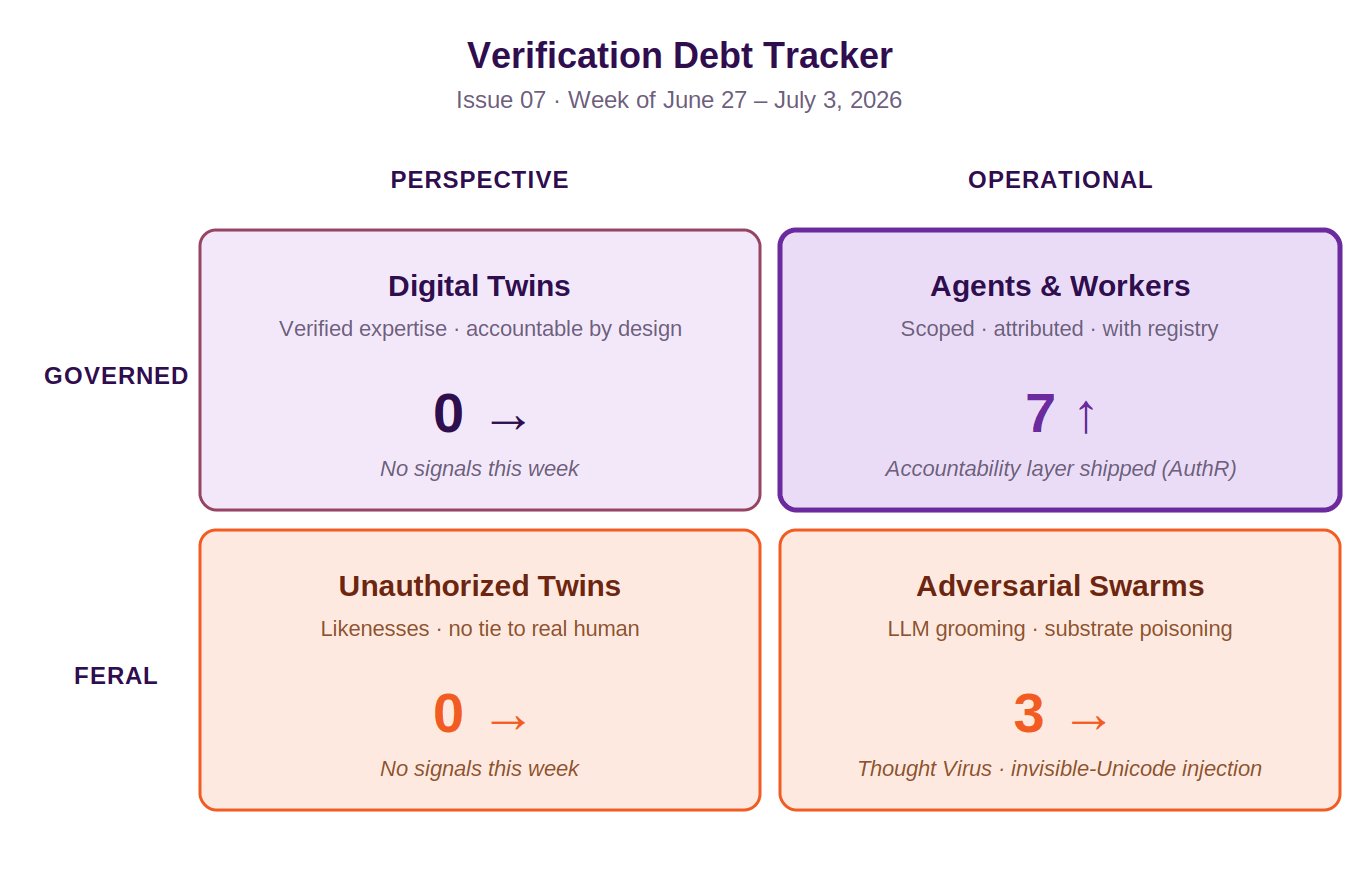
The story this week is the Operational / Governed quadrant, which jumped from 6 to 7 as the accountability layer moved from description to implementation — Network Guardian shipping runtime authority governance, Tooze’s four foundations, Wong’s ownership boundaries, Sethi’s judgment-first security org. Adversarial Swarms held at 3 but shifted in character: from external enforcement events last week to attack-vector research this week — the Thought Virus and the invisible-Unicode injection reframe. The Digital Twins quadrant stayed quiet. The signal underneath the whole board: for the first time in seven issues, the governed quadrant is being filled by things that were built, not just argued.
Monday Morning
Three things to do next week.
01 · Draw your agent authority graph. Not a data-flow diagram — an authority graph. For your most consequential agentic workflow, map who delegated authority to each agent, at what scope, revocable by whom, within what limits. If you cannot draw it, you cannot govern it — and this week proved that the drawing is buildable, not hypothetical.
02 · Price your agents against the Confidence Index. Take the MIT/Microsoft framing to your AI portfolio. Which deployments sit in the high-confidence band, where verification debt is cheap? Which sit in the low-confidence band, where a wrong answer is both likely and hard to catch? Move your human-oversight investment to match the map, not the demo.
03 · Write your model-continuity plan. Access to your primary frontier model sat under an export-control suspension for weeks before access was restored on July 1. Treat that as the drill it was. Document what runs, what degrades, and what stops if your primary model goes dark tomorrow — and where the fallback is. Model portability is now a continuity control, not a procurement footnote.
The Reading Room
Three pieces worth your time this week.
Pradeep Sanyal — Plan for AI Abundance, Not AI Scarcity (LinkedIn, 29 June, 24 reactions). The strategic counterpoint to this week’s model-restriction signals: advanced AI diffuses faster than anyone plans for, so the durable posture is resilience and governance, not access control. Read alongside Signal 03 for the full argument.
Birgul Cotelli — Your board finally approved an AI governance framework — now what? (LinkedIn, 30 June, 28 reactions). Argues that board-approved frameworks are already being outpaced by AI-native execution and provider dependency. The governance-maturity companion to this issue’s Pattern.
Darlene Newman — Ford and the limits of enterprise AI (LinkedIn, 1 July, 11 reactions). A concrete case: Ford’s AI quality-inspection story shows that documented SOPs cannot replace operational judgment. The human-above-the-loop argument, grounded on a factory floor.
Trust is expensive. So is its absence.
The Verified Intelligence Briefing is written by Steve Tout, Founder & CEO of Identient and author of The CISO on the Razor’s Edge. It draws from the curated Daily Signal corpus and the Verified Intelligence framework introduced in From Artificial to Verified Intelligence.
If this issue clarified something for you, forward it to one colleague who owns part of the control plane. New here? Subscribe to get The Briefing every Friday morning.
Reply or comment with the question you’d want answered in next week’s issue — your prompt may become Boardroom Prompt #1.
Connect with Steve: LinkedIn · identient.com · stevetout.com