



The weekly read on verification debt — for leaders who own the control plane.
The Pattern
This was the week three things converged onto one conclusion: AI is identity’s problem now.
The European Parliament voted to amend the EU AI Act, delaying enforcement while preserving the regulatory structure. The post surfacing the vote drew 2,011 reactions — by a wide margin the largest signal this briefing has tracked. Michael Lee, with 576 reactions behind him, named the underlying market shift: AI models are becoming a commodity, and the moat is now everything the model is wrapped in. KPMG retracted an AI-generated report on UBS after the kind of hallucinated content that ran EY through the same news cycle in Issue 01. Different Big Four firm. Same failure mode. Identical conclusion: the verification layer has to live somewhere.
All of this happened in the same week as Identiverse — the identity industry’s largest annual conference, where the entire conversation pivoted to AI agents, non-human identities, and the operating model required to govern both. SailPoint acquired Entro Security, signaling that the identity market is now consolidating around non-human identity governance. Rohan Pinto framed it as “Human on Top.” Jason Keenaghan asked the question directly on stage: is securing agentic AI an identity problem? The room said yes.
The pattern: the AI agent problem just moved to identity’s home turf — and the market is reorganizing to meet it there.
Last week, the buyers reframed AI procurement as control procurement. This week, the identity industry stepped forward as the discipline that owns the control layer. Capability is the floor. Control is the moat. And the moat is being dug by the identity vendors that have been building this substrate for twenty years.
Thesis. AI governance is now an identity discipline. The institutions that already operate mature identity programs get most of the AI governance work for free. The ones that built their AI strategy without their identity team in the room will rebuild it.
The Signals
01 · The European Parliament voted to amend the EU AI Act
The Signal. The European Parliament voted to amend the EU AI Act, delaying enforcement dates while keeping the regulation’s core structure largely intact. The surfacing post drew 2,011 reactions — by a wide margin the largest single engagement signal this briefing has tracked across five issues (Patel, LinkedIn, 16 June).
The Lineage Gap. This is the second EU enforcement step-back the briefing has tracked. Issue 02 covered the December 2027 effective-date slip. This week’s amendment is the formal parliamentary action. The pattern is now a posture: the regulator wants the framework on the books and the deadlines pushed. The institutions reading this as relief are missing the structural point. Enforcement delay does not erase the regulatory architecture — it concentrates the audit risk for the institutions whose AI behavior is documented in public press releases, vendor case studies, and quarterly earnings calls. When the AI Act eventually enforces, the institutions with five years of undocumented deployment behind them face a different conversation than the ones with five years of audit logs. The delay is a gift only if you use the runway.
Boardroom Prompt. If the AI Act became enforceable next quarter, could your institution produce the documentation a high-risk classification requires — or would the gap between “ready” and “compliant” be visible from outside?
02 · KPMG retracted an AI-generated report on UBS after hallucinated claims
The Signal. KPMG retracted an AI-generated report on UBS after the report contained hallucinated claims about the bank. Oliver Bussmann’s surfacing of the story drew 137 reactions and surfaced the obvious comparison: this is EY in Issue 01, with a different Big Four name on the letterhead (Bussmann, LinkedIn, 13 June).
The Lineage Gap. The second Big Four retraction in five weeks of this briefing makes the failure mode official, not anecdotal. Sailesh P. wrote the sharpest reframe (Signal 06 below): the issue is not AI generation. It is AI verification. Both firms produced credible-looking output. Both firms shipped it. Both firms discovered, after publication, that the verification step had not survived contact with production. The Four Pillars failed in identical sequence — grounding (no anchor to a real UBS source), scope (the model extrapolated into firm-specific claims), provenance (no trace back to the actual statement), drift awareness (no signal flagged the fabrication). When the same failure happens twice in five weeks in the same vertical, it stops being an incident and starts being a category. The category is “external assurance produced by AI without an enforced verification step.”
Boardroom Prompt. For every external document your institution publishes that involved AI generation, what verification step is enforced before publication — and is that step distinct from the generation step?
03 · Michael Lee: AI models are becoming a commodity
The Signal. Michael Lee (576 reactions) named the market reality the buyers were already pricing into procurement decisions. AI models are commoditizing. The real moat is the system the model lives inside: governance, permissions, workflows, orchestration, evaluation, observability. The model is no longer the strategy. The system is (Lee, LinkedIn, 18 June).
The Lineage Gap. This is last issue’s “capability is the floor, control is the moat” thesis stated with broader market authority. When 576 reactions land on a commoditization argument inside a week, the market consensus has crossed the threshold from “emerging view” to “operating assumption.” The implication for procurement is direct: the vendor who arrives with the best model and the worst system loses to the vendor who arrives with the second-best model and a real system around it. The Five Questions are system properties, not model properties. Who authorized it? lives in the orchestration layer. Who can revoke it? lives in the permissions layer. Who is it economically aligned to? lives in the observability layer. The institution buying “an AI” needs to buy the system. The institution buying “a model” is buying the loss leader.
Boardroom Prompt. When you next evaluate an AI vendor, will the scorecard weight the model, or the system around it — and what is the weight you assign to each?
Every AI agent in your firm is quietly taking out loans in your name. It’s called Verification Debt — and it compounds.
Retire it with Identient, the governance layer that puts identity, evidence, and ownership behind every AI decision.
Identient helps regulated firms answer the questions that come due at the worst moment — a release, a regulatory inquiry, an audit: What is your AI doing? Who authorized it? Can you prove it?
Built on AI Operating Discipline, Identient’s four-phase methodology, your firm can:
See what’s actually running: inventory every AI use case, agent, and identity-to-data touchpoint — with a named owner for each
Bound what agents can do: governed identity and access for AI agents in your Microsoft environment, from Entra ID to Purview
Prove it when it counts: audit-ready evidence trails that stand up to examiners, boards, and enterprise security reviews
04 · Rohan Pinto at Identiverse: “Human on Top” as the governance frame
The Signal. Rohan Pinto (161 reactions) connected Identiverse 2026’s biggest themes — AI agents, non-human identities, the runtime authority problem — to a single governance framework he called “Human on Top.” The argument: agents and non-human identities have to operate beneath a human-controlled authority layer, not parallel to it (Pinto, LinkedIn, 16 June).
The Lineage Gap. “Human on Top” is the architectural correlate of last issue’s structural Chief AI Officer signal. The early agent deployments put humans next to AI — review queues, periodic audits, ethics committees that meet quarterly. Pinto’s reframe is structural: the human authority is not adjacent to the agent stack; it sits above it, owning the delegation chain. The Five Questions all answer back up to that human authority. Authority is delegated downward through scopes, time bounds, and budgets; accountability flows upward through audit logs, exception escalations, and revocation events. The institutions that build their agent architecture this way get governance for free at runtime. The ones that don’t will spend Q3 retrofitting it onto deployments that were architected without an authority chain in mind.
Boardroom Prompt. For every AI agent in your environment, is there a named human at the top of its delegation chain — or does the chain terminate inside the vendor’s platform?
05 · SailPoint acquired Entro Security — NHI consolidation accelerates
The Signal. SailPoint acquired Entro Security, an early leader in non-human identity governance. Eric Thacker (64 reactions) framed the deal as a market signal: non-human identity governance is now becoming core infrastructure for the identity platform, not an adjacent capability. The acquisition is part of a consolidation wave that began earlier this year and is accelerating (Thacker, LinkedIn, 15 June).
The Lineage Gap. The acquisition is the market voting on Issue 04’s permission-layer thesis. Identity vendors are not adding “AI agent support” as a feature — they are buying the companies that own the non-human identity governance primitives. Service accounts, machine identities, agent tokens, scoped credentials, time-bounded delegations — these stop being IAM corner cases and become the central category. The vendor that arrives at the next Identiverse with the most mature NHI stack is the vendor your CISO will be evaluating in Q4. The vendor that arrives with only human identity is selling the past. The institutions choosing identity platforms in the next six months should be asking exactly one question: what is the NHI architecture and is it credible.
Boardroom Prompt. In your current identity platform, how many distinct types of non-human identity are governed today — and what is the audit log telling you about the rest?
06 · Sailesh P.: the KPMG story isn’t really about KPMG
The Signal. Sailesh P. (76 reactions) wrote the sharpest commentary on the KPMG retraction. The issue is not AI generation. It is AI verification. Every organization producing AI-generated content has the same exposure. KPMG just discovered it publicly (Sailesh P., LinkedIn, 15 June).
The Lineage Gap. The reframe is the entire briefing in two sentences. Verification debt is what accumulates between generation and publication when no controlled checkpoint catches the gap. The Five Questions answer this directly: at the moment of publication, can your institution produce the chain from claim → source → confidence interval → reviewer → approval? Most institutions cannot, because the AI tools were adopted faster than the verification workflow was redesigned. The interesting question is not how KPMG let this happen. The interesting question is how many institutions are producing similar artifacts right now without realizing it — because the failure mode is silent until the subject of the report happens to notice the fabrication.
Boardroom Prompt. For every external artifact your institution published with AI assistance last quarter, can you produce the verification chain on demand — or only the generation chain?
07 · Jason Keenaghan asked Identiverse the structural question
The Signal. Jason Keenaghan (20 reactions) asked the question that framed half of Identiverse 2026: is securing agentic AI an identity problem, or a new end-to-end security discipline? His own answer leaned identity — but acknowledged the discipline boundaries are still being negotiated in real time (Keenaghan, LinkedIn, 16 June).
The Lineage Gap. The discipline boundary question matters because budget follows discipline ownership. If agentic AI security is an identity problem, the budget sits with IAM. If it is a separate discipline, the budget sits in a new line item that will be invented in the next planning cycle. The institutions that already have mature identity programs will quietly absorb the AI governance scope without doubling headcount — and the ones that don’t will discover that “AI governance” requires hiring a team that turns out to have the same skill profile as the IAM team they did not invest in. Identity is the most mature discipline closest to the agent problem. The market is voting on that proximity through acquisitions, conference programming, and budget reallocation. Keenaghan is naming the vote out loud.
Boardroom Prompt. Inside your organization, who currently owns the AI agent security budget — IAM, security, AI strategy, or three people pointing at each other?
08 · Regis Haegler: AI as the cheap-now, expensive-later business model
The Signal. Regis Haegler (65 reactions) warned that AI is starting to look like the next great cheap-now, expensive-later business model — capability bundled at attractive pricing today, with the real cost trajectory revealed only after the institution has committed. Boards should stress-test costs, usage, lock-in, and exit options before the conversion happens (Haegler, LinkedIn, 18 June).
The Lineage Gap. Haegler is naming the economic shape of last issue’s consumption-cost shift. The current price of frontier AI does not reflect the cost at scale, the cost of model upgrades, or the cost of the verification stack that will eventually be required by regulation or contract. The Five Questions need a financial answer at runtime — Who is it economically aligned to? — and that answer changes when the vendor’s pricing model changes. The institutions that wire exit options into their AI architecture now keep their leverage. The ones that don’t will discover, in the second or third quarter of dependency, that the cheapest path forward is the one the vendor has the most pricing power over. Exit options are a verification debt control, not just a procurement concern.
Boardroom Prompt. For every consequential AI vendor in your stack, what is your documented exit plan — and what would it cost to execute in the next two quarters?
09 · Russ Pearlman: minimum viable governance is a category mistake
The Signal. Russ Pearlman (30 reactions) argued that AI governance should be calibrated to use-case risk, not minimized like an MVP. The MVP frame assumes failures you can afford. Most AI failures in regulated industries are failures you cannot afford. Governance should be proportional to consequence, with platform-level controls applied where the stakes warrant them (Pearlman, LinkedIn, 17 June).
The Lineage Gap. Pearlman’s piece is the calibration argument behind last issue’s Gartner warning that uniform AI governance will cause enterprise failures by 2027. The MVP frame is doubly wrong for AI governance: it imports a startup mental model into a regulated context where the wrong AI output produces a public retraction, a regulatory inquiry, or a class action — none of which are failure modes you can afford to ship and learn from. Proportional controls require risk tiering at the platform level, not at the application level. The institutions that build platform-level governance primitives — identity, scoping, logging, kill switches — can apply them proportionally. The ones that build governance per-application will build the controls four times and still miss the use cases the controls were supposed to catch.
Boardroom Prompt. For your top three AI use cases, is the governance posture calibrated to the worst-case consequence — or to the average-case workflow?
10 · Mandy Andress: AI-driven impersonation is changing the trust model
The Signal. Mandy Andress (12 reactions) wrote that AI-driven impersonation attacks — synthetic voices, deepfaked video, model-generated text indistinguishable from a known sender — are making trust and identity verification central security concerns. The attack model has changed; the verification model has not kept up (Andress, LinkedIn, 18 June).
The Lineage Gap. Andress is naming the Unauthorized Twins quadrant of the keynote 2×2 in its operational form. Likenesses spun up in minutes, no tie to the real human, indistinguishable from authorized communication. The Five Questions all break at the impersonation boundary — Who created it? and Who authorized it? become identity verification problems before they become governance problems. The institutions that built passwordless, phishing-resistant authentication for their workforce are now adequately protected against the inbound version of these attacks. The ones still operating on shared secrets and SMS codes are not. The convergence with this issue’s Pattern is direct: AI agent governance and AI-driven impersonation defense share an identity substrate. The institutions investing in one get most of the other.
Boardroom Prompt. If a deepfake of your CEO instructed your treasury team to authorize a wire transfer tomorrow, what would catch it — and would it catch it before the wire posted?
The Verification Debt Tracker
The 2×2 from From Artificial to Verified Intelligence. Signal counts this week, with direction vs. last issue.
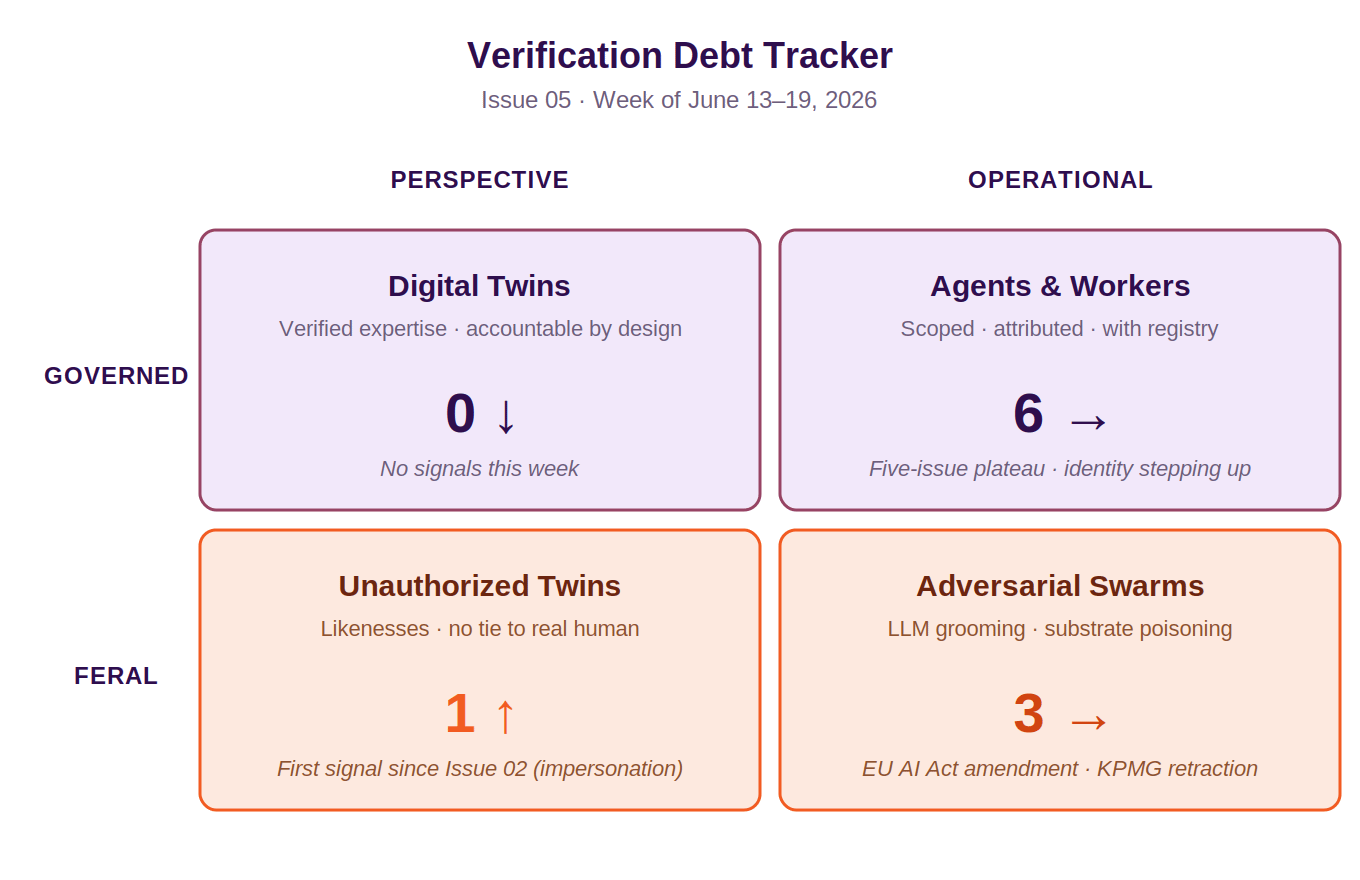
The Agents & Workers quadrant held at 6 — five consecutive issues at the plateau, a steady-state read of the governance conversation. Adversarial Swarms held at 3, but the qualitative magnitude jumped on the back of two signals: the EU AI Act amendment (the largest engagement signal this briefing has tracked) and the second Big Four AI retraction in five weeks. Unauthorized Twins moved from 0 to 1 — the first signal in this quadrant since Issue 02 — driven by Andress on AI-driven impersonation. The keynote taxonomy’s most feral quadrant is no longer quiet.
Monday Morning
Three things to do next week.
01 · Get your identity team in the room. Map every AI deployment against your identity program — every agent should have an identity record, an authorization chain, a delegation scope, and a kill switch in your IAM system. If your CIAM or IAM team was not in your last AI architecture review, that is the gap. Fix that before your next planning cycle.
02 · Apply the KPMG retraction lens to your own institution. Where is AI-generated content reaching external audiences — clients, regulators, partners, public — without an enforced verification checkpoint? The KPMG event is the second Big Four retraction in five weeks. The third will be more expensive for whoever it lands on. Audit your verification workflows this quarter, not next.
03 · Pressure-test your posture for an EU AI Act enforcement surprise. Enforcement dates are slipping, not disappearing. Document what compliance would look like today, even if you do not have to demonstrate it yet. The institutions that arrive at enforcement with documentation ready will pass through. The ones writing it under deadline will not.
The Reading Room
Three pieces worth your time this week.
Steve Tout — Intent Is the New Perimeter (LinkedIn, 16 June, 34 reactions). The briefing’s author published a longitudinal analysis of three years of Identiverse session data this week, arguing that identity has crossed a perimeter shift from credentials to intent. Companion read to this issue’s Pattern, and the empirical case for the “AI is identity’s problem now” conclusion.
Alexandra C. — Operational reality of AI governance is missing from theory (LinkedIn, 18 June, 26 reactions). Argues that AI governance must move from declarative theory to deterministic runtime controls — telemetry, policy-as-code, and enforced revocation. The Carolyn Cotelli signal from Issue 04 made operational.
Khwaja Shaik — One Executive Order. Your AI Goes Dark. What’s Your Board’s Plan? (LinkedIn, 17 June). The geopolitical dimension of vendor concentration. If a sanctions order tomorrow cut your access to a frontier model, what is your continuity plan? Most boards have not asked the question.
Trust is expensive. So is its absence.
The Verified Intelligence Briefing is written by Steve Tout, Founder & CEO of Identient and author of The CISO on the Razor’s Edge. It draws from the curated Daily Signal corpus and the Verified Intelligence framework introduced in From Artificial to Verified Intelligence.
If this issue clarified something for you, forward it to one colleague who owns part of the control plane. New here? Subscribe to get The Briefing every Friday morning.
Reply or comment with the question you’d want answered in next week’s issue — your prompt may become Boardroom Prompt #1.
Connect with Steve: LinkedIn · identient.com · stevetout.com