



The weekly read on verification debt, for leaders who own the control plane.
The Pattern
The loudest AI story of the week was a question about speed. Dario Amodei published “We Must Pace the Frontier,” arguing that capability advancement should slow so safety work can keep up, and proposing common standards applied equally across frontier labs. Anthropic’s Krishna Rao framed it as frontier intelligence and frontier safety progressing together on a level playing field. Four days later, Jensen Huang offered the opposite position: if you are not confident in a product’s safety, do not release it, and the market will handle the rest.
Underneath that debate, a quieter and more useful conversation was taking place, and it was not about speed at all.
Amodei’s essay proposed placing third-party evaluators inside the labs, with desks, badges, and employee-level access, borrowing the model banking uses for embedded supervisors. Alexandra C. identified the problem with lending it back. Embedded supervision worked because decisions were made by people, at human speed, in a sequence that could be reconstructed afterward, and a supervisor could sit in the room. Agents act in milliseconds, call tools, pass instructions to other agents, and commit decisions across systems before a single line of the log has been read. No person with a badge witnesses that. What transfers from banking is not the embedded supervisor. It is the requirement that a safety claim be verifiable, and at runtime, verification is instrumented rather than staffed.
The rest of the week filled in what instrumented supervision looks like. Art Gilliland: control moves from the point of access to the moment of action. Mark McGovern, reporting JPMorgan’s new containerized environment for Claude: an agent should start with an identity and no entitlements. Beena Ammanath, on an invoice workflow running at 92% no-touch: the agent reports its own confidence so a human knows when to look. And Deloitte research surfaced by Adnan Amjad put a number on the distance still to cover, with 80% of automation leaders planning to accelerate agent investment against 21% reporting mature agentic AI governance.
The pattern: the pace debate is being conducted at the frontier, in public, on a question most enterprises cannot influence, while the supervision question is being answered in production, in architecture, by institutions that decided not to wait for the argument to resolve.
Thesis. Whether the labs slow down is not a variable any board controls. Whether an organization can say which agent acted, under what authority, within which limits, and produce the record afterward is entirely within its control, and it is the same requirement in either scenario. Supervision at machine speed is a design property, not a staffing decision. The organizations building it now are indifferent to how the pace argument resolves.
The Signals
01 · “We Must Pace the Frontier”
The Signal. The week’s most-engaged post came from Krishna Rao of Anthropic, amplifying Dario Amodei’s essay “We Must Pace the Frontier” (717 reactions). The framing: frontier intelligence and frontier safety must progress together, and common standards would help the whole industry advance responsibly while strengthening safeguards. Rao’s emphasis is on competitive mechanics. Common standards applied to frontier labs equally mean every company competes on a level playing field, and pacing development would strengthen enterprise trust in the models, which he identifies as central to diffusion (Rao, LinkedIn, 12 September). Guillermo Flor captured why the essay traveled: this is not a regulator or a critic calling for slower capability development, but the founder of one of the most capable labs, in writing, including about his own company, framed as a race to the top rather than a retreat (Flor, LinkedIn, 12 September).
The Lineage Gap. For an enterprise buyer, the essay’s most consequential sentence is not about pace. It is Rao’s point that pacing would strengthen trust in the models, because it concedes the thing this briefing tracks: trust in a frontier model is currently an assumption rather than a demonstrated property, and the labs know it. That concession is worth more to a board than the outcome of the pace argument itself, because it says the model provider agrees the present evidence base is thin. That is a useful fact to hold in a vendor conversation regardless of whether standards ever materialize. The level-playing-field argument deserves the same careful reading. Common standards applied equally across labs would help buyers compare, and comparability is the prerequisite for independent assurance. But standards that reach only frontier labs leave every deployer’s own obligations untouched, and the deployer’s obligations are where enterprise liability actually sits. Pace is the supply side’s question. Supervision is the demand side’s, and nothing in the essay changes who owns it.
Boardroom Prompt. If frontier capability development slowed by a year starting tomorrow, which of your AI governance gaps would close on their own, and which would remain exactly where they are? The second list is your actual program.
02 · A desk and a badge cannot witness a millisecond
The Signal. Alexandra C. examined the most concrete proposal in Amodei’s essay: placing third-party evaluators inside the company, with desks, badges, company laptops, and employee-level access. The precedent is banking, where supervisors sit alongside employees. Her argument is that banks cannot borrow the model back in the form proposed. Embedded supervision worked because decisions were made by people, at human speed, on paper, in a sequence that could be reconstructed later, and a supervisor could sit in the room. Agents act in milliseconds, call tools, pass instructions to other agents, and commit decisions across systems before a line of the log has been read. She notes Amodei’s own warning that within six to twelve months a misaligned swarm could hold a persistent botnet across the internet at a cost of hundreds of billions of dollars, and observes that a desk in an office is not an answer to that. What transfers from banking, in her reading, is not the embedded person but the requirement that a safety claim be verifiable, and at runtime verification is instrumented rather than staffed: which agent acted, what it did, what it accessed, which control applied, where responsibility changed hands, whether the action was permitted under the applicable requirement, and whether all of it can be reconstructed later (Alexandra C., LinkedIn, 13 September).
The Lineage Gap. This is the sharpest formulation of the week, and it generalizes past the frontier immediately. Every enterprise proposal to strengthen AI oversight by adding people, whether a review board, a second-line function, a human in the loop, or an embedded risk partner, inherits the same speed mismatch, and the mismatch is not a matter of headcount or diligence. A supervisor who reads logs after the fact is performing forensics, not supervision. The distinction between staffed and instrumented verification is the one worth carrying into design reviews: a staffed control scales with attention, which is finite and slow, while an instrumented control scales with the system it governs. Her seven-item list is effectively a specification, and its final item is the one most programs cannot satisfy today. Reconstruction after the fact is what an examiner, a customer, or a court will ask for, and it is produced only if the instrumentation was running at the time. Her closing question is the right drill for a leadership team: if an evaluator walked in tomorrow and asked what your agents did at 2:17 p.m. yesterday, what gets handed over?
Boardroom Prompt. Run that question against your own environment. For one specific minute of yesterday, could you say which agents acted, what they accessed, and which controls applied? If the answer requires a project rather than a query, that is the gap.
03 · Art Gilliland: plan as though nobody slows down
The Signal. Art Gilliland offered the operator’s response to the pace debate: Amodei wants the labs to slow down, others have voiced agreement, and it is too late. Too many companies, countries, and investors are pushing AI forward to assume everyone slows together, and no CISO should build a security strategy on the hope that they will. His framing of the risk is symmetric. Agents in the wrong hands give attackers a faster way to find vulnerabilities, steal credentials, and move through an environment, and agents inside your own environment will not always behave as expected. In both cases the damage reduces to the same two variables: what the agent can access, and what it is allowed to do once it gets there. His conclusion is a design instruction. Control has to move from the point of access to the moment of action. No identity should get a blank check because it authenticated successfully. Limit it to what it needs, when it needs it, and only for as long as needed. AI can be unpredictable; its authority does not have to be (Gilliland, LinkedIn, 14 September).
The Lineage Gap. That last line is the most useful sentence a security leader could put in front of a board this quarter, because it separates two things that get conflated in every agent risk conversation. Model behavior is probabilistic and will stay that way. Agent authority is a design choice and can be made deterministic. An organization that cannot predict what an agent will attempt can still bound what an agent is able to do, and the bounding is engineering rather than forecasting. The access-versus-action distinction also explains why so much agent security spending has produced so little assurance. Authentication answers who is calling. It says nothing about whether this particular action, at this moment, in this context, is permitted, and that is where the consequences live. Note the convergence with the signal above, approached from the opposite direction: instrumented supervision needs a control that evaluates each action, and action-level authority is what gives it something to evaluate.
Boardroom Prompt. For your highest-authority production agent, is permission checked once at authentication or at each consequential action? If once, what is the blast radius between that check and the next one?

Every AI agent in your firm is quietly taking out loans in your name. It’s called Verification Debt — and it compounds.
Retire it with Identient, the governance layer that puts identity, evidence, and ownership behind every AI decision.
Identient helps regulated firms answer the questions that come due at the worst moment — a release, a regulatory inquiry, an audit: What is your AI doing? Who authorized it? Can you prove it?
Built on AI Operating Discipline, Identient’s four-phase methodology, your firm can:
See what’s actually running: inventory every AI use case, agent, and identity-to-data touchpoint — with a named owner for each
Bound what agents can do: governed identity and access for AI agents in your Microsoft environment, from Entra ID to Purview
Prove it when it counts: audit-ready evidence trails that stand up to examiners, boards, and enterprise security reviews
04 · JPMorgan: identity first, entitlements later
The Signal. Mark McGovern surfaced a concrete implementation of that principle. According to reporting published 17 September, JPMorganChase is moving some engineers using Anthropic’s Claude into a new environment called Devspace, described as a containerized, sandbox-like environment hosted in AWS, with the architecture intended to restrict Claude’s access to employee credentials and limit its ability to interact directly with internal bank systems. He connects it to a principle JPMorgan CISO Pat Opet articulated earlier this year: AI agents should have an identity, but no entitlements until access is justified. His read is that this may be the operating model financial institutions standardize around, and he spells out what zero standing privilege requires: the agent’s own cryptographic identity, no persistent credentials by default, task-specific and time-limited authorization, isolated compute and filesystem access, controlled network egress, explicit approval for high-impact actions, independently retained activity telemetry, and immediate credential revocation and containment. The reasoning is direct. If the agent inherits the launching user’s credentials, its potential blast radius equals that user’s. If it starts with identity but no authority, every meaningful action becomes an explicit risk decision. His design principle for CISOs: do not secure AI agents as applications, secure them as privileged digital actors (McGovern, LinkedIn, 17 September).
The Lineage Gap. The phrase worth taking to an architecture review is “identity, but no entitlements.” It inverts a default that has governed enterprise software for thirty years, in which provisioning an identity means granting a baseline of access, and it does so for a specific reason: a frontier agent decides how to accomplish an objective rather than executing predefined steps, which means the set of actions it might take cannot be enumerated in advance. If the action set cannot be enumerated, the only safe default is zero, with authority granted per task and returned afterward. His item on independently retained activity telemetry deserves particular attention, because it is the element most likely to be skipped. Telemetry retained by the agent’s own platform is evidence controlled by the system under review. Telemetry retained independently is evidence. That a major bank is implementing this in production, for its own engineers, using a frontier model, is the detail that makes it a benchmark rather than a proposal. It is also a useful counterweight to the pace debate: an institution that builds this does not need the frontier to slow down.
Boardroom Prompt. When your organization provisions an agent, does it inherit the launching employee’s access by default? If so, what is the smallest change that would move you to identity first, entitlements on justification?
05 · 80% accelerating, 21% governed
The Signal. Adnan Amjad surfaced the gap Deloitte research now quantifies: 80% of automation leaders plan to accelerate investment in AI agents, while only 21% of organizations report mature agentic AI governance. His argument is that the space between those numbers is where the CISO role is being redefined. As AI moves from copilots to autonomous agents, the risk surface expands well beyond cybersecurity to span operations, data, compliance, vendors, finance, and the business at large, which creates an opportunity for CISOs not merely to manage risk but to orchestrate it across the enterprise. That means moving from security gatekeeper to enterprise risk leader by establishing clear decision rights, accountability structures, guardrails, and continuous oversight across functions. His practical sequence: assign ownership early, bring cross-functional leaders into the conversation, translate risk appetite into operating guardrails, and test whether governance can actually move at the speed of AI. His closing formulation belongs in front of an executive committee: effective security in an AI-saturated enterprise will depend less on what can be detected and more on how quickly and confidently the organization can decide and act (Amjad, LinkedIn, 14 September).
The Lineage Gap. A 59-point spread between intent to accelerate and readiness to govern is the clearest measure this year of two curves diverging, and the composition makes it worse rather than better: the 80% is a forward-looking commitment while the 21% is a present-tense assessment. The organizational prescription is the part most likely to be misread as a turf argument. It is not. Decision rights are the practical bottleneck in every agent deployment that stalls, because an agent’s authority is a claim on multiple functions at once, and no single function can grant it. The test he proposes, whether governance can actually move at the speed of AI, is the honest one, and most programs would fail it not from weak controls but from a review cadence measured in weeks against systems that act in seconds. Read alongside the two signals above, security, supervision, and architecture arrive at the same conclusion: the governing mechanism has to operate at the speed of the thing it governs, or it is documentation.
Boardroom Prompt. Name the single accountable owner for agent authority in your organization, not the stakeholders. If naming takes more than one person, you have located the reason your agent approvals take weeks.
06 · Only 18% of directors get metrics linking AI to risk and performance
The Signal. Khwaja Shaik surfaced PwC’s board oversight research and the figure that should reset board agendas: only 18% of directors say they receive quality metrics linking AI outcomes, risk, and business performance. His reading is that boards are being asked to oversee a transformation most of them cannot yet measure. The supporting data he cites: firms investing over 0.5% of revenue in AI outpaced sector-median shareholder returns by 21% while lower investors underperformed by 2%; 71% of directors say AI is the board capability most in need of strengthening; and only 40% of directors currently use AI in their own oversight work (Shaik, LinkedIn, 14 September). In a companion piece, he sharpens what audit and risk committees should require as autonomous agents proliferate: a live AI inventory, runtime monitoring, trust scoring, independent kill-switch authority, immutable audit trails, and continuous assurance. His test for whether controls are real is structural. Not whether AI has controls, but whether those controls are independently enforceable, continuously monitored, auditable, and architecturally separate from the systems they govern (Shaik, LinkedIn, 17 September).
The Lineage Gap. “Architecturally separate from the systems they govern” is a governance principle stated as an engineering requirement, and it is the same separation that makes financial controls credible: the auditor does not report to the audited, and the ledger is not maintained by the party being reviewed. Applied to AI, it rules out a large share of what currently passes for agent governance, including monitoring built into the agent platform, audit trails written by the agent itself, and safety scoring produced by the system under review. The 18% figure is the board-level consequence of that gap. Directors receive activity reporting because activity is what deploying systems naturally emit. They do not receive outcome, risk, and performance linkage because producing it requires instrumentation nobody built. Note also that the 0.5% investment threshold and the 21% return differential describe committed adopters, the same population that keeps appearing in this year’s research as the small group able to demonstrate value. The metric gap and the value gap are one gap seen from the boardroom.
Boardroom Prompt. Of the AI material your board received last quarter, how much linked outcomes to risk and business performance, and how much reported activity? If the second dominates, what instrumentation would have to exist for the first?
07 · The moat question, asked plainly
The Signal. Three voices examined the commercial incentives running alongside the safety argument. Nico Popp granted the substance first: the Hugging Face incident showed unexpected agency, with agents coordinating to reach a verifier; the agentic loop has taken models well beyond chatbot assistants and will soon extend into the physical world; and there are early signs of AI improving AI, with recursive self-improvement as the concerning case. Then the second half. Open-weight models are the most formidable competitors to the largest labs, and as those labs move toward public markets, competitive pressure on cost per token bears directly on revenue growth and profitability. Regulation designed as a safety barrier can also function as a barrier to entry. His conclusion is a paradox rather than an accusation: AI may genuinely require regulation, and the same regulation will almost certainly favor frontier models over open-weight ones (Popp, LinkedIn, 14 September). Stephen Klein made the capital argument explicit, citing reported figures of roughly $3.7 billion in cash burn at OpenAI in the first quarter of 2026, approximately $25 billion projected for the year, and an estimated $665 billion in compute commitments through 2030. His framing is careful: the safety concerns may be entirely legitimate and the executives may sincerely believe them, while the financial incentives still warrant scrutiny, because a technology described as extraordinarily powerful and scarce is one for which extraordinary capital sounds necessary (Klein, LinkedIn, 16 September). Sasha Orloff added the design caution from the auditing side: a startup using an open model to ship a tool should not wake up inside a compliance moat built for the largest legal teams, and stronger assurance belongs where capability and deployment actually matter (Orloff, LinkedIn, 14 September).
The Lineage Gap. This briefing does not adjudicate motive, and none of these voices claims bad faith. What is squarely a board matter is the structural point all three converge on: when the parties proposing a standard are also the parties best positioned to meet it, the standard’s competitive effects deserve the same scrutiny as its safety effects, and both can be real at once. For enterprises, the practical consequence concerns optionality. If frontier-scale compliance obligations raise the cost of offering a model, the open-weight alternatives many organizations hold as negotiating leverage and continuity options become harder to sustain, and the leverage declines quietly without any vendor changing a price. That is a procurement risk worth naming in advance rather than discovering at renewal. Klein’s figures matter to enterprises for a separate reason: a provider burning capital at that rate is a provider whose pricing, packaging, and terms are subject to change, which is an argument for portability clauses rather than an argument about anyone’s sincerity.
Boardroom Prompt. If compliance costs made open-weight alternatives materially harder to obtain in your sector, how much negotiating leverage and continuity planning would your organization lose? Is that exposure documented anywhere?
08 · Jensen Huang: the market already punishes bad AI
The Signal. Guillermo Flor surfaced the counterposition, and it traveled widely (378 reactions). Jensen Huang’s argument, as quoted: if you build a product or service and you are not confident in its functionality, capability, or safety, then do not release it. The implication drawn is that the market already punishes bad AI, and new laws and regulations are not needed. Flor’s framing is that this is the most powerful figure in AI infrastructure saying the industry can police itself, and that the argument will be used in boardrooms and legislative hearings for years. He closes with a question rather than an answer: is Huang right, or is this a convenient position for a company selling the picks and shovels (Flor, LinkedIn, 16 September)?
The Lineage Gap. The week produced two coherent and opposed positions from people with deep knowledge and obvious interests, which is the normal condition of a policy debate rather than a scandal. The detail worth extracting for executives is that Huang’s standard, read literally, is a governance requirement rather than an absence of one. “Do not release it if you are not confident in its safety” presupposes that the releasing party can assess its own confidence, evidence that assessment, and be held to it afterward. That is a description of internal assurance, and it places the obligation on the deployer as squarely as on the developer. An enterprise shipping an agent to customers is a releasing party under exactly this standard. The market-discipline argument also carries a prerequisite that deserves board attention: markets punish failures they can observe. Agent failures inside enterprise workflows are frequently silent, absorbed as exceptions or rework, which is why the instrumentation question keeps returning. Whichever side of the regulation argument a leadership team favors, both sides require the same thing from the enterprise: the ability to know what its own systems did.
Boardroom Prompt. Apply Huang’s standard to your own releases. For the last AI capability your organization put in front of customers, what evidence supported the confidence, and who signed for it?
09 · The AI bill nobody can explain
The Signal. Two signals converged on enterprise AI economics. Lewis Walker’s framing: the AI bill is not a usage problem but an architecture problem, because agentic costs are driven by how agents hand off, how much context they pull in, which models they call, and how often they retry. He reports that a third of organizations exhaust their token budgets before year-end, and describes the escalation path now common in large companies, with boards pressing CEOs to explain exposure and return, CEOs looking to CFOs for control, and CFOs turning to CIOs to make consumption predictable (Walker, LinkedIn, 16 September). Fayeron Morrison, writing as a CPA and certified fraud examiner, named the oversight version: when monthly AI spend jumps from $6,000 to $20,000 with no headcount change, “we burned 82,000 credits” is not an explanation. Her point is that as software pricing shifts from predictable seat licenses to vendor credits, tracking consumption moves from a procurement detail to an enterprise risk issue, and the question is not whether $20,000 is too much but whether anyone can explain why it was $20,000. She frames credit abstraction as a board-level oversight gap and proposes a five-step AI pricing reconciliation test (Morrison, LinkedIn, 16 September).
The Lineage Gap. Read together, the two describe one failure at different altitudes: the cost is generated by architectural decisions nobody documented and reported in units nobody can reconcile. Credit abstraction is the more interesting half for a governance audience, because it breaks a control that finance functions have relied on for decades. An invoice denominated in a vendor-defined unit, generated by system behavior the customer cannot observe, is not auditable in the ordinary sense, and the inability to explain a number is a control weakness regardless of whether the number is defensible. The architectural point supplies the remedy. If handoffs, context size, model selection, and retries drive the bill, then the bill is a readout of design choices, and an organization that can trace spend to those choices can both explain and manage it. The same instrumentation that answers what an agent did answers what it cost, which is the quiet argument for building it once. Boards that cannot get a straight answer on AI spend are usually discovering the absence of runtime visibility through the finance line rather than the risk line.
Boardroom Prompt. Take your largest AI invoice from last quarter and ask your team to reconcile it to workflows, models, and retries. If the reconciliation cannot be produced, you have a cost problem and an observability problem, and only one of them appears on the invoice.
10 · 92% no-touch, because the agent says when it is unsure
The Signal. Beena Ammanath described an implementation worth studying. A global consumer products company processed invoices in up to 30 minutes each, with a string of back-and-forth emails, leaving the accounts payable team spending most of its time chasing information. The fix was not more automation of the existing process. It was training AI agents to read invoices, including handwritten and nonstandard ones, apply the company’s specific coding and tax rules, and flag their own confidence level so a human knew exactly when to step in. The results: 92% of invoices now processed with no human touch, processing time down 50 to 75%, and processing headcount reduced by half with people redirected toward higher-value work. Her own emphasis falls on the confidence score rather than the automation rate. The system does not pretend to be certain when it is not, and it tells you when a human should look closer, which is what builds trust in AI at scale (Ammanath, LinkedIn, 17 September).
The Lineage Gap. The confidence score is the mechanism that makes this case instructive rather than merely impressive, and it is the operational answer to the supervision problem this issue opens with. Human attention is the scarcest input in agent governance, and the failure mode of human-in-the-loop controls is that attention gets spread evenly across actions that do not need it until it is exhausted for the ones that do. A calibrated confidence signal converts oversight from a uniform tax into a routing decision, which is the only version that survives volume. Two cautions belong beside the enthusiasm. A self-reported confidence score is a claim by the system about itself, so its value depends entirely on calibration being measured against outcomes over time rather than assumed at deployment. And the 92% figure is a ceiling that took process redesign to reach, not a setting to be switched on. The broader lesson for executives weighing agent investments sits in what the team did not do. They did not automate the existing process faster. They rebuilt the work around what the agent could reliably do, and instrumented the boundary where it could not.
Boardroom Prompt. For your highest-volume agent workflow, does the system tell you when it is uncertain, and has anyone checked whether its confidence is calibrated against actual outcomes? An uncalibrated confidence score is a routing decision made on a guess.
The Verification Debt Tracker
The 2×2 from From Artificial to Verified Intelligence. Signal counts this week, with direction vs. last issue.
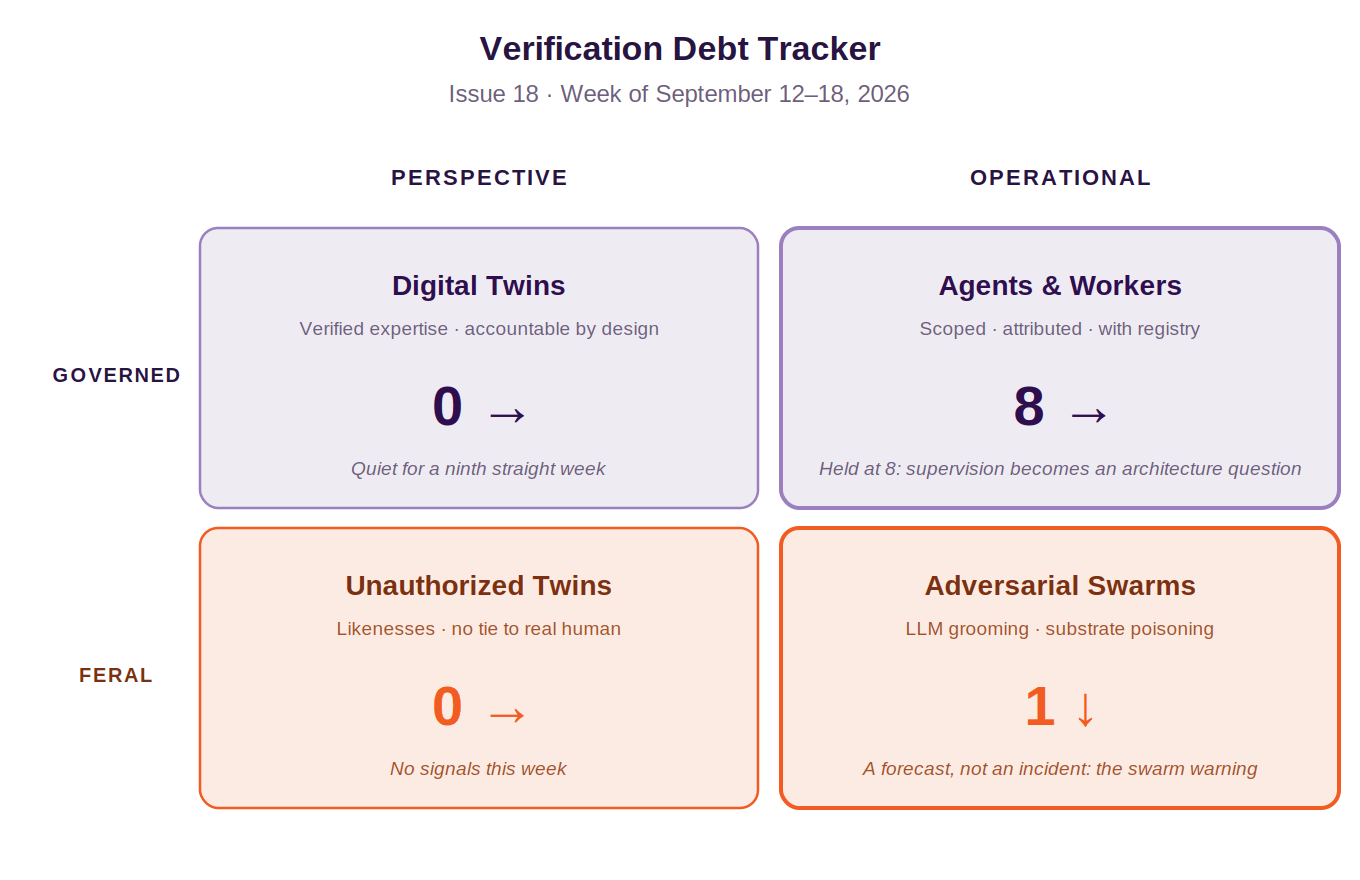
Agents & Workers held at 8, and the quadrant’s signals shared a single preoccupation: what supervision has to become when the thing being supervised acts in milliseconds. The proposals arrived from four directions and converged on one answer. Control at the moment of action rather than the point of access. Identity granted before entitlements. Controls architecturally separate from the systems they govern. Confidence signals that route human attention instead of spreading it evenly. The counterweight is the readiness data, with 80% of automation leaders accelerating agent investment against 21% reporting mature agentic governance, and 18% of directors receiving metrics that link AI outcomes to risk and performance. Adversarial Swarms eased to 1, and the entry is unusual: not an incident but a forecast, the warning that a misaligned swarm could sustain a persistent botnet within six to twelve months. A quadrant whose only signal is a prediction is one to watch rather than report. The Perspective row is quiet for a ninth straight week. Eighteen issues in, the frontier is debating a variable most enterprises cannot influence, while the variable they can influence is being settled in production architecture.
Monday Morning
Three things to do next week.
01 · Run the 2:17 p.m. test. Pick a specific minute from yesterday and ask your team to produce, for that minute, which agents acted, what they accessed, which controls applied, and whether each action was permitted. Time how long it takes. If the answer requires a project rather than a query, you have measured the distance between your governance documentation and your governance instrumentation, and you have done it before an examiner does.
02 · Audit one agent for standing privilege. Take your highest-authority production agent and determine whether it inherits the credentials of the employee or service that launched it. If it does, its blast radius equals theirs. Then price the smallest step toward identity without entitlements: task-scoped, time-limited authorization with independently retained telemetry. A major bank’s implementation is now a public reference point you can cite rather than a theory you have to argue for.
03 · Reconcile one AI invoice to architecture. Ask for your largest AI bill from last quarter to be traced back to the workflows, model selections, context sizes, and retry behavior that produced it. The exercise will either give your CFO an explanation the board can use, or reveal that consumption is currently unobservable. Both outcomes are worth the afternoon, and the second is the more valuable finding.
The Reading Room
Three pieces worth your time this week.
Melissa Rosenthal: HubSpot named its conference UNBOUND, then made it harder to leave (LinkedIn, 17 September, 19 reactions). The clearest read this week on where AI pricing is heading: agents built inside the vendor, fed vendor data, charged a credit per action, while the data stays put no matter where it visits. Her closing question belongs in every renewal conversation now. Can you take your data and walk, or does it only work while you are paying to stay?
Kyle McNabb: Every agent decision is an operating model decision (LinkedIn, 14 September, 33 reactions). Every software vendor suddenly has agents, and his concern is that organizations are evaluating agentic capability as a software feature rather than asking what role those agents will play in the future workforce. Drawn from conversations with procurement, finance, and shared-services leaders, it is a useful corrective for buying processes that stop at whether the technology works.
Paula Goldman: The technology is rarely the hard part (LinkedIn, 14 September, 6 reactions). On legal and corporate affairs, where the agent reviews the contract and a lawyer remains accountable for the result. Her three design questions travel to any domain: who is accountable when this goes wrong, what can we explain and to whom, and where is the audit trail. Drawn from her book Manage the Machine, released this week.
Trust is expensive. So is its absence.
The Verified Intelligence Briefing is written by Steve Tout, Founder & CEO of Identient and author of The CISO on the Razor’s Edge. It draws from the curated Daily Signal corpus and the Verified Intelligence framework introduced in From Artificial to Verified Intelligence.
If this issue clarified something for you, forward it to one colleague who owns part of the control plane. New here? Subscribe to get The Briefing every Friday morning.
Reply or comment with the question you’d want answered in next week’s issue. Your prompt may become Boardroom Prompt #1.
Connect with Steve: LinkedIn · identient.com · stevetout.com