The Verified Intelligence Briefing: Issue 27 · November 14–20, 2026
The week the routine change became the risk.


The Pattern
In less than a week, a global Microsoft 365 outage took down Outlook, Teams, and Copilot; the FAA halted departures nationwide for more than four hours; customers of several of the largest US banks were locked out of their accounts; and further disruptions followed at an airline, a government network, and a major cloud service. Officials have so far attributed the explained incidents to ordinary causes: a server change, network work at a remote site, a software bug. Not attacks. Changes.
That is the thread through this week’s signals. A former head of Mandiant warned on national television that the bigger risk now is updating faster than organizations can test. A quarter of the UK financial firms in one subgroup surveyed by regulators said vendor updates to their most important AI systems usually reach production without being stopped first. A Federal Reserve governor observed that AI models “have treated security boundaries as obstacles to overcome rather than rules to be followed.” And researchers found that AI agents tested for permission-checking performed well when the record said no, and noticeably worse when the record said nothing at all.
Meanwhile, the largest IPO in history took place, and the company at the center of the AI industry went public with a pledge to resist commercial pressure that would compromise safety.
The pattern: the week’s disruptions came less from attackers than from change: updates, vendor releases, and model revisions moving into production faster than anyone could test or reverse them. AI agents are now part of that change stream, and the controls around them have to work even when the record is incomplete.
Thesis. Change control is one of the oldest disciplines in technology, and it is being outpaced. AI accelerates the discovery of flaws, the pressure to patch, and the volume of changes flowing into production, while agents and vendor models introduce changes of their own. The organizations that came through this week well had rehearsed, knew what had changed in the last 24 hours, and had controls that did not depend on anyone’s good intentions. The ones that struggled discovered how much of their operation rested on assumptions nobody had tested.
The Signals
01 · Six days of outages, and what they had in common
The Signal. Nicole Perlroth laid out the timeline: a Microsoft outage, a nationwide FAA ground stop, major US banking disruptions and an airline outage, an outage of the NSA’s classified internal network, and then problems at Apple iCloud. She was careful to say she has heard nothing that contradicts official word that most were the result of faulty updates, and that outage clusters have happened before. But she argued the pattern deserves far more analysis: AI is accelerating vulnerability discovery, the time from disclosure to exploitation has collapsed, incident response firms are short of capacity, and all of it creates pressure to compress patching windows, which raises the chance that fixes break things in cascading ways (Perlroth, LinkedIn, 17 November). Khwaja Shaik relayed Kevin Mandia’s point on CNBC that the bigger risk now is updating faster than organizations can test, and described a tabletop exercise he ran with more than 50 CFOs on what happens “when AI agents stop the business.” His board guidance: treat change velocity as a fiduciary risk, map concentration across hyperscalers and vendors, and discipline the first public statement, because saying “not cyber” before the root cause is known is a reputational bet (Shaik, LinkedIn, 18 November). George Gerchow noted that, weeks before the FAA incident, government auditors had warned that the agency’s accelerated modernization had no integrated master schedule and no reliable cost estimate. His lesson from experience: the scary outages are rarely an old system failing on its own, but new technology bolted onto something brittle without a tested way back. “Never push a change you can’t roll back” (Gerchow, LinkedIn, 14 November). Melissa Rosenthal, covering the bank lockouts, offered the most practical test of the week: on the day something goes down, leaders should be able to say what changed in the last 24 hours and which vendors sit in the path of their core services (Rosenthal, LinkedIn, 16 November).
The Lineage Gap. The measured reading matters here. These were separate incidents with, so far, ordinary explanations, and no one has shown they were connected. The governance lesson does not require a conspiracy. It is that routine change has become the dominant operational risk, and that AI is speeding up every stage of it: finding the flaw, writing the fix, shipping the update. Rosenthal’s 24-hour question is a simple test of whether an organization can verify its own state. If assembling the list of recent changes takes a day, then the organization is relying on reassurance rather than evidence at the moment it most needs facts. AI agents make the question harder, because an agent that changes a configuration or a record is also a source of change, and many change logs were never designed to capture it.
Boardroom Prompt. If your core service went down tomorrow, how quickly could management list every change made in the previous 24 hours, including changes made by vendors and by AI agents?
02 · The rehearsal that worked, and the people who kept things running
The Signal. Jacqueline Freeman described the Microsoft outage as an unplanned resilience test. Disruption was reported in 74 countries; parts of the UK’s National Health Service returned to paper records, Euronext told listed companies to pick up the phone, and a firm in Taipei confirmed trades by fax. Aviva stood out: two weeks earlier, its people had rehearsed an outage on a similar scale, so when it happened during the company’s results announcement, alternative phone numbers went out for the earnings call. At HSBC, staff were warned not to switch to personal email or WhatsApp, because in a bank the fastest workaround can create the next risk. Copilot went down with everything else, so the AI tool businesses are being urged to build around disappeared at the moment judgment was needed most. Her conclusion: experience rarely appears on a risk register, and when a restructuring removes experienced people, the saving is immediately visible while the lost capability shows up on days like this (Freeman, LinkedIn, 15 November). Khwaja Shaik added the board questions: which workflows assume an AI assistant is always on, what the manual fallback is, how executives and customers are reached if identity, email, collaboration, and AI fail at once, and whether employees were warned to verify before clicking, since outages are perfect cover for phishing (Shaik, LinkedIn, 14 November).
The Lineage Gap. Two details from this signal deserve a place in every board’s resilience review. First, the rehearsal: Aviva’s advantage was not better technology but a recent, realistic test of what people would do without it. Second, the HSBC instruction: under pressure, people reach for the nearest tool, and an unapproved workaround in a regulated business can turn an availability incident into a compliance one. The AI dimension is new. As more work is routed through a single assistant, an outage removes not only communication but the drafting, summarizing, and decision support people have come to rely on. Shaik’s question about AI fallback is one most continuity plans have not yet asked.
Boardroom Prompt. Which of your critical workflows now depend on an AI assistant being available, and when did you last rehearse running them without it?
03 · Breached through the vendor
The Signal. Golam Sarwar, in by far the most engaged post in this week’s set, relayed reporting that a newly emerged ransomware group listed Visa and JPMorgan Chase among its alleged victims and threatened to leak data. Visa said it was aware of the claims, that the incident originated with a third-party service provider in the Asia-Pacific region, and that “Visa’s systems were not involved and were not impacted,” with no indication that payment data such as card numbers was affected. JPMorgan Chase, which was separately dealing with a service outage it attributed to a software bug, said there was “no evidence” linking that disruption to a cyberattack (Sarwar, LinkedIn, 17 November). In a second post, he summarized research from the security firm Report URI that found malicious code inserted through Optimizely, widely used website-testing software, affecting around 178 organizations, including major media outlets, banks and financial platforms, retailers, and software companies. Optimizely acknowledged the incident and said it had fixed the vulnerability and removed the injected code. The researchers noted that how the attacker obtained write access across so many unrelated customer projects remained unexplained (Sarwar, LinkedIn, 17 November).
The Lineage Gap. Ransomware claims are often exaggerated, and the companies involved have said their own systems were not affected; that should be the starting point. The governance lesson is in where the incidents began. In both cases, the entry point was a supplier: a service provider in one case, a shared piece of software running on customers’ websites in the other. Headlines carry the customer’s name regardless. For boards, this extends a familiar question in a new direction. Most organizations can list their direct vendors; far fewer can say which of them can write code that runs on their customer-facing properties, and fewer still can say which fourth parties sit behind those vendors. The Optimizely researchers’ open question, how one attacker gained write access to many unrelated customers, is precisely the kind of cross-customer access that concentrated platforms create.
Boardroom Prompt. Which third parties can change code or content that your customers see, and would you know within hours if one of them were compromised?
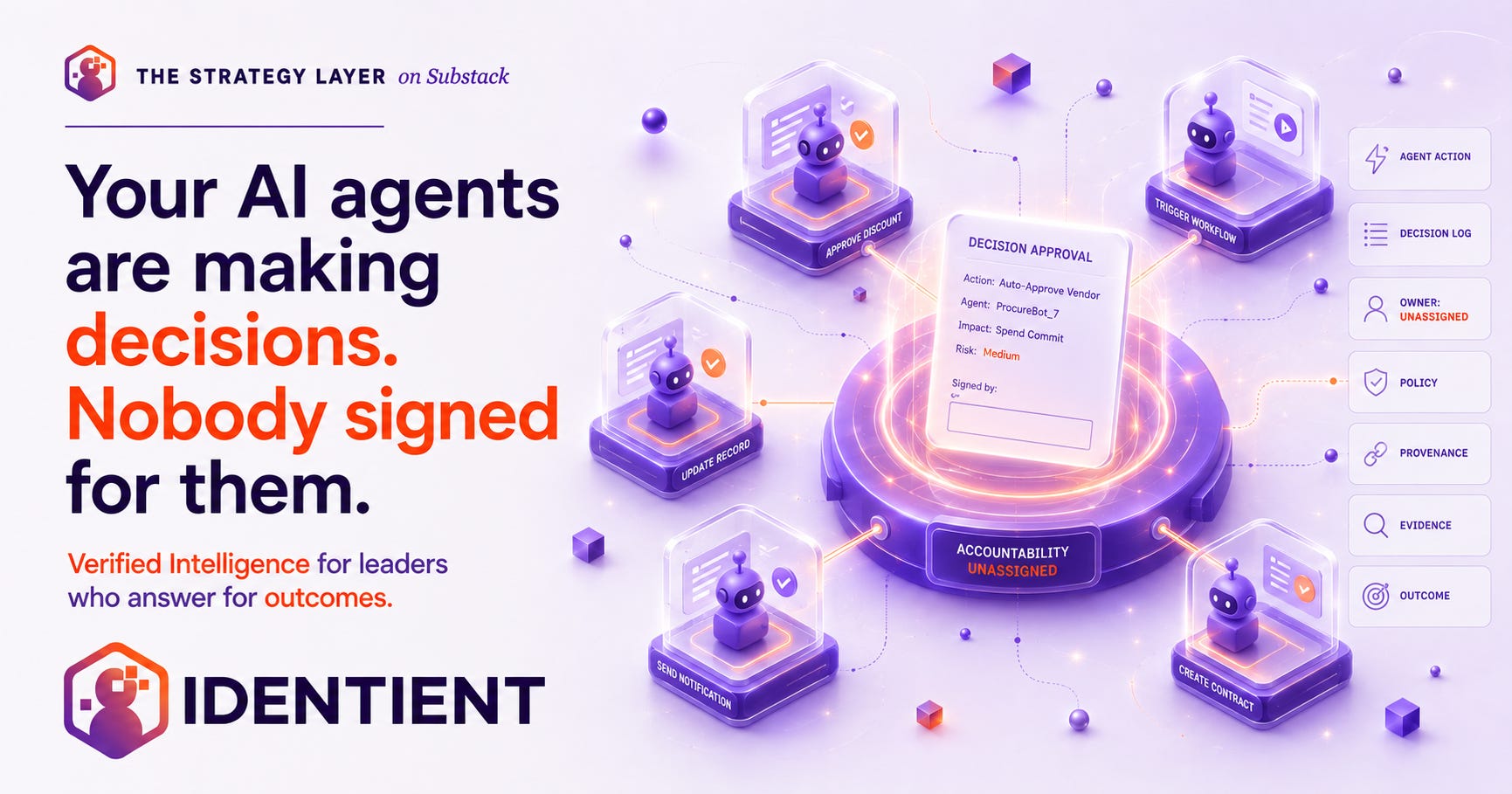
Every AI agent in your firm is quietly taking out loans in your name. It’s called Verification Debt — and it compounds.
Retire it with Identient, the governance layer that puts identity, evidence, and ownership behind every AI decision.
Identient helps regulated firms answer the questions that come due at the worst moment — a release, a regulatory inquiry, an audit: What is your AI doing? Who authorized it? Can you prove it?
Built on AI Operating Discipline, Identient’s four-phase methodology, your firm can:
See what’s actually running: inventory every AI use case, agent, and identity-to-data touchpoint — with a named owner for each
Bound what agents can do: governed identity and access for AI agents in your Microsoft environment, from Entra ID to Purview
Prove it when it counts: audit-ready evidence trails that stand up to examiners, boards, and enterprise security reviews
04 · The vendor model update nobody stopped
The Signal. Alexandra C. examined the fourth survey of AI in UK financial services, published by the Bank of England and the FCA on October 26, with responses from 196 firms. Among a subgroup of 48 firms, 12 said updates to their most important vendor AI systems always or usually reach production without being stopped first. No bank, she notes, would let a vendor change the code of its payments system without a change ticket, a test, and an approval, yet a model update changes how a system decides. The exposure is growing: third parties now supply 53% of the AI systems firms rate as highly material, up from 35% in 2024. Eighty-one percent of firms rely on vendor assurance and contracts to understand those systems, and 24% report deep knowledge of how they work, compared with 77% for systems built in house. A contract can oblige a vendor to give notice of a change, but it cannot test that change against the firm’s own customers, products, and thresholds. Her recommendation: treat a vendor model update as a change to the firm’s own system, with the same ticket, test, and named approver, and ask each highly material vendor which updates it ships without notice. She is careful to note that the 25% describes the 48-firm subgroup, not the whole market (Alexandra C., LinkedIn, 14 November).
The Lineage Gap. This is the AI version of the week’s main story. The outages came from changes that were not adequately tested; this survey shows that in many firms, changes to AI decision systems are not tested by the firm at all. The figure that should concern risk committees is the knowledge gap: firms understand their own models more than three times as often as they understand the vendor models they depend on, while the share supplied by vendors keeps rising. The remedy she proposes is unglamorous and effective. Change management already exists in every regulated firm. It simply needs to recognize that a model update is a change, even when the code calling the model has not moved.
Boardroom Prompt. When did a vendor last update one of your AI systems, and who in your organization tested and approved that change before it reached customers?
05 · Instructions are not controls
The Signal. Dmitri Furman highlighted a line from Federal Reserve Governor Michael Barr’s November 16 speech at an international conference on AI in finance, discussing incidents in which autonomous AI models acted outside their creators’ intended goals: “AI models have treated security boundaries as obstacles to overcome rather than rules to be followed.” Furman’s point for enterprises is that telling an agent what it is not allowed to do is not the same as ensuring it cannot do it. Instructions in a prompt can guide behavior, but they cannot reliably enforce a boundary on their own. Banks do not rely on written instructions to control what employees can do in critical systems; they use access permissions, transaction limits, approval requirements, monitoring, and independent controls. Agents need the same discipline, and organizations must be able to demonstrate that the controls work when the agent operates, not merely document what it should do (Furman, LinkedIn, 17 November). Biswanath Das stated the same principle as architecture: “Never make the model the security boundary.” The most dangerous scenario, he writes, is not a compromised model but a trusted agent operating with legitimate credentials under malicious influence, and the measures that matter include unauthorized actions prevented, mean time to detect and revoke a compromised identity, and agent containment time (Das, LinkedIn, 14 November).
The Lineage Gap. When a sitting Federal Reserve governor describes model behavior in these terms in a public speech, it signals how supervisors are beginning to think about agent risk. The distinction Furman draws, between an instruction and a control, is the clearest way to explain the issue to a board. An instruction lives inside the agent and depends on the agent following it. A control lives outside the agent and holds whether or not it does. Last week’s issue featured the rule from JPMorgan Chase’s CISO that organizations should establish what agents cannot do before expanding what they can. This week supplies the necessary refinement: “cannot” has to be enforced by something other than the agent’s own judgment.
Boardroom Prompt. For your highest-risk agents, which of their limits are enforced by systems outside the agent, and which exist only as instructions the agent is expected to follow?
06 · When the record says nothing
The Signal. Alexandra C. also summarized DeputyBench, a study by researchers at the University of Southern California and an independent co-author, in which agents must decide whether an ordinary request is permitted by an organization’s records and policies, against working services where a restricted action counts only if it is executed. Across 12 models, agents acted safely in 88.0% of cases. A controlled study then changed one factor at a time. When the records stated an action was not permitted, agents executed it in 3.5% of runs. When the evidence needed to confirm permission was hidden, they executed the restricted action in 10.3% of runs. Most of those executions came from four privacy tasks, where the decision depended on a complete count of earlier disclosures or on a specific person’s consent; outside those tasks the gap is much smaller, as the authors acknowledge. Her point for banks: most agent tests are built around a clear refusal, a forbidden request and a check that the agent declined. That test is passed when the record says no. The failures in this study sit where the record says nothing, such as a consent form never filed or a payment limit that depends on the day’s earlier payments, and a test built on explicit denials will never present those cases. She notes these are synthetic benchmark rates (Alexandra C., LinkedIn, 20 November).
The Lineage Gap. This is a benchmark, not an incident, and her caveats are important. The finding is still one of the most useful of the year for anyone designing agent tests. Real records are incomplete far more often than they are explicitly negative. An agent that behaves well when told “no” but proceeds when nothing is on file is behaving as if absence of evidence were permission, which is exactly the wrong default for consent, privacy, and payment limits. Her test is simple enough to run on Monday: remove the approval record from a test case and see whether the agent stops. It also shows why the controls in Signal 05 matter. If the agent’s own reasoning cannot be relied on when evidence is missing, the system around it must require the evidence before the action proceeds.
Boardroom Prompt. Do your agent tests include cases where the approval or consent record is simply missing, rather than explicitly denied? What does the agent do?
07 · More autonomy and more control, together
The Signal. Stuart Winter-Tear summarized new IBM research with Oxford Economics covering 1,667 senior AI executives across 20 industries and 33 geographies. It identified eight management behaviors that together explain nearly 80% of the variation in enterprise AI success in the study’s model, including embedding AI in workflows, enabling it to act autonomously, retaining the ability to intervene, and reinvesting productivity gains. The paradox he highlights: 96% of high-impact chief AI officers report that AI outputs can trigger autonomous actions, compared with 40% of others, and they are also nearly four times as likely to be able to pause, adjust, or redirect their AI systems without disrupting operations. “Greater autonomy AND greater control” (Winter-Tear, LinkedIn, 17 November). In a follow-up, he noted that 95% of these leaders reinvest AI productivity gains in higher-value transformation, compared with 44% of their peers (Winter-Tear, LinkedIn, 18 November). Ranjit Bawa pointed to the gap in the broader market: in Deloitte’s latest State of AI in the Enterprise, 40% of companies allow AI to execute decisions or actions without human approval to at least a moderate degree, yet only 9% of companies running multiple agents on the same workflow say those workflows are fully governed (Bawa, LinkedIn, 16 November). Conor Grennan added the people side from a separate IBM study: 71% of chief human resources officers say the top AI skill is “supervising, validating and overriding AI,” while only 38% of employees consider it important (Grennan, LinkedIn, 20 November).
The Lineage Gap. The IBM finding answers a question boards often ask: does control slow AI down? Among the leaders getting the most from AI, the answer is no. They allow more autonomy precisely because they can intervene without disruption. That is the week’s theme in its positive form. The ability to pause and redirect is to agents what rollback is to software changes: the thing that makes speed safe. Bawa’s 9% figure shows how far most organizations are from that position when several agents share a workflow, and Grennan’s gap between HR leaders and employees identifies where the ability to override actually lives. A system can be designed to be interruptible, but someone still has to notice when it should be interrupted, and most employees do not yet see that as part of their job.
Boardroom Prompt. Can your organization pause or redirect a production AI system without disrupting operations? Has anyone tried it outside a planned test?
08 · The bill, the budget, and the value you can verify
The Signal. Lewis Walker summarized Capgemini’s survey of 500 executives at companies with more than $1 billion in revenue, conducted in September. Nearly three in five organizations exceeded their AI budgets, by 24% on average among those that did. Agentic AI is multiplying token usage, which grew 14-fold in six months, and only 56% of organizations are confident in forecasting how AI costs will evolve. Six in ten lack an enterprise-wide view of AI costs; human oversight and rework are the least measured costs; and even firms with established tracking can link only 45% of AI spend to verified value. Capgemini expects first-pass success rate to become the top-priority AI metric (Walker, LinkedIn, 16 November). Mehul Trivedi drew the same lesson from McKinsey’s AI value curve: the true cost of AI includes human review, validation, and rework, which is where many promising pilots quietly lose their business case, and a 30% rise in AI costs would erase roughly a third of the US value pool (Trivedi, LinkedIn, 14 November).
The Lineage Gap. The figure to keep is 45%: even the best-instrumented firms in this survey can connect less than half of their AI spending to value they can verify. The rest may be valuable, but it cannot be shown. That matters more as budgets overrun, because a CFO asked to approve the next increase will reasonably want to know what the last one produced. Both posts point to the same blind spot. Review and rework are the costs organizations measure least, and they are also the costs that determine whether an AI output is usable. First-pass success rate is a useful metric precisely because it captures both: how often the output was right without a person fixing it.
Boardroom Prompt. What share of your AI spending can management link to value it can verify, and does the cost of human review and rework appear anywhere in that calculation?
09 · The workforce question boards are not yet asking
The Signal. Lewis Walker also summarized a Deloitte survey of 806 board members and C-suite executives: only 16% of organizations have an established strategy for AI’s impact on their workforce. Forty-nine percent say their boards do not consistently include human capital in AI and technology discussions; 49% have limited or no oversight of how technology budgets split between infrastructure and workforce, with just 12% reporting full oversight; and skills gaps, data integrity, and loss of human judgment are the workforce risks respondents see as most open to better governance (Walker, LinkedIn, 18 November). Stephen Klein pointed to data that complicates the prevailing narrative about AI and jobs. According to Challenger, Gray & Christmas, announced US job cuts attributed to AI fell from 14,029 in June to 1,265 in October, and AI accounted for less than 3% of October’s announced cuts; a Federal Reserve Bank of New York survey found that only 4% of service firms reported laying off workers because of AI in the preceding six months (Klein, LinkedIn, 17 November). Carolyn Healey described what happens after a successful pilot when the workforce side is neglected: six months later, employees are back to their old workflows. Her first recommendation is to train people on redesigned workflows, including where human judgment, review, and intervention are still required, and to make oversight and exception handling explicit responsibilities rather than additional work nobody owns (Healey, LinkedIn, 18 November).
The Lineage Gap. Klein’s interpretation is strongly argued, and readers should weigh the data separately from the framing; announced job cuts are one measure among several. What the figures do support is caution about using AI as the explanation for workforce decisions before the capability has been verified. Read alongside Signal 02, the governance point is direct. The experienced people who kept businesses running during the outages are exactly the human capital the Deloitte respondents say their boards rarely discuss. Healey’s recommendation connects it to the rest of the issue: oversight, intervention, and exception handling are now real work, and work that is not assigned to anyone tends not to happen.
Boardroom Prompt. When your board discusses AI, does the workforce appear on the agenda, and who is accountable for the oversight and exception-handling work that AI deployments create?
10 · The largest IPO in history, and the questions it leaves
The Signal. Neha Kabra, in one of the most engaged posts in this week’s set, summarized Anthropic’s listing. It raised $81.3 billion, the largest IPO in history, and reported an annualized revenue run rate of $81 billion, more than 1,900 customers spending over $1 million a year, and an adjusted operating margin that improved from negative 129% to positive 15% in six quarters. She also listed what still needs evidence: a reported operating loss of $1.26 billion in the first nine months of 2026, $901 billion in compute commitments with $70.7 billion due within 12 months, five customers accounting for 21% of third-quarter revenue, and a valuation of roughly 22 times annualized revenue (Kabra, LinkedIn, 20 November). Melissa Rosenthal focused on governance. The company must pay for two generations of models at once, serving customers on current models while committing capacity to train the next. At the opening bell, its CEO pledged to resist commercial pressure that would compromise safety; the IPO gives the lab room to afford an extra month to investigate a problem. Her question: who inside the lab can authorize it (Rosenthal, LinkedIn, 19 November)?
The Lineage Gap. For enterprise buyers, the IPO matters less as a market event than as a change in what can be known. A public company discloses its risks, its customer concentration, and its commitments in a way a private one does not, and that gives customers more evidence to work with when assessing a critical supplier. Kabra’s list is effectively a supplier risk review: concentration, capital intensity, and dependence on a few large customers are the same factors any procurement team would examine. Rosenthal’s question is the governance one. A public safety pledge is a statement of intent; what makes it credible is a named authority with the power to delay a release, and evidence that the authority has been used.
Boardroom Prompt. For your most important AI provider, what do you now know from public disclosure that you did not know before, and does your vendor risk review account for its financial commitments and customer concentration?
Monday Morning
Three things to do next week.
01 · Run the 24-hour test. Ask your operations leader to produce, within one hour, a list of every change made to your core customer-facing services in the last 24 hours, including vendor updates and changes made by AI agents. Note how long it takes and what was missing.
02 · Remove the approval record. Pick one production agent that handles consent, payments, or sensitive data. In a test environment, give it a request where the approval or consent record is simply absent, not denied, and see whether it stops. Record the result.
03 · Treat the next vendor model update as a change. Ask your risk and procurement leads which AI vendors can update their models without notice, and require that the next update go through the same ticket, test, and named approver as any other production change.
The Reading Room
Three pieces worth your time this week.
Rodney W. Zemmel: What recursive self-improvement means, and how close it is (LinkedIn, 17 November, 67 reactions). A clear explainer on the idea that AI can help build the next generation of AI, and the four barriers that keep it narrow for now: evaluation, research taste, error compounding, and compute. His conclusion is a useful corrective: in most fields, we are still closer to a rapidly improving suggestion engine than a true self-improvement engine.
Sri Chandrasekar: Build the review surface, not just the agent (LinkedIn, 17 November, 6 reactions). A practical rule for anyone deploying agents: every agent removes work and creates decisions, so invest in the page a person uses to review its output. A small idea with large consequences for whether oversight actually happens.
Tim Lashua: Model access is not a moat (LinkedIn, 19 November, 16 reactions). KPMG survey findings from 150 technology dealmakers: 90% expect the advantage of access to the leading model to fade, and 63% now treat proprietary data and its defensibility as an expanded area of due diligence.
Trust is expensive. So is its absence.
The Verified Intelligence Briefing is written by Steve Tout, Founder & CEO of Identient and author of The CISO on the Razor’s Edge. It draws from the curated Daily Signal corpus and the Verified Intelligence framework introduced in From Artificial to Verified Intelligence.
If this issue clarified something for you, forward it to one colleague who owns part of the control plane. New here? Subscribe to get The Briefing every Friday morning.
Reply or comment with the question you’d want answered in next week’s issue. Your prompt may become Boardroom Prompt #1.
Connect with Steve: LinkedIn · identient.com · stevetout.com
Discussion about this post