


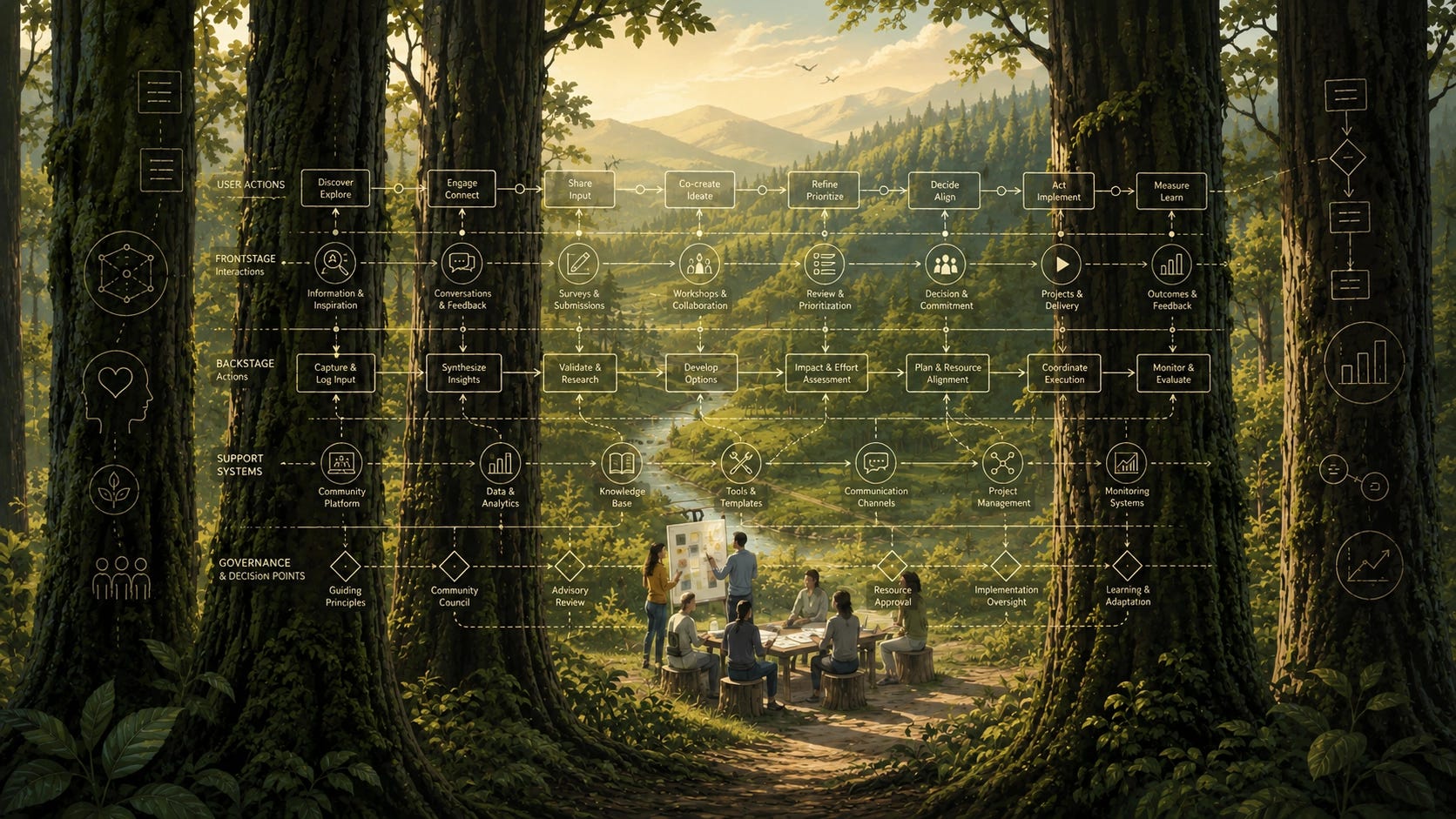
We're glad to feature this guest post from Darcie Fitzpatrick, a friend of Identient and human-centered design leader who guides teams through change.
A rather fast-growing forest
Human-centered designers are a bit like foresters.
We study patterns and changing conditions to understand the health of an ecosystem. We notice what is flourishing, what is competing for resources, and what happens when one fast-growing thing is introduced without considering everything living around it.
Hey, I’m Darcie, a human-centered design leader. Seeing the forest through the trees is what I do for organizations navigating change and transformation.
And right now, AI is growing like a weed.
Companies raced to put AI into the organization. Now we are discovering that the harder work is redesigning the organization around the humans expected to use it.
AI did not create most of the problems showing up around it. Unclear priorities, fragmented workflows, fuzzy ownership, and decisions trapped in silos were already there.
AI simply gave that struggle a growth supplement.
Where the roots were already tangled
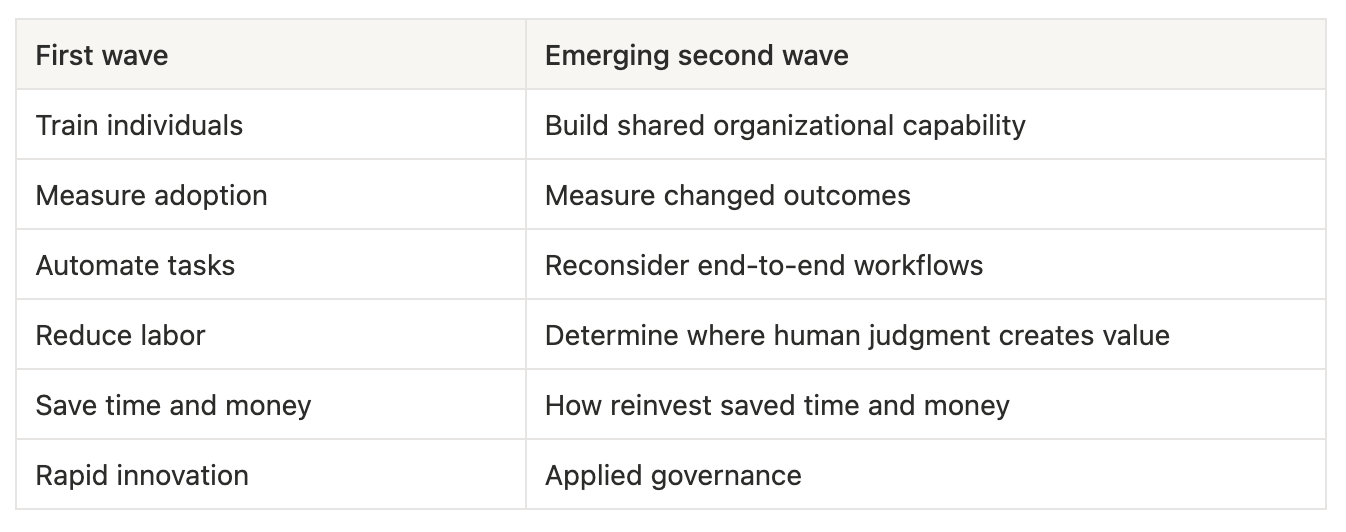
The first wave of AI transformation was a race to implement. Could a product team get AI functionality into the tool yesterday? Could an employee turn an idea into a working prototype, automate a ton of tasks, or produce more in less time?
Useful questions. Yet these are tasks that don’t live alone.
They sit inside complex workflows crossing people, systems, policies, and invisible labor. Speeding up one task can create a bottleneck elsewhere or shift unverified AI outputs downstream to someone else’s effort.
Only 11% of leaders say their organizations have reached AI reinvention, and most say AI has yet to deliver meaningful enterprise value. (McKinsey, 2026)
This first wave of AI has behaved a bit like an organizational dye test. It revealed where decisions jam, ownership fades, and the official process differs from how work actually gets done.
Trust, weak strategic clarity, limited agency, and poor workflow integration are problems that were there before. People had simply become good at working around them by being human: through relationships, informal handoffs, and office diplomacy.
AI can scale the workflow, but not the soft skills that kept it moving.
Healthy growth needs a bit of mess
Human-centered design begins with a wonderfully inconvenient truth: humans are human.
We learn by creating order from the mess of our experiences. We experiment with new possibilities, notice where they fall down, ask more questions, and iterate our understanding. Change makes sense when we stop designing around people and start exploring it with them.
I once worked on a Department of Defense project tackling a flight-scheduling problem that had persisted since the 1950s. After more than a decade of trying to solve it with technology, we started the project somewhere different: with the pilots.
“Application development for mission-critical processes, like United States Armed Forces flight scheduling, needs to start at a fundamental level by understanding and addressing the real problem.”
— Michael Walker, Project Stakeholder, Red Hat Open Innovation Labs
We spent a few months learning how work actually happened inside the squadrons. That research revealed the real problems and helped the team test ideas and build digital tools in new human-centered ways. Those practices continue today.
More recently, I facilitated a strategic workshop for 27 leaders from 20 departments at Horizon House, a senior living nonprofit with a 65-year history of serving older adults. Together, we translated organizational goals into concrete OKRs and initiatives that will help guide the organization's next chapter, including its continued growth and expansion.
The group thought independently, worked across functions, challenged one another’s ideas, and gradually prioritized more than 130 possibilities through critique and voting. As the sticky notes multiplied, so did the visibility. The shared mess made alignment happen.
AI transformation needs more of that.
Creating AI Solutions in Service of People
Listen to the people closest to the work
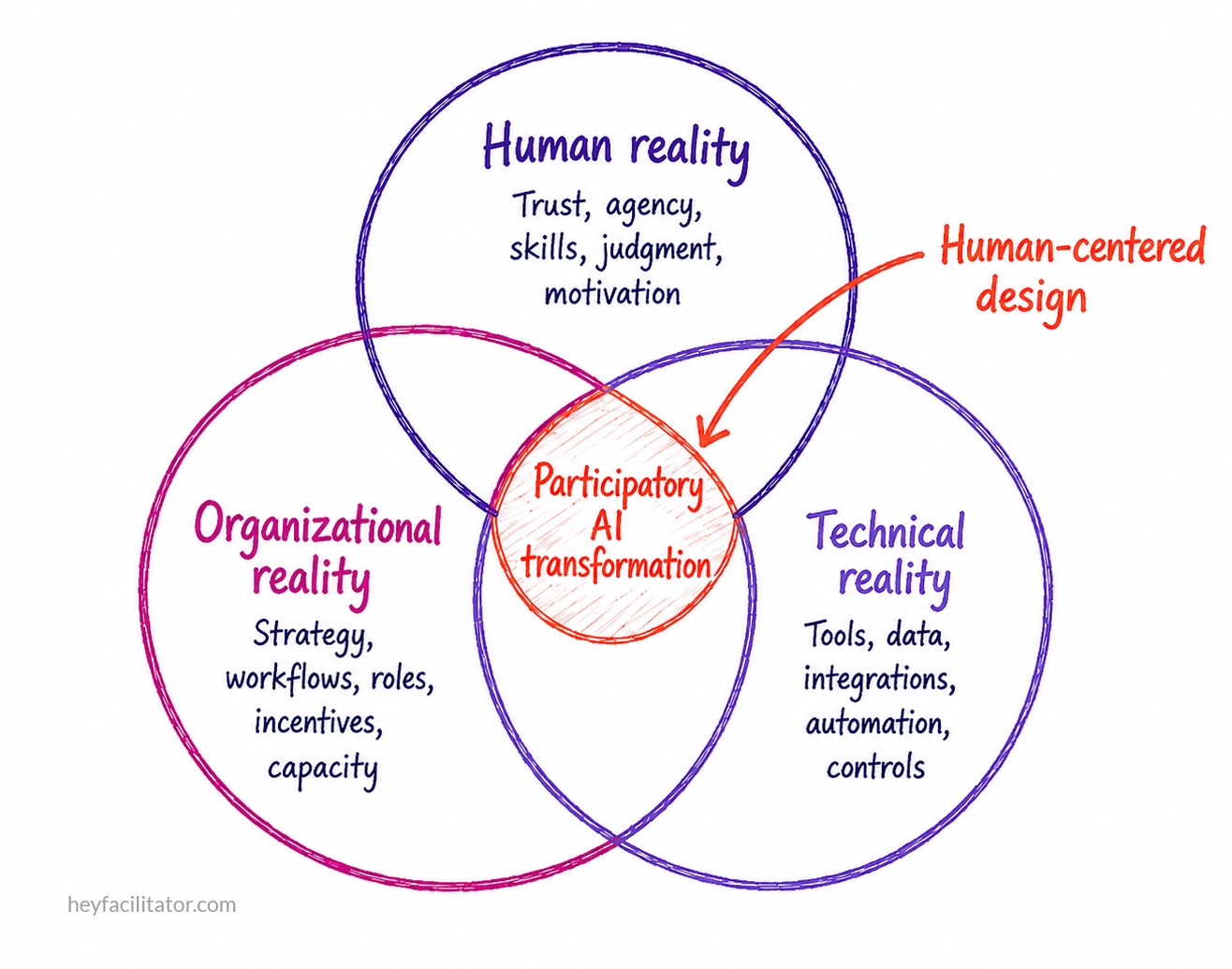
Human-centered design is known for bringing empathy to the table, my DoD story shows why that matters. Yet when it comes to AI transformation, its most valuable contribution may be meaningful participation.
Empathy helps us learn from employees and understand their lived experience. Participation goes a step further, inviting them to help shape how the future of work is designed. That can build greater agency, ownership, and commitment to the change.
Engaging employees in AI ideation is associated with a 22-point increase in measurable business impact. (BCG, 2026)
Leaders still set the direction. Participation pairs top-down ambition with the intelligence of people closest to the work. Together, they expose dependencies, challenge assumptions, and shape the workflows that make strategy real.
Pushback on AI-enabled change is often treated as reluctance when it is actually information. Someone may be protecting a hidden quality check, know that an automation depends on informal handoffs, or see a risk that has not reached the strategy deck.
Without participation, leaders lose access to that collective intelligence.
Tend to the system, not just the task
A facilitative leader creates the conditions for people to contribute insight, challenge assumptions, and make decisions together.
Teaching someone to use an AI tool leaves unanswered questions like:
What should this person stop doing?
Who remains accountable for the output?
Which work should remain intentionally human?
How will saved time be reinvested?
These are strategy, operating model, and governance questions.
Service blueprints, journey maps, process maps, and event storming make invisible work visible. They show handoffs, bottlenecks, workarounds, decision points, duplicated effort, and places where human judgment matters.
Leaders are 5.3 times more likely to report enterprise value when workflows are redesigned around AI rather than left unchanged. (McKinsey, 2026)
Once the current system is visible, teams can see where AI may remove friction, where a workflow or role must change, when a risk may become a problem, and where automation could by merely pushing work onto somebody else.
The Second Wave of AI Transformation
The shift is less about adding more AI and more about tending to the people around it.
Responsible governance requires stewardship
Governance is often treated as a hurdle before launch. Applied governance is the day-to-day practice of determining what an AI system can be.
It answers: Why must this system do what it does? Who or what is acting, with access to which data? Where does human review belong? Who owns the outcome?
Identient calls the risk created by AI activity that cannot be fully traced or explained Verification Debt. Its AI Operating Discipline offers a practical way to reduce that risk by making ownership, evidence, performance, identity, and inventory part of how the system operates.
I like this framing because it treats governance as something organizations practice. Together, human-centered design and applied governance connect the lived reality of work with the discipline needed to keep AI accountable as it scales.
Because “human in the loop” is not much of a safeguard if nobody has decided which human, in which loop, with what authority.
What happens when struggle takes root?
AI fluency without organizational redesign becomes another responsibility placed on employees. A tool may speed up one task while creating new work further down the workflow. AI may automate the visible while increasing the invisible labor of your workforce.
Human-centered design helps organizations slow down in the right place so they can move faster elsewhere. Facilitative leadership gives people a way into the work while applied governance keeps agreements alive as technology changes.
The organizations gaining lasting value from AI are looking honestly at existing problems, learning through productive mess, and redesigning the work with the people who know it best.
AI is already reshaping the landscape.
The question is whether you are planting more trees or tending the whole forest.
