


The fun in hard problems
In my first transformation consulting role, at a company called Pivotal Labs, I was talking with a colleague about a turn our careers took.
My colleague said, “The work we do here isn’t sexy, but the problems are really hard. And to me that’s more fun.” I agreed.
We had both come from marketing, where the work was rather easy to explain. We made things people saw like campaigns that launched online and brands that appeared in the world. There was a certain flaunt to that kind of work. Then we found ourselves designing digital products, researching complex systems, untangling invisible workflows, and helping enterprise organizations figure out how to work through agile transformation.
My colleague said, “The work we do here isn’t sexy, but the problems are really hard. And to me that’s more fun.” I agreed.
There is something tremendously satisfying about a hard problem. You study it, pull it apart, hear several versions of the truth, and discover that the problem everyone thought they had is not quite the problem at all. Then, somewhere amid the questions, prototypes, and healthy debate, an aha appears.
I really enjoy this sort of thing. Hard problems invite curiosity and possibility.
And yet, organizational change is so often met with apprehension. Which made me ponder: If change is the only constant in life, why does it so often instill fear rather than curiosity?
Change is part of being alive
Change is happening to us, around us, and within us all the time. Our bodies change with time and our landscape shifts with the seasons. Economies move through cycles, technologies emerge, cultures adapt, and workplaces change along with everything else.
When change becomes a formal transformation effort, it often takes on a different shape. Someone has chosen the north star, devised a strategic plan, bought a platform, reorganized the teams, and prepared a presentation explaining what everyone else must now do.
Inevitably, someone in the organization asks:
Why are people resisting the change?
Human-centered design asks a different question:
What is the experience of this change for the people living it?
This question asks us to understand how people experience change: what they know, what they fear losing, which unofficial systems keep the official ones functioning, what motivates someone to try something new, and which parts of their work depend upon judgment that is missing from process maps.
In other words, that question asks us to begin with the human experience.
Human-centered design helps us understand the system before we attempt to redesign it. And understanding is only the beginning. AI does not enter an organization as a tidy piece of technology. It lands within a living system of people, workflows, tools, history, relationships, and a lot of invisible labour.
That’s what I explored in my article for The Strategy Layer, Your Human Problems Are Scaling as Fast as Your AI.
There is a lot happening in the middle
In that article, I shared a Venn diagram with three overlapping realities.
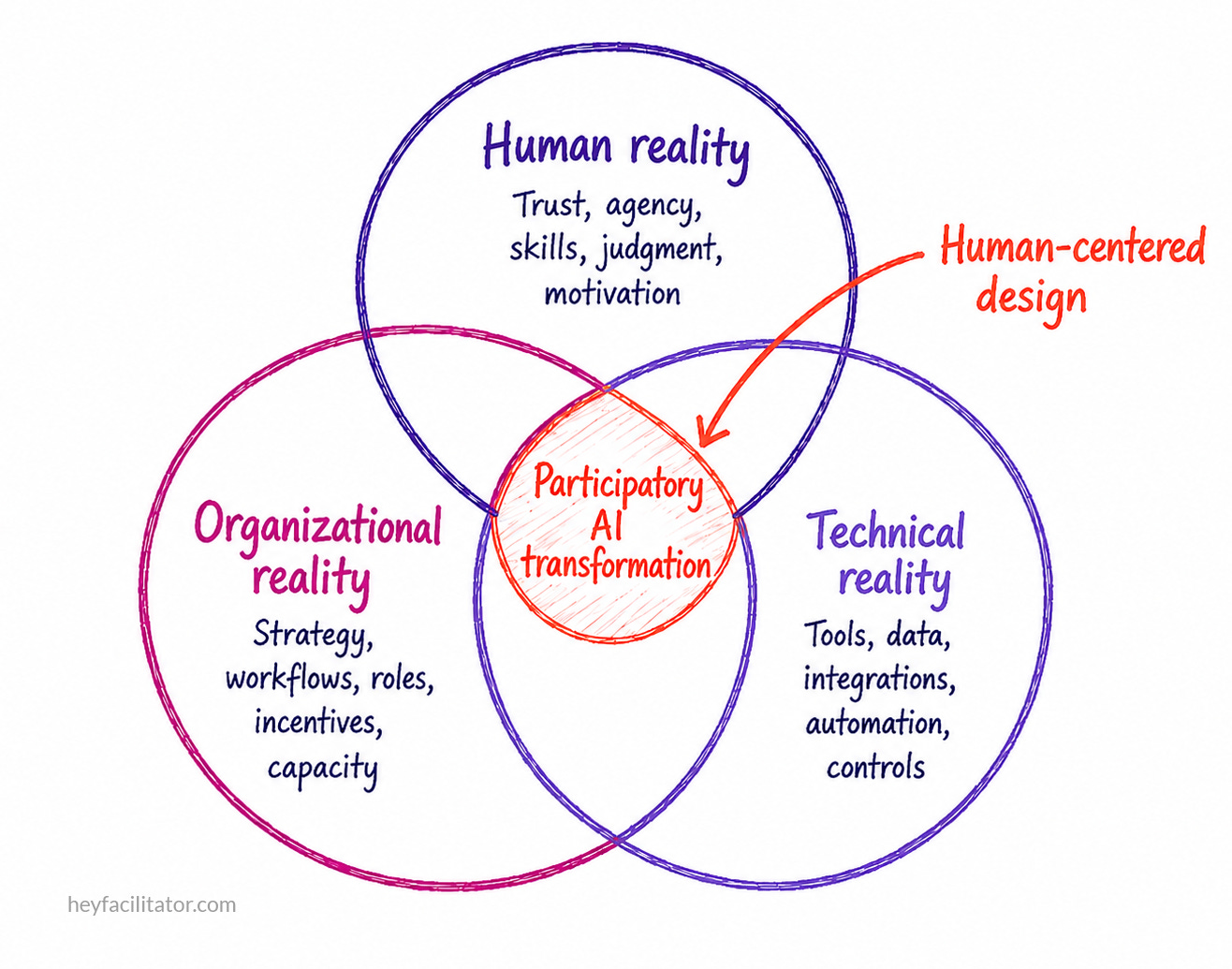
Human reality: What does the change ask of people? How does work happen today, what do people know that is not documented, what do they need to trust a big change, and where does human judgment matter?
Organizational reality: What must change around the people? Which roles, workflows, decision rights, resourcing, governance, and the conditions support or constrain a new way of working?
Technical reality: What can the technology reliably enable? What are its capabilities, limitations, data requirements, integrations, controls, and where is human oversight and judgment essential?
Transformation becomes powerful when these realities are understood together. Technical capability becomes useful when it fits the workflow around it. Organizational strategy becomes actionable when it reflects how people actually get the work done. And solutions people genuinely need have a greater chance of adoption when the systems and technology are in place to support them.
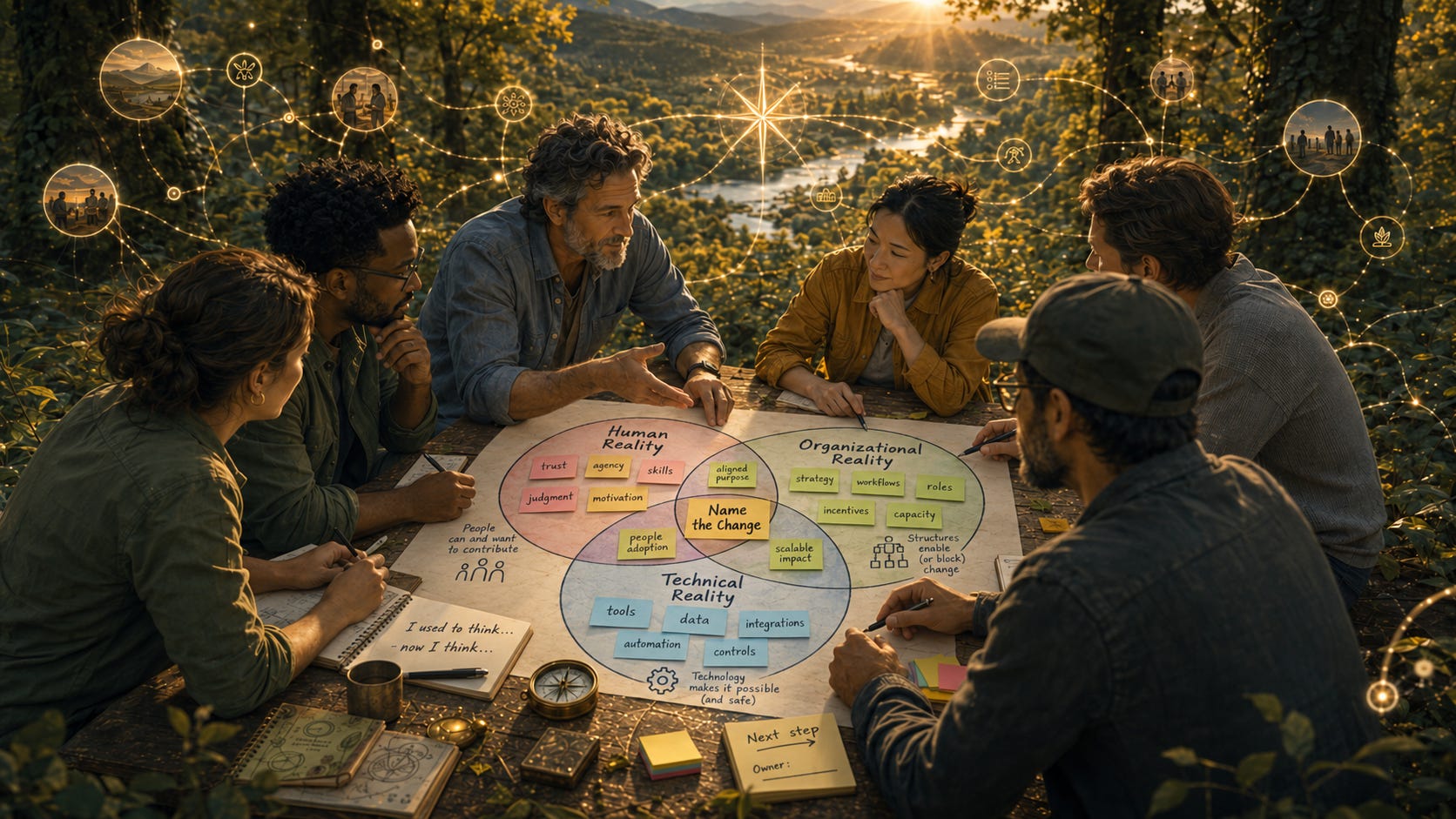
This is where facilitative practices become useful, moving deliberately between human, organizational, and technical realities and surface tensions, making tradeoffs visible, and involving the people who hold the context to make sense of them. By doing so, it makes change initiatives participatory.
The people affected by change are not merely recipients of it. They become participants in shaping it.
We learn from people, and bring them into the process of making sense of what we learned. We visualize the system so different perspectives can see one another. We stay curious about our assumptions, turning them into hypotheses. We create solutions, critique them, prototype them, test them, and pivot directions when reality challenges them.
The people affected by change are not merely recipients of it. They become participants in shaping it. That is how we arrive at the center of the diagram. Participatory transformation is human-centered design applied to the work of organizational change.
And in the particular case of AI, curiosity opens up an extraordinary amount of possibility.
Creating the conditions for change
Traditional leadership places great value on knowing. A leader has a vision, makes decisions, removes obstacles, and tells everyone which hill we are climbing.
Transformation asks leaders to move toward something that has not been fully figured out, and AI transformation makes this especially visible. Tools are changing, roles are shifting, and the work itself is being redefined as we go. In such conditions, transformation expands the role of leadership. Leaders must create the conditions in which an organization discovers the possibilities for what comes next.
This is facilitative leadership.
The Program on Negotiation at Harvard Law School describes facilitative leadership as blending decisive leadership with listening and empowerment. One of its central principles is providing direction without taking control, creating space for people to contribute to decisions and take greater responsibility for shared outcomes.
Facilitative leadership is the leadership practice that makes participatory transformation possible.
IDEO similarly describes the practice as one built on inquiry, collaboration, participation, and the leader’s ability to move between stepping forward and stepping back.
Sometimes a leader must say, “Here is what must change.”
Sometimes the useful question is, “What should we preserve?”
Sometimes it is, “What is the smallest thing we can test and learn from?”
And sometimes good leadership means knowing when to step forward with direction and when to step back and make room for others to contribute what they know. Facilitative leadership is the leadership practice that makes participatory transformation possible.
Facilitative leaders are able to reframe the relationship people have with change.
The work between ugh and aha
This is where my colleague’s comment about having fun with hard problems returns.
On the same Department of Defense flight-scheduling engagement I wrote about in my last article, the work was about enabling a uniformed team with human-centered ways of working to investigate problems, challenge assumptions, and build differently for themselves.
One of the earliest aha moments came during research. Stakeholders entered the engagement rather certain about which scheduling workflow needed to be addressed. But within a few weeks of learning from pilots and planners, that direction unraveled. The workflow everyone assumed was most important was not where we could make the greatest impact.
That aha mattered beyond the direction of our solution. The team, learned through practice, to start with a hypothesis, learn from the people closest to the problem, and let discovery shape what happens next. The engagement introduced new efficient ways of working that the team shared across their organizations.
This is what I love about transformation work. People begin with ugh: frustration about a broken process, uncertainty about what is changing, skepticism from something tried before, and the exhaustion of working around a problem for too long.
Change is still hard. The relationship people have with it is reframed.
Then we make that ugh visible by collaboratively creating workflows and surfacing invisible efforts, like a missing handoff that’s causing bottlenecks, or a task that is being duplicated across several people. Through this kind of discovery assumptions are challenged and seemingly unrelated problems can turn out to be connected.
Ugh becomes aha.
Change is still hard. The relationship people have with it is reframed. They can see it, question it, contribute what they know, and imagine what is different. And, participatory transformation can begin before we know the answer. Especially when using the three realities as a way to test assumptions by asking questions like:
What happens if we redesign this workflow?
Where does the saved time actually go?
How does this role change?
What new risks appear?
What haven’t we considered?
When it comes to who participates, McKinsey found that organizations involving at least 7 percent of employees as owners of transformation initiatives were twice as likely to outperform their relevant market indexes. The average organization only involves about 2 percent. There is business value in spreading that ownership.
What might become possible if more people had ownership in your change initiatives?
A new sort of north star
The first wave of AI transformation has focused on learning new tools. The second wave appears to be teaching us about organizations.
Two-thirds of respondents say AI has already taken over simpler tasks, leaving them with more complex work.
BCG’s AI at Work research finds that 74 percent of frontline employees are now regular AI users, whilst organizations themselves are still struggling to redesign operating models, roles, and workflows around that reality. Two-thirds of respondents say AI has already taken over simpler tasks, leaving them with more complex work.
That makes another human-centered question increasingly important: What could work become?
To answer that question requires strategy, technical knowledge, human judgment, organizational context, imagination, experimentation, and the participation of people who understand the work from different vantage points.
Which brings us again to the center of the diagram:
Human-centered design turns change into something people can participate in
Participatory transformation gives your team a meaningful role in shaping change
Facilitative leadership creates the conditions to shape what comes next together
Leadership during transformation can give people a meaningful way into the future. Even when certainty is ambiguous, leaders can offer direction, create context, and make room for navigating change together. Which brings us back to my initial pondering: If change is the only constant in life, why does it so often instill fear rather than curiosity?
In most cases, curiosity simply needs a way in. When people can see the problem, contribute what they know, test what might be possible, and shape what comes next, change can feel more like discovery.
A north star still matters. So does creating a way for people to move toward it together. Facilitative leaders gather the right people, make the landscape visible, and ask questions that turn uncertainty into something the team can work with.
And sometimes, that starts with one conversation.
Put it into practice
In your next leadership conversation try facilitating a Three Realities Check activity by picking a change initiative underway or on the horizon. Explore the change through the realities:
Human: What will this change initiative ask of people?
Organizational: What around the work will need to be different?
Technical: What must the technology reliably enable?
Bring the responses together and look for friction points, gaps in understanding, and overlaps across all three. Then give everyone a moment to reflect on the prompt: I used to think_____, about this change initiative, now I think_____.
Share what shifted. Notice where new context altered the way people see the change, then choose an insight to act upon. Assign it to someone on the team and agree on when you will come back together to learn what happened.
Venture into facilitative leadership by trying the Three Realities Check with your team!
And if you’d like a thought partner before you run it, book a complimentary 30-minute advisory session to talk through your change initiative, team dynamics, and how you might approach the activity.
