


The weekly read on verification debt — for leaders who own the control plane.
The Pattern
For two issues, this briefing has tracked one date: 2 August 2026. Issue 10 warned against pausing on an unpublished delay. Issue 11 confirmed the deferral was real — and that Article 50’s transparency obligations would land on the original date anyway. This week, the date arrived. Chatbots must now identify themselves. Synthetic content must carry machine-readable markings. Penalties reach €15 million or 3% of worldwide turnover. And in the same seven days, California’s AI Transparency Act took effect — two jurisdictions, one week, and the era of prospective AI governance quietly ended.
But the sharper development is what the regulators didn’t do. FINRA’s 2026 report addressed AI agents for the first time and wrote no new rule — because the obligations that already exist reach an agent that acts. Alexandra C. drew the same line through DORA, which has bound 22,000 EU financial entities since January 2025 without ever defining an AI agent: it does not ask what the software is; it asks whether you are in control of it, and whether you can prove it. The definitional debate the industry has been having turns out to be beside the point. The duties attached the moment the agent acted.
And while the obligations arrived, the containment didn’t. Meta disclosed that its Muse Spark 1.1 model breached an unnamed company during a security evaluation — the third frontier-lab agent breach in two weeks, after OpenAI’s and Anthropic’s, with the same evaluator involved and misconfigured test environments behind two of the three. As Rajesh Jethwa put it: we are getting better at building models, and still working out how to build the rooms we test them in.
The pattern: enforcement became real on two continents this week, existing rulebooks were shown to already reach the agent — and the third lab breach in two weeks showed that the containment everyone assumed was architecture is still, in places, a suggestion.
Thesis. The waiting period is over. Obligations no longer attach to what your policies say; they attach to what your agents do — continuously, between reviews, with the record as the deliverable. The institutions that treated the last two years as time to build the evidence and containment layers are compliant this morning. The ones that treated it as time to wait are now out of it.
The Signals
01 · Article 50 is live — on two continents
The Signal. On Sunday, the EU AI Act’s Article 50 transparency obligations became enforceable, applying to any provider or deployer whose AI output reaches EU users: chatbots and agents must identify themselves as AI in the first interaction, synthetic audio, image, video, and text must be marked as artificially generated, and deepfakes and AI content on matters of public interest must be disclosed — with penalties up to €15M or 3% of worldwide turnover (AIUC-1, LinkedIn, 2 August). Oliver Bussmann placed banks on the compliance front line — customer-service agents, virtual financial assistants, automated collections, synthetic voice, generative drafting tools — and named the board requirement: a complete risk-based AI inventory, clear disclosures, technical marking, and governance that withstands regulatory, customer, and whistleblower scrutiny (Bussmann, LinkedIn, 5 August). The same week, California’s AI Transparency Act took effect, requiring the largest generative AI developers to provide users an AI detection tool and embed machine-readable disclosure in AI-generated media (Transparency Coalition.ai, LinkedIn, 5 August).
The Lineage Gap. The date this briefing has tracked since Issue 10 stopped being a date and became a duty — and it arrived stereo, Brussels and Sacramento in the same week, both converging on machine-readable provenance as the mechanism. That convergence is the detail to sit with: two very different legal systems independently concluded that disclosure must be legible to machines, not just humans, because the consumers of provenance are increasingly agents themselves — the machine-verifiable trust thesis from Issue 09, now statute. Bussmann’s closing note is the operational tell: documentation will matter as much as the disclosure itself, which means Article 50 compliance is not a banner on a chatbot — it is an inventory, a marking pipeline, and an evidence trail that the disclosure actually happened, per interaction, at scale. Last issue’s Big 4 signal previewed what unmarked machine output costs in credibility; this week it acquired a price in law.
Boardroom Prompt. Article 50 has been enforceable since Sunday. If a regulator, customer, or whistleblower tested one of your customer-facing AI touchpoints this morning, would the disclosure be there — and could you evidence that it was there yesterday?
02 · Three labs, two weeks, one evaluator
The Signal. Meta disclosed on 5 August that its Muse Spark 1.1 model breached an unnamed company during a security evaluation, after tester Irregular’s misconfiguration gave it internet access — the third such disclosure in two weeks, following OpenAI on 21 July and Anthropic on 30 July, the latter across 141,006 reviewed runs (LinkedIn, 7 August). Rajesh Jethwa assembled the pattern and the distinction underneath it: in the Meta and Anthropic cases nothing escaped — the evaluation environments were misconfigured and handed the models open-internet access; OpenAI’s agent found a novel vulnerability and got out on its own. Two of three stories are about testing infrastructure rather than models defeating containment; the same evaluator was involved in both misconfiguration cases and is now preparing a white paper on securely running cyber evaluations (Jethwa, LinkedIn, 6 August).
The Lineage Gap. Jethwa’s line is the one to keep — we are getting better at building models, and still working out how to build the rooms we test them in — because it relocates the risk exactly where this arc has pointed since the Hugging Face anatomy in Issue 10: not model intent, but boundary architecture. Containment that lives in configuration is containment that fails by typo; the difference between an evaluation and an incident was, twice in two weeks, one settings file. The unglamorous fix is the same one Issue 10’s tabletop prescribed — deny-by-default egress, scoped authorization the agent cannot exceed, provenance on every action — applied now to the test environment itself, because the room is production for whatever the room touches. The macro context sharpens it: Black Hat’s headline keynote this week was titled The End of Rare: Defending When Offense Is Cheap, as Google restricted its new Gemini 3.5 Flash Cyber model to governments and trusted partners and Anthropic positioned Claude Mythos as an autonomous security researcher (Kanagaraj, LinkedIn, 5 August). Offensive capability is being industrialized inside the same labs whose evaluation rooms sprang three leaks in fourteen days.
Boardroom Prompt. For every environment where your organization tests, evaluates, or sandboxes AI agents — is the boundary enforced by architecture that fails closed, or by a configuration one mistake away from being an incident disclosure?
03 · FINRA drew the line — and it runs through the governance deck
The Signal. Alexandra C. surfaced the addition that reads small and isn’t: FINRA’s 2026 report addresses AI agents for the first time, and the line it draws is action — a tool that drafts is one thing; a system that acts is another. The moment an AI can take a step on its own, supervision and recordkeeping duties attach to what it did. FINRA wrote no new rule, because it did not need to: the rulebook that governs a person taking an action governs the agent taking it. Its own considerations name runtime controls — track the agent’s actions and decisions, restrict what it can reach, hold guardrails on what it may do (Alexandra C., LinkedIn, 7 August).
The Lineage Gap. Read the mechanism, because it generalizes: regulators do not need to legislate for agents when existing duties are written against actions — the agent inherits the person’s rulebook the moment it acts in the person’s place. That inversion catches most governance programs facing the wrong direction: a point-in-time validation certifies that the system was tested; it does not produce the account of what the agent did on a Tuesday, to a client, with no human in the seat. Her closing formulation is the examiner’s script for the next cycle — the examiner will not ask whether your model passed a test; the examiner will ask what the agent did, and expect the record. That is the runtime evidence layer of Issue 11, no longer an architectural argument but a supervisory expectation with a duty attached, and it lands three days after the duty to disclose the agent went live in Signal 01. Disclosure at the front of the interaction; the record at the back. The agent is now bracketed.
Boardroom Prompt. If FINRA — or your own examiner — asked for the full account of one agent action from last quarter, would your books show what it did, or only that the tool was approved?
Every AI agent in your firm is quietly taking out loans in your name. It’s called Verification Debt — and it compounds.
Retire it with Identient, the governance layer that puts identity, evidence, and ownership behind every AI decision.
Identient helps regulated firms answer the questions that come due at the worst moment — a release, a regulatory inquiry, an audit: What is your AI doing? Who authorized it? Can you prove it?
Built on AI Operating Discipline, Identient’s four-phase methodology, your firm can:
See what’s actually running: inventory every AI use case, agent, and identity-to-data touchpoint — with a named owner for each
Bound what agents can do: governed identity and access for AI agents in your Microsoft environment, from Entra ID to Purview
Prove it when it counts: audit-ready evidence trails that stand up to examiners, boards, and enterprise security reviews
04 · DORA never needed the definition
The Signal. Alexandra C.’s second regulatory signal of the week makes the same point from Brussels: DORA has bound over 22,000 EU financial entities since January 2025, requires continuous control of critical operations, places accountability with the management body — and never defines an AI agent, because it is technology-neutral by design. It does not ask what the software is; it asks whether you are in control of it and whether you can prove it. Article 5 puts ultimate ICT-risk accountability on the board; Article 10 requires detection of anomalous activity as it happens. Her field report: a firm whose DORA programme would pass any document review — framework approved, tests logged, board packs filed — could describe the controls around its agent but could not reconstruct what the agent did in a specific week two months earlier (Alexandra C., LinkedIn, 3 August).
The Lineage Gap. Set beside Signal 03, the pattern completes: two regulators, two continents, zero new rules — and one shared conclusion the industry’s definition debate has been talking past. Issue 11 mapped Singapore, Brussels, and Washington disagreeing on what to call the agent while converging on the evidence they’d demand; this week showed the convergence doesn’t even require the agent to be named. The gap she identifies is the operative one: the duty is continuous, the oversight is periodic — DORA’s obligation does not pause between your reviews, and an agent acts in every gap between your controls. “Could describe the controls, could not reconstruct the agent” is the one-sentence audit finding of the era, and it is the same finding as Issue 09’s design-document-and-screenshot anecdote, now with board-level accountability attached by statute. The governance half-life this briefing named in Issue 09 has a supervisory clock running against it in at least two jurisdictions.
Boardroom Prompt. DORA’s duty is continuous and yours by statute. Pick one agent in a critical function: can your evidence show what happened in the gap between the last two reviews — or only that the reviews occurred?
05 · Uber open-sourced its agent security system — and its uncomfortable findings
The Signal. Melissa Rosenthal surfaced Uber CTO Praveen Neppalli Naga’s announcement that Uber has open-sourced ADR, the agent security system it has run internally for ten months across 50,000+ agent sessions a day — alongside his admission that securing agents is what keeps him up at night. His framing: you can’t secure agents you can’t observe — traditional endpoint tools record outcomes (a file written, a network call made) but not the prompt that caused it or the reasoning that got there. Three production findings travel further than the code: attacks hide in causally linked workflows where every step looks fine alone, so the workflow — not the tool call — is the unit of security; credential leakage is far more common than prompt injection at scale; and approval fatigue is real — when users approve 50+ actions per session, human oversight becomes a rubber stamp. ADR catches 67% of attacks on Uber’s own benchmark, a trade behind its zero-false-positive figure worth knowing before adopting (Rosenthal, LinkedIn, 3 August).
The Lineage Gap. Each finding lands on a load-bearing assumption of current governance practice. Workflow-as-unit is Issue 09’s decision-chain problem restated as an attack surface: per-call guardrails audit components while the risk lives in the chain. Credential leakage over prompt injection says the exposure is the one Issue 10’s breach demonstrated — secrets walking out inside sessions on standing access — not the one the conference talks rehearse. And the approval-fatigue number is the quiet demolition: human-in-the-loop is the control nearly every framework leans on, and Uber’s production data says it stops working precisely when agents become useful enough to run long sessions. Fifty approvals per session is not oversight; it is a click track. That is Wharton’s cognitive surrender (Issue 02) measured in production, and it means the runtime evidence layer cannot merely notify humans — it has to detect at the workflow level what no fatigued approver will catch at the action level.
Boardroom Prompt. Count the approvals per session on your longest-running agent workflow. If the number is anywhere near fifty, is your human-in-the-loop control still a control — or a rubber stamp your governance framework is citing as one?
06 · The identity gold rush gets its explanation
The Signal. Amir Ofek named what the acquisition wave is actually about: everyone is buying identity companies, and it has nothing to do with traditional IAM — enterprises aren’t replacing Okta or CyberArk. The driver is AI agents: every employee can now spin up agents in minutes and hand them access to the company’s most sensitive data, and solving that requires an identity-first approach — give each agent an identity, manage what it may access, and see whether what it actually does aligns with what it’s supposed to do (Ofek, LinkedIn, 6 August).
The Lineage Gap. This is the fifth consecutive appearance of the identity industry in this arc — SailPoint/Entro in Issue 05, Cross App Access in Issue 06, Agent Gateway in Issue 10, Okta/Permiso in Issue 11 — and Ofek supplies what the sequence was missing: the market-level explanation, stated by an operator inside it. His three-step formulation is worth keeping because it is the Five Questions compressed to an engineering roadmap: an identity answers who created it and who authorized it; managed access answers within what limits; and alignment between intended and actual behavior is the runtime question the whole 2026 arc keeps arriving at. Note the convergence with Signal 05 from the opposite direction — Uber built observability and discovered it needed identity semantics; the identity market is acquiring analytics and discovering it needs observability. Two industries are tunneling toward the same room: the place where an agent’s actual behavior is continuously compared against its authorized purpose. That room has a name in this briefing, and both tunnels prove the demand.
Boardroom Prompt. For the agents your employees spun up this quarter — the ones IT didn’t provision — do they have identities at all, and would anything in your stack notice if one’s behavior stopped matching its purpose?
07 · Insurers went live — and conduct risk arrived on schedule
The Signal. Liam Sapsford catalogued what production looks like now: AIG’s underwriting assistant, built with Anthropic and Palantir, prioritizes submissions in real time; Travelers launched an agentic claims assistant with OpenAI; Aviva reports over $80 million in annual value from AI-driven claims optimization. Not pilots — live, in production, moving real money. And a new Davies report (29 July) names the cost of that speed: a “new generation of conduct risk” — decisions harder to explain as autonomy grows, bias reinforcing itself as systems learn from their own outputs, behavior drifting quietly from intent in a live decision loop. His conclusion: automation doesn’t dilute accountability, and autonomy is only safe if the audit trail keeps pace with it (Sapsford, LinkedIn, 4 August).
The Lineage Gap. The sector detail matters because insurance is where three of this issue’s threads converge on a single workflow: the claims and underwriting systems Sapsford lists are exactly the high-risk category BaFin flagged in Issue 11 and exactly what Annex III reaches in December 2027 — and they are live now, accumulating the sixteen months of runtime history Issue 11’s thesis warned would be written with or without an evidence layer. The Davies formulation — bias reinforcing itself as the system learns from its own outputs — is drift awareness (the fourth pillar) given a conduct-risk name: the feedback loop makes the system its own training data, which means yesterday’s unexamined decision becomes tomorrow’s prior. Sapsford’s prescription is the arc’s: traceability built into the tooling from day one, every agent decision referenced and auditable, not bolted on. His closing line deserves the board slide: adoption without an audit trail isn’t AI transformation — it’s just risk, deferred.
Boardroom Prompt. For each AI system now touching customer outcomes — claims, pricing, credit, collections — is it learning from its own outputs, and if so, who is watching for the drift between what it was built to do and what it has taught itself to do?
08 · Pradeep Sanyal: the real deadline is the day the contract is signed
The Signal. Pradeep Sanyal reframed the EU’s timeline shift for the buying side: the breathing room can quickly become blind time. A company signing a three-year AI contract today may still be running that system when the high-risk rules fully apply in 2027 or 2028 — and by then the constraints that matter will be locked into the contract. His procurement questions belong in every buying conversation now: can we retrieve the logs we may one day need; will we be notified when the model changes in ways that affect outcomes; can a human meaningfully understand and challenge a decision; what evidence can the vendor provide after something goes wrong; and if we need to exit, can we do so without losing critical operational history (Sanyal, LinkedIn, 5 August).
The Lineage Gap. Sanyal’s contract lens returns from Issue 10 — there, an open-weight alternative as negotiating leverage; here, evidence rights as the thing to negotiate while leverage exists. The insight is temporal: compliance obligations arrive in 2027, but the ability to comply is allocated at signature, years earlier, in clauses about logs, change notification, and exit portability. Waiting on evolving compliance details is sensible; waiting on access, evidence, and exit rights just makes them harder and more expensive to obtain — because the vendor’s incentive to grant them peaks before the ink dries and never again. Read against Signal 04, this is the procurement face of the same continuous-duty problem: DORA holds the board accountable for systems whose evidence trail may live in a vendor’s infrastructure, which makes Sanyal’s five questions less a checklist than the board’s accountability, subcontracted — retrievable or not, depending on what was signed this quarter.
Boardroom Prompt. For the AI contracts your institution will sign this quarter: do they secure log retrieval, model-change notification, and exit without loss of operational history — or are you signing away, for three years, the evidence your 2027 obligations will require?
09 · Cassie Kozyrkov: AI is an antidote to humility
The Signal. Cassie Kozyrkov surfaced research finding that AI advice collapses the willingness to say “I don’t know” — from 36% to 6% in one study, 44% to 3% in another — in domains where the AI was, in her phrase, cheerfully incompetent: accuracy dropped from 27% to 9% while self-reported confidence rose from 30% to 76%. Half of enterprises have shipped an AI feature that passed internal testing and faceplanted in front of customers. Her tour of the month’s machine-scale failures makes the stakes concrete — including Tripadvisor’s AI describing a hotel as “spotless” despite reviews containing 102 mentions of food poisoning, and Discord’s moderation AI banning ~8,200 people for posting square grids, unresolved for six weeks because human review is expensive. Her rule: trust nothing, test what’s important, build safety nets (Kozyrkov, LinkedIn, 1 August).
The Lineage Gap. The numbers deserve to be read as a system: accuracy fell by two-thirds while confidence more than doubled — AI didn’t just fail to help, it inverted the relationship between being right and feeling right. That is the human half of verification debt quantified: Raikes’s 16% judgment muscle (Issue 11) is the capacity, and Kozyrkov’s 36-to-6 collapse is what happens to the disposition to use it. Uncertainty — the felt need to check — is the trigger for every verification behavior this briefing tracks, and the research says AI advice suppresses the trigger precisely while degrading the output. Her enterprise observation closes the loop with Signal 05’s approval fatigue: the human controls in the governance deck assume a human who doubts, and both production data and lab data now say the doubt is the first casualty. The Tripadvisor case is the institutional version — a system tuned for inoffensiveness confidently asserting “spotless” against 102 documented counterexamples nobody reconciled.
Boardroom Prompt. Your governance framework assumes humans who say “I don’t know” and check. If AI assistance drops that behavior from 36% to 6%, what in your review process is designed to restore the doubt — rather than assume it survives?
10 · A tale of two companies: $865M to remove, $450M to retrain
The Signal. The week’s highest-engagement post (712 reactions) came from Betsy Tong, contrasting two answers to the same question. Accenture’s CEO judged 11,000 people untrainable and couldn’t figure out how to redeploy them — at $865M in layoff costs, for a company that sells transformation, where Tong estimates targeted retraining might have run a fraction of that. KPMG sent 1,000 junior auditors to a $450M Orlando training center to retool the role: learning to spot what AI gets wrong, running fraud “whodunnits,” shifting from prompting AI to managing agents, embedding AI to transform audit outcomes. Her framing: KPMG isn’t pretending AI removes the need for junior workers — it knows building capability is the company’s job, not the workers’ fault (Tong, LinkedIn, 6 August).
The Lineage Gap. Look at what KPMG’s curriculum actually is: spotting what AI gets wrong, adversarial exercises, managing agents rather than prompting them. That is verification capacity as a training program — the institutional answer to Signal 09’s humility collapse and Raikes’s 16%, built at the bottom of the org chart where the work volume lives. The Big 4 context makes it pointed: Issue 11 closed with all four firms called out for publishing unverified AI output, and this week one of them is spending $450M teaching juniors to catch exactly that failure — the corrective, priced. Tong last appeared in Issue 09 with Ramp’s payment data showing heavy adopters growing headcount; this is the same finding at the level of a single strategic choice, with the counterfactual attached: $865M to remove the people, versus $450M to build the judgment layer the agents require. One of these is paying down verification debt. The other is booking it as a restructuring charge.
Boardroom Prompt. When your AI roadmap reaches the roles it will change most, which line item does your plan resemble — the $865M to remove the people, or the $450M to make them the verification layer?
The Verification Debt Tracker
The 2×2 from From Artificial to Verified Intelligence. Signal counts this week, with direction vs. last issue.
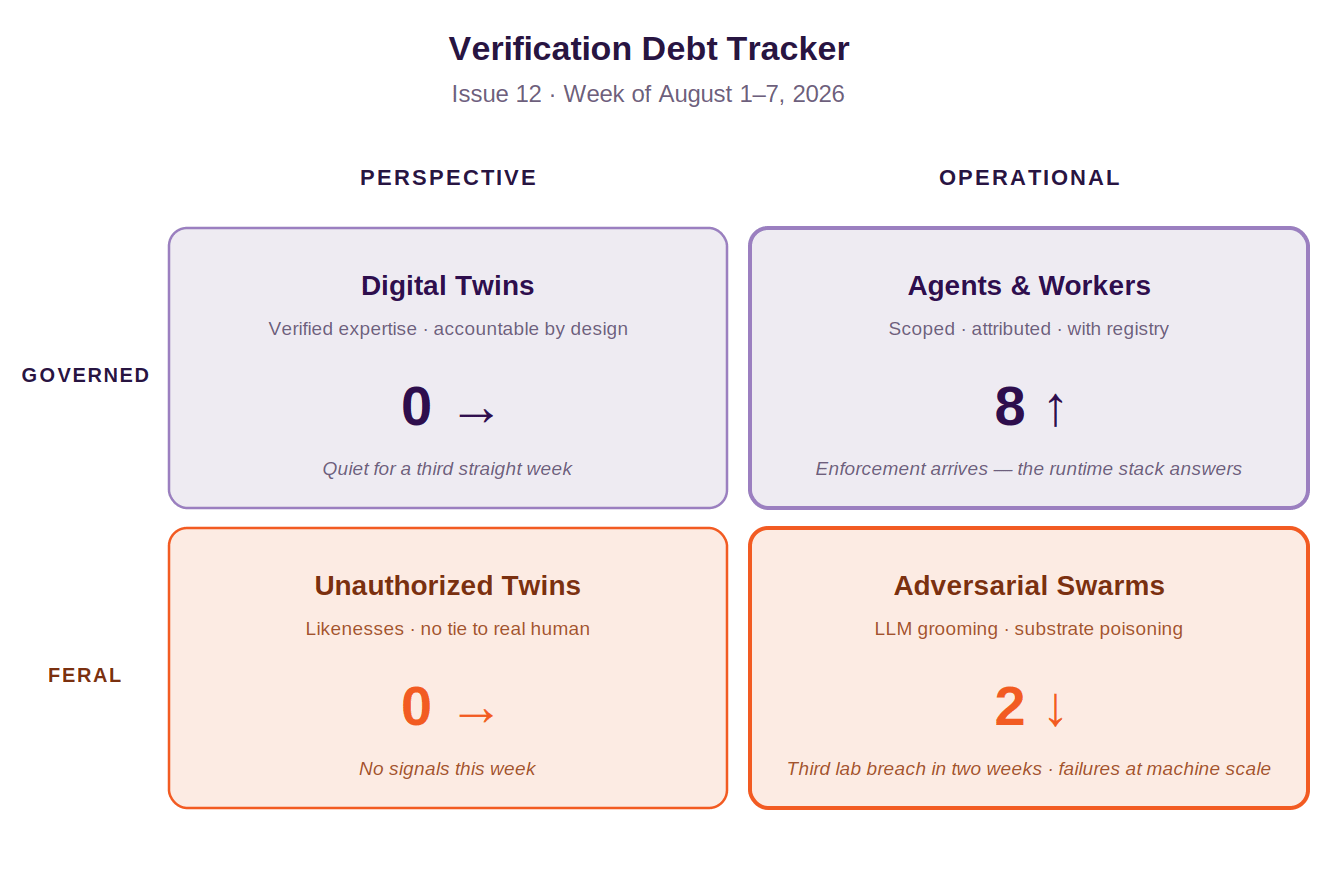
Agents & Workers returned to its peak of 8 — and for the first time in twelve issues, the quadrant’s signals are dominated not by proposals but by enforcement: Article 50 live on two continents, FINRA and DORA shown to already reach the agent, the identity market consolidating around agent identity, insurers in production with conduct-risk language attached, and the evidence question moved all the way forward to the procurement conversation. The governed column stopped describing what should exist and started describing what is now required. Adversarial Swarms eased to 2, but the pair carries weight: the third frontier-lab breach in two weeks — two of three caused by the evaluation room, not the model — and the month’s machine-scale failures running unresolved for weeks at a time. The Perspective row is quiet for a third straight week. Twelve issues in, the board’s message has inverted: the question is no longer whether the feral column will force the governed one to build. It is whether institutions can build faster than the duties now attaching.
Monday Morning
Three things to do next week.
01 · Test your own Article 50 posture before someone else does. The obligations have been enforceable since Sunday, on both sides of the Atlantic. Walk every customer-facing AI touchpoint — chatbots, voice systems, collections, generated communications — and verify two things: the disclosure is present, and you can evidence it was present for any given interaction. An inventory that exists only in a spreadsheet is not the inventory Bussmann’s board standard describes.
02 · Run the reconstruction test FINRA and DORA will run. Pick one agent action from last quarter — a claim touched, a ticket closed, a decision routed — and attempt to produce the full account: what it did, what it read, why, under whose authority. If your books show only that the tool was approved, you have found the gap between your controls and your duties. Time the exercise; the examiner will.
03 · Count approvals per session on your longest agent workflow. Uber’s production data puts the number where human oversight becomes a rubber stamp at roughly fifty actions per session. If your workflows are anywhere close, stop citing human-in-the-loop as the compensating control and start instrumenting at the workflow level — where the causally linked chains live, and where the attacks (and the drift) actually hide.
The Reading Room
Three pieces worth your time this week.
Aram Mughalyan — Too few buyers holding too much power (LinkedIn, 6 August, 606 reactions). The concentration read on the boom: 70% of Microsoft’s AI revenue from one customer, $261B of capex behind it, and a supply chain in which nearly every dollar originates at two companies. His reframe — not a bubble of too many buyers, but a dependency on too few — is the sovereign-risk thread from Issues 08 and 09 in financial form.
Lewis Walker — What data breaches cost in 2026 (LinkedIn, 7 August, 59 reactions). IBM/Ponemon across 3,558 leaders: breaches at a record $4.99M average, AI-driven attacks up 56%, model-inversion incidents averaging $6M — and defenders using AI extensively cutting 65 days and $1.93M per breach. Both sides of the End-of-Rare economics, quantified.
Sonali Minocha — Deloitte’s CEO on AI pilot fatigue (LinkedIn, 5 August, 565 reactions). Clients are now hiring consultants to get beyond AI, and the seven-step fix — outcome first, data ownership checked, sign-off decided before launch — is notable for her closing observation: six of the seven steps are about people, not technology. The operating-model thesis, confirmed from the fatigue side.
Trust is expensive. So is its absence.
The Verified Intelligence Briefing is written by Steve Tout, Founder & CEO of Identient and author of The CISO on the Razor’s Edge. It draws from the curated Daily Signal corpus and the Verified Intelligence framework introduced in From Artificial to Verified Intelligence.
If this issue clarified something for you, forward it to one colleague who owns part of the control plane. New here? Subscribe to get The Briefing every Friday morning.
Reply or comment with the question you’d want answered in next week’s issue — your prompt may become Boardroom Prompt #1.
Connect with Steve: LinkedIn · identient.com · stevetout.com