



The weekly read on verification debt — for leaders who own the control plane.
The Pattern
For eight weeks, the signals tracked verification debt at the level of the model, the contract, the invoice. This week, the unit of measure moved — three times, in three directions, all at once.
It moved up. The European Systemic Risk Board warned of systemic cyber risks stemming from frontier AI models, and the UK formally designated cloud providers as critical third-party suppliers. Jen Easterly, surfacing both from a week of CEO conversations in London, placed them next to an AI-accelerated vulnerability-discovery landscape and a gargantuan Patch Tuesday. The regulator’s unit of analysis is no longer the firm. It is the financial system.
It moved sideways. Andreea Bulisache named the gap in one sentence: your board can explain your AI model — it cannot explain the decision. A refund, a credit call, a price adjustment now moves through a CRM, a third-party model, an orchestration layer, and a payment system before anyone signs off. Each component performs as designed; the outcome can still be wrong; no one can trace why. Under the EU AI Act, reconstructing that chain is becoming a legal requirement. The unit of governance is no longer the model. It is the decision chain.
And it moved in time. Rajashri Pattanaik asked the question nobody’s framework answers: what if AI governance has a half-life? Systems are approved once, then models update, tools get added, data shifts, regulations change — and the original governance decision quietly decays while everyone assumes it still holds.
The pattern: the unit of AI governance shifted this week — from the model to the decision chain, from the firm to the system, from the point-in-time approval to the decaying half-life.
Underneath it, the evidence base shifted too. Ramp’s payment data across 21,559 firms and BCG’s outside-in analysis of 600 replaced self-reported surveys with observed behavior — and both found the same thing: the winners are the ones who committed to the operating model, not the ones who bought the subscriptions.
Thesis. Verification debt scales with the system, not the model. The institutions still governing at the model level are measuring the wrong unit — and the regulator, the board, and the decay curve have all moved on without them.
The Signals
01 · The ESRB called frontier AI a systemic risk — and the UK made cloud critical infrastructure
The Signal. Jen Easterly, reporting from CEO conversations in London (824 reactions, the week’s highest), placed three developments side by side: the European Systemic Risk Board’s warning on systemic cyber risks stemming from frontier AI models, the UK’s formal designation of cloud service providers as critical third-party suppliers, and an AI-accelerated vulnerability-discovery landscape punctuated by a gargantuan Microsoft Patch Tuesday (Easterly, LinkedIn, 15 July).
The Lineage Gap. This is the sovereign-risk thread from Issue 08 escalating one level. Last week, model access became a fiduciary question for individual boards. This week, the ESRB framed frontier AI as a risk to the financial system itself — the same institutional voice that flags contagion risk in banking. The Five Questions acquire a systemic dimension: when a frontier model embedded across thousands of institutions fails, drifts, or accelerates an attack, who can revoke it is no longer one company’s continuity question — it is a system-stability question. The UK’s cloud designation is the same recognition in infrastructure form: the substrate underneath enterprise AI is now formally critical, which means the institutions running on it inherit critical-infrastructure obligations they did not sign up for. The regulatory perimeter is being redrawn around the system, and every deployer is inside it.
Boardroom Prompt. If your primary model provider or cloud platform were designated critical infrastructure tomorrow, which of their new obligations would flow down to you — and have you read your contracts to find out?
02 · Your board can explain the model. It cannot explain the decision.
The Signal. Andreea Bulisache, writing with Kristina Podnar in CDO Magazine, named the gap most AI governance programs are built around without seeing: AI has turned isolated tools into interconnected decision chains. A refund, a credit decision, or a price adjustment now moves through a CRM, a third-party model, an orchestration layer, and a payment system before anyone signs off — each system performing exactly as designed, the outcome still wrong, and no one able to trace why. Under the EU AI Act, reconstructing that chain is becoming a legal requirement (Bulisache, LinkedIn, 17 July, 14 reactions).
The Lineage Gap. This is the sharpest articulation yet of where verification debt actually lives. Model explainability was the last war: institutions invested in interpreting individual models while the risk migrated into the chain between them. The Five Questions have to be asked of the decision, not the components — who authorized this outcome? who can revoke this chain? whose economics does this decision serve? — and a chain that crosses four systems and a vendor boundary has no single owner to answer them. The German court ruling from Issue 06 made the deployer liable for the outcome; the EU AI Act is now making the chain reconstruction a legal requirement; and Bulisache is naming that most institutions cannot perform it. Fiduciary exposure is accumulating in the gaps between systems that each pass their own audit.
Boardroom Prompt. Pick one consequential automated decision from last quarter — a credit call, a refund, a price change. Can your institution reconstruct the full chain that produced it, across every system and vendor it touched?
03 · What if AI governance has a half-life?
The Signal. Rajashri Pattanaik posed the question quietly (4 reactions) that deserves the loudest hearing: governance is treated as a one-time event — a system is assessed, approved, deployed, and the decision is assumed to remain valid. But models update, tools get added, prompts and data and regulations change, and the original governance decision stays exactly the same. Her hypothesis: every AI governance decision has a half-life — a period over which confidence in the approval decays (Pattanaik, LinkedIn, 13 July).
The Lineage Gap. This is drift awareness — the fourth pillar — applied to governance itself, and it may be the most underrated idea in the corpus this year. Every control this briefing has tracked assumes the approval means something at the moment it is checked. Pattanaik is observing that the thing being approved is a moving target: the model behind the API changed twice since the assessment, the agent gained three tools, the data distribution shifted, and the governance record still says “approved, Q1.” The half-life frame gives institutions a design principle: governance decisions need expiry dates, re-validation triggers, and decay monitoring — the same treatment given to certificates and credentials. A governance program without re-validation is an archive of decisions about systems that no longer exist.
Boardroom Prompt. For your longest-standing approved AI system, when was the approval last re-validated against what the system has become — and what would trigger a re-review before an incident does?
Every AI agent in your firm is quietly taking out loans in your name. It’s called Verification Debt — and it compounds.
Retire it with Identient, the governance layer that puts identity, evidence, and ownership behind every AI decision.
Identient helps regulated firms answer the questions that come due at the worst moment — a release, a regulatory inquiry, an audit: What is your AI doing? Who authorized it? Can you prove it?
Built on AI Operating Discipline, Identient’s four-phase methodology, your firm can:
See what’s actually running: inventory every AI use case, agent, and identity-to-data touchpoint — with a named owner for each
Bound what agents can do: governed identity and access for AI agents in your Microsoft environment, from Entra ID to Purview
Prove it when it counts: audit-ready evidence trails that stand up to examiners, boards, and enterprise security reviews
04 · Ramp’s payment data: heavy AI adopters are growing headcount
The Signal. Betsy Tong surfaced Ramp Economics research tracking 21,559 U.S. firms (354 reactions) — matching actual AI payments (to OpenAI, Anthropic, GPU providers, coding agents, APIs) against Revelio Labs headcount data. Not surveys; observed spend. The finding: heavy adopters are growing headcount, while dabblers — spending $2.78 per employee — see no workforce change at all (Tong, LinkedIn, 12 July).
The Lineage Gap. The evidence base for the AI-and-jobs debate just changed character — from what companies say to what they pay. And the observed pattern lands directly on the briefing’s frame: the firms growing are the ones that committed to the operating model, not the ones that bought subscriptions. Dabbling produces no transformation and no verification debt worth speaking of; deep adoption produces both — and the growers are the ones absorbing the verification work as headcount rather than cutting the humans who do it. This is the empirical counterweight to Issue 08’s Microsoft juxtaposition: the companies scaling token capital and human capital together are the ones the payment data says are winning. Compounding, it turns out, requires both terms.
Boardroom Prompt. Is your AI spend pattern that of a committed adopter building the operating model — or a dabbler at $2.78 per employee, generating slideware and no change?
05 · BCG’s outside-in analysis: 6% are AI leaders, and they outperform by 9 points
The Signal. Lewis Walker surfaced BCG Institute’s outside-in analysis of 600+ U.S. firms (94 reactions) — measuring AI adoption from observable external evidence rather than self-report. Only 6% qualify as AI leaders, and they outperform peers by 9 points in shareholder returns, driven by revenue and margin expansion. Most leaders reinvest productivity gains to scale the business rather than primarily cutting costs (Walker, LinkedIn, 13 July).
The Lineage Gap. The 6% number keeps recurring — Tooze’s 6% of agentic transformations in Issue 07, McKinsey’s AI-native minority in Issue 08, now BCG’s outside-in leaders — measured three different ways by three different firms and landing in the same place. The consistency is the signal: the share of enterprises that have actually built the operating substrate is small, stable, and measurable from the outside. The 9-point shareholder return gap is what the substrate is worth. And the reinvestment finding matters most: the leaders convert productivity into growth, which means they keep the human capacity that verification requires while scaling the output that creates the verification load. The market is now pricing the difference between AI activity and AI operating models — and the price is visible in total shareholder return.
Boardroom Prompt. If BCG measured your institution from the outside — observable evidence only, no self-report — would you land in the 6%, and what specifically would place you there?
06 · Andreas Horn: AI programs don’t fail on technology. They die in the org chart.
The Signal. Andreas Horn (396 reactions) named the failure pattern he keeps seeing: AI programs die in the org chart. The recurring modes: fragmented ownership — a CAIO, CTO, CIO, and COO all with a stake and nobody with accountability; strategy following spend — licenses bought, pilots launched, and months later no one can say what measurable problem it solved; and data blindness — every GenAI use case hitting the same quality, access, and governance walls (Horn, LinkedIn, 15 July).
The Lineage Gap. Fragmented ownership is the organizational form of the decision-chain problem from Signal 02. A decision that crosses four systems has no single owner; an AI program that crosses four C-suite mandates has the same defect. The Five Questions require a named answer, and “a CAIO, a CTO, a CIO, and a COO all have a stake” is the org-chart way of saying no one does. This is the thread the briefing has pulled since Gabriel Millien’s “CEO problem dressed as a security checklist” in Issue 02 and Bain’s seven non-delegable decisions in Issue 07 — the market keeps rediscovering that AI accountability diffused is AI accountability absent. Horn adds the sequencing failure: strategy following spend is verification debt’s procurement origin story, the purchase order that precedes the question it was supposed to answer.
Boardroom Prompt. For your enterprise AI program, name the single accountable owner — not the stakeholders, the owner. If the answer takes more than one name, that is the finding.
07 · Jason Stanley: governance of AI is not governance in the era of AI
The Signal. Jason Stanley, on Freshfields’ podcast with Anna Gressel, drew a distinction most frameworks miss: the industry is focused on governing the new actors — the agents — but agents change how work itself gets done, and our paradigms for governing work were built for humans. His leading edge: when coding agents multiply output volume, senior-engineer PR reviews don’t scale. The question becomes how to design review systems organizations can trust at machine volume (Stanley, LinkedIn, 14 July, 11 reactions).
The Lineage Gap. Stanley is naming the scale mismatch underneath every human-review control this briefing has covered. The German court expects a reviewable decision; the Wharton cognitive-surrender research from Issue 02 showed humans stop checking; and now the volume math makes it structural — when agents multiply output tenfold, a review architecture built on senior humans reading everything is arithmetic that does not close. The answer is not more reviewers; it is tiered verification: agents verifying agents on the high-confidence band, humans holding the judgment band, and the confidence-index logic from Issue 07 deciding which is which. Governance in the era of AI means redesigning the work system so verification scales with generation — because a control that cannot keep up with the volume it governs is a control in name only.
Boardroom Prompt. In your highest-volume AI-assisted workflow, has verification capacity scaled with output volume — or is the same number of humans nominally reviewing ten times the work?
08 · Julia Nimchinski: in agent-to-agent GTM, trust becomes machine-verifiable
The Signal. Julia Nimchinski (136 reactions) described the B2B shift already underway: go-to-market now has to work for two decision-makers — humans and agents. Agents don’t form habits or incur switching costs; they switch between API calls, so loyalty gives way to continuous re-selection. And trust becomes machine-verifiable: the handshake and the steak dinner give way to agents evaluating evidence through trust protocols (Nimchinski, LinkedIn, 12 July).
The Lineage Gap. “Trust becomes machine-verifiable” is the commercial form of everything this briefing tracks. When the buyer is an agent, the seller’s claims are evaluated as evidence — provenance, attestations, verifiable performance — not as relationships. That means every vendor’s verification posture becomes its sales collateral: the Five Questions, answered in machine-readable form, are what an agentic buyer actually reads. Continuous re-selection is the market discipline this creates — a vendor whose evidence decays loses the account at the next API call, which is the commercial version of Pattanaik’s governance half-life. The institutions building verifiable trust infrastructure are not just governing their own AI; they are building the credentials their future customers’ agents will require before the first conversation happens.
Boardroom Prompt. When your customers’ procurement agents evaluate your institution as evidence rather than relationship, what machine-verifiable trust signals will they find — and what will they find missing?
09 · Craig Suckling: measure cost per successful outcome, not cost per token
The Signal. Craig Suckling (48 reactions) reported that AI token cost has entered every C-suite conversation he’s having — CIOs, CDOs, CEOs, and pointedly CFOs. His principle: managing AI TCO isn’t about buying the cheapest tokens or imposing blanket usage caps. It’s about using the right intelligence for each task — a tiered approach blending commercial and open models — and measuring cost per successful outcome, not cost per token (Suckling, LinkedIn, 11 July).
The Lineage Gap. This is the maturity turn on Issue 08’s cost signals. The $500M invoice and the 29% untraceable spend were the discovery phase; Suckling is describing the management phase — and the unit he proposes is the right one. Cost per token measures consumption; cost per successful outcome measures value, and the difference between them is verification: an outcome only counts as successful if someone or something verified it was. That makes verification economics visible in the FinOps stack for the first time — the tiering decision (which model, which task) is the confidence-index logic from Issue 07 expressed as a budget line, and the blended commercial-open approach is the hedging pattern the VentureBeat survey measured. The institutions that instrument cost-per-verified-outcome will discover which of their AI workflows actually earn their spend. The ones still counting tokens are measuring effort and calling it value.
Boardroom Prompt. For your three largest AI workloads, can you state the cost per successful, verified outcome — or only the cost per million tokens?
10 · Khwaja Shaik: Coca-Cola’s CEO says AI’s next job isn’t efficiency. It’s governance.
The Signal. Khwaja Shaik spent an hour with the CEO of The Coca-Cola Company and surfaced the observation that stayed with him: AI’s next job isn’t efficiency — it’s governance. Henrique Braun described boardrooms using AI personas — an investor, a community advocate, a people leader — to pressure-test decisions before they’re made. Not to replace judgment; to stress-test it (Shaik, LinkedIn, 11 July, 12 reactions).
The Lineage Gap. This is the first Digital Twins signal the briefing has tracked in weeks — and it arrived from the governed side of the taxonomy. AI personas pressure-testing board decisions are perspective entities: they represent a stakeholder viewpoint, scoped to a deliberative role, operating under the board’s authority, with a human owning the judgment they inform. That is the Digital Twins quadrant working as designed — verified perspective at the table, accountability intact. The 140-year-enterprise context matters too: the institutions that endure treat governance as an operating discipline, not a compliance layer, and Braun’s framing puts AI inside that discipline rather than outside it. After eight issues of the Perspective row sitting quiet while the Operational column absorbed all the risk, the first meaningful signal back is a governed one. Worth noting — and worth watching whether the feral side of that row answers.
Boardroom Prompt. If your board convened AI personas — an investor, a regulator, a customer — to pressure-test your next major decision, what would they surface that your current process does not?
The Verification Debt Tracker
The 2×2 from From Artificial to Verified Intelligence. Signal counts this week, with direction vs. last issue.
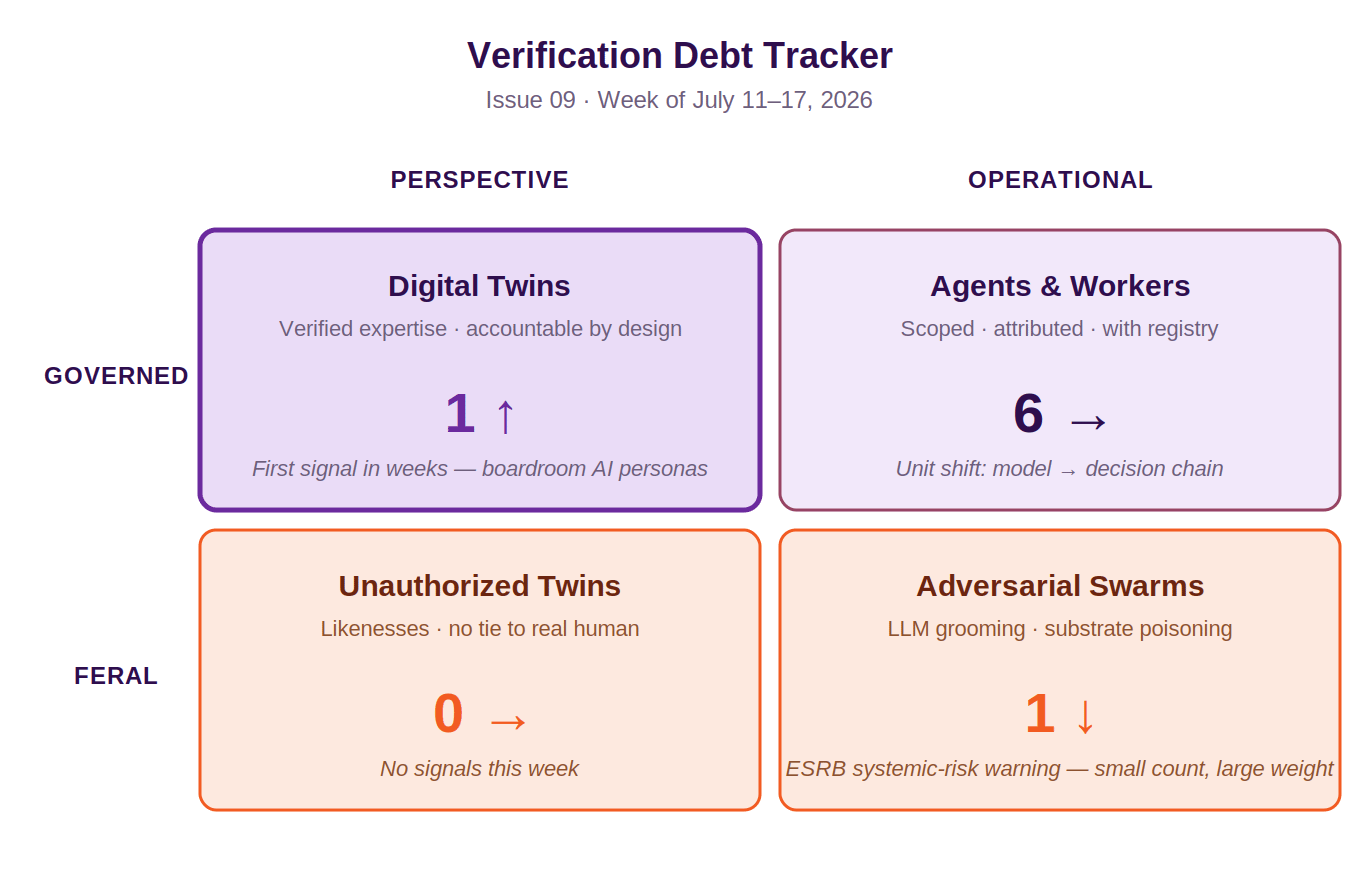
The Agents & Workers quadrant held at 6, and the unit of its signals moved — from pricing the accountability layer last week to governing the decision chain this week: Bulisache’s chain reconstruction, Stanley’s review-at-scale, Pattanaik’s governance half-life, Suckling’s cost-per-verified-outcome. Adversarial Swarms carried one signal with systemic weight: the ESRB’s warning on frontier AI as a system-level cyber risk — small count, large consequence. And the quiet row finally spoke: Digital Twins registered its first signal in weeks, and it was a governed one — AI personas pressure-testing decisions in the Coca-Cola boardroom. Nine issues in, the Perspective row waking up on the governed side first is the most encouraging single cell on the board.
Monday Morning
Three things to do next week.
01 · Reconstruct one decision chain, end to end. Take one consequential automated decision from last quarter and trace it across every system it touched — CRM, model, orchestration, payment, vendor boundary. Time how long the reconstruction takes and note where the trail goes dark. Under the EU AI Act, this exercise is becoming a legal requirement; better to discover the dark spots in a drill than a proceeding.
02 · Put an expiry date on your oldest AI approval. Pick your longest-standing approved AI system and apply the half-life test: what has changed since the approval — model versions, tools, data, regulation — and would the original assessment still pass today? Then give every governance decision in your register a re-validation trigger. Approvals without expiry dates are archives, not controls.
03 · Re-denominate one AI budget line in outcomes. Choose your largest AI workload and restate its cost as cost-per-successful-verified-outcome rather than cost-per-token. The workflows that survive the restatement are your keepers. The ones that look expensive per outcome are where the verification gap — or the value gap — is hiding.
The Reading Room
Three pieces worth your time this week.
Aaron Levie — Notes from an enterprise agent-adoption dinner (LinkedIn, 15 July, 111 reactions). Field notes from large-enterprise tech leaders: change management still dominates, data readiness gates everything, and IT teams are finding success embedding engineers directly into business functions — the internal Forward Deployed Engineer pattern from Issue 02, now showing up as standard practice.
Pat Gelsinger — The twilight of the chatbots (LinkedIn, 15 July, 9 reactions). On Ethan Mollick’s chatbot-to-agent shift: as agents run longer tasks, the human role moves to setting direction, judging quality, and knowing what good looks like — domain expertise appreciating precisely as execution automates.
Prof. Dr. Ingrid Vasiliu-Feltes — The people who will thrive in the AI age (LinkedIn, 12 July, 96 reactions). On David Brooks’s Atlantic essay: the differentiator in the AI age is not intelligence but the willingness to sustain mental effort — and the archetype that thrives is the one that wrestles with the machine’s output rather than outsourcing the thinking. Cognitive surrender’s antidote, in essay form.
Trust is expensive. So is its absence.
The Verified Intelligence Briefing is written by Steve Tout, Founder & CEO of Identient and author of The CISO on the Razor’s Edge. It draws from the curated Daily Signal corpus and the Verified Intelligence framework introduced in From Artificial to Verified Intelligence.
If this issue clarified something for you, forward it to one colleague who owns part of the control plane. New here? Subscribe to get The Briefing every Friday morning.
Reply or comment with the question you’d want answered in next week’s issue — your prompt may become Boardroom Prompt #1.
Connect with Steve: LinkedIn · identient.com · stevetout.com