



The weekly read on verification debt — for leaders who own the control plane.
The Pattern
Two numbers arrived this week, measured by different people, in different ways, and landed on the same figure.
A large portfolio company examined 60,000 agents across its holdings and found roughly 2% drive most of the actual business impact. Two days later, Lexi Reese reported that 2% of companies can tie AI use to an increase in revenue per head or profits — with OpenAI’s own enterprise research finding no statistically significant correlation between heavier usage and revenue per employee. Sixty thousand agents, one number. Thousands of companies, the same number.
Set that against what the same seven days priced. Anthropic booked $11.5 billion last quarter; OpenAI runs near $40 billion annualized. Ramp and a16z data show the top 1% of firms spending $7,500 per employee per month on AI, with no ceiling in sight. NVIDIA trimmed a proposed backstop for an Ohio data center from $250 billion to under $120 billion — and the Wall Street Journal’s larger finding is that the AI race is increasingly financed through trillions in off-balance-sheet commitments. Meanwhile EY’s numbers show what happens when a model stops answering and starts acting: a $0.04 interaction becomes a $1.20 agentic workflow. Same task, thirty times the cost.
And the people paid to check the direction of travel are leaving. Alexandra C. counted them: six safety leaders, two labs, eighteen months — most recently Anthropic’s head of safeguards research, who left a letter saying the world is in peril. The mechanism proposed to replace them has its own problem: the FRONTIER Act’s independent verification organizations would be chosen and paid by the developers they certify, which is the credit-rating agency structure that failed in 2008.
The pattern: the week priced AI’s future in trillions and located its realized value in 2% — while the people and mechanisms paid to verify either number thinned out.
Thesis. Verification debt has taken a market form. Spending commitments are contractual, forward-looking, and enormous; evidence of value is scarce, backward-looking, and concentrated in a fraction of deployments — and the gap between them is currently underwritten by nobody. The institutions that can name which 2% of their agents actually remove a constraint are managing a portfolio. The rest are financing one.
The Signals
01 · Six safety leaders. Two labs. Eighteen months.
The Signal. Alexandra C. counted the departures the industry has been absorbing one at a time: Anthropic’s head of safeguards research, Mrinank Sharma, has resigned, leaving behind a letter saying the world is in peril. At OpenAI, the head of the Safety Systems team has gone, the Preparedness team has been folded into research, the two co-leads of Superalignment were gone more than a year ago with the team dissolved behind them, and the chief futurist has left after nearly nine years. Her tally: six safety leaders, two labs, eighteen months — the people paid to slow things down being replaced by the schedule. The question a risk committee put to her last month is the one she could not comfortably answer: if the model builders cannot keep their own safety leaders, what is being relied upon when a board signs off on a third-party model? (Alexandra C., LinkedIn, 20 August).
The Lineage Gap. Her reframe of the race metaphor is the part worth carrying into a board meeting: a race has a finish line, and this one does not — what ships cannot be recalled, and it is a capability that acts on its own, in production, in the gaps between the audits meant to govern it. That sentence is the briefing’s thirteen-issue thesis stated from the supply side. The deployer-side consequence is the one boards keep deferring: third-party model risk has been managed, in most institutions, as an assessment of the vendor’s safety posture at a point in time — and the posture being assessed is staffed by people who are leaving. This is Issue 09’s governance half-life applied to the vendor’s own control environment: controls signed off in May say nothing about what an agent did in June, and an assurance premised on a counterparty’s safety team says less every quarter that team turns over. Her closing question is the one to answer before the next model approval: are you governing the behavior of these systems, or trusting that someone else still is?
Boardroom Prompt. For every third-party model your institution has approved, what portion of your assurance rests on the vendor’s internal safety function — and what would you still be able to evidence about that model’s behavior if the function did not exist?
02 · The plan to police frontier AI has a 2008 problem
The Signal. Alexandra C.’s second signal takes apart the structure of the proposed fix. The FRONTIER Act and the state bills behind it would license private independent verification organizations — IVOs — to certify that frontier AI developers manage their risks. The developer picks the IVO. The developer pays the IVO. Her historical parallel is exact: credit rating agencies were paid by the issuers whose securities they graded, issuers shopped for the rating they wanted, agencies that graded hard lost business to agencies that graded soft, and the official inquiry put the agencies at the center of the crisis. Competition, the feature meant to guarantee rigor, becomes the channel that competes rigor away. Her alternative: a verifier that pays for being wrong. An insurer carrying the developer’s liability loses its own capital when the risk it cleared arrives — it cannot be shopped into leniency, because leniency shows up as claims, and its verdict is not a certificate signed once but a price, repriced for as long as the cover runs (Alexandra C., LinkedIn, 19 August).
The Lineage Gap. Read Signals 01 and 02 as one argument and the week’s governance question sharpens: the internal verifiers are leaving, and the external mechanism being drafted to replace them is structurally incentivized to go easy. What makes the insurance frame worth a board’s attention is not the policy debate but the design principle underneath it — she names the distinction this briefing has circled since Issue 09: a certificate that ages the moment it is signed, versus capital that stays exposed at runtime. That is the point-in-time-versus-continuous problem expressed in the language of who bears loss, and it generalizes past frontier policy directly into enterprise procurement. Every AI attestation an institution accepts today is a certificate; the question of who is exposed when it turns out to be wrong is almost never asked in the same conversation. Underwriters have kept dangerous industries honest for a century by answering it — not because they are more rigorous, but because they are on the hook.
Boardroom Prompt. For every AI assurance your institution relies on, who bears the loss if it is wrong — the party that issued it, the vendor that paid for it, or you? If the answer is you, what makes the certificate an assurance rather than a transfer of confidence?
03 · 60,000 agents, and 2% that matter
The Signal. Dr. Irina Raicu surfaced the finding a large portfolio company reached by examining 60,000 agents across its holdings: roughly 2% drive most of the actual business impact — a ratio she says her own rollout across a 2,000-person support organization was not far from. Which changes the question from how do we build more agents to which of the ones we already have are the 2%. Her test is the disappearance test: ask the team that relies on an agent what actually breaks if it vanished overnight — not whether they would miss it. Most answers are survivable (”I’d spend forty extra minutes on case summaries”). A few land differently: one system connecting agents to senior experts and full case history meant the hardest problems stopped queuing behind a handful of people — remove it and the bottleneck comes back. Her rule: if removing the agent costs effort, it’s productivity; if removing it brings a constraint back, it’s value. Her warning about reporting: hours saved and constraints removed look identical on a dashboard, which is exactly how the high-value ones get lost in the noise (Raicu, LinkedIn, 17 August).
The Lineage Gap. The disappearance test is the cleanest verification instrument this briefing has encountered, and it works because it is counterfactual rather than declarative — it cannot be satisfied by a narrative, which is precisely the failure Issue 13 documented in fluent artifacts. Note what it shares with Bradd Busick’s line-item test from last issue: both refuse the self-reported claim and demand an observable change. And her dashboard warning is a governance finding, not a reporting one. When productivity agents and constraint-removing agents are aggregated into a single adoption metric, the institution loses the ability to fund the second category deliberately — which is the measurement version of the same error BCG named as distributed de-skilling, where the dashboard reads healthy while the substance thins. Her sequencing is the actionable part: the 2% aren’t found by building more, they’re found by testing what you already have.
Boardroom Prompt. Run the disappearance test on your ten most-used agents this month. For each, does removal cost effort or restore a constraint — and does your current reporting let anyone tell the difference?
Every AI agent in your firm is quietly taking out loans in your name. It’s called Verification Debt — and it compounds.
Retire it with Identient, the governance layer that puts identity, evidence, and ownership behind every AI decision.
Identient helps regulated firms answer the questions that come due at the worst moment — a release, a regulatory inquiry, an audit: What is your AI doing? Who authorized it? Can you prove it?
Built on AI Operating Discipline, Identient’s four-phase methodology, your firm can:
See what’s actually running: inventory every AI use case, agent, and identity-to-data touchpoint — with a named owner for each
Bound what agents can do: governed identity and access for AI agents in your Microsoft environment, from Entra ID to Purview
Prove it when it counts: audit-ready evidence trails that stand up to examiners, boards, and enterprise security reviews
04 · Lexi Reese: usage is not value, and the missing layer is the work itself
The Signal. Lexi Reese reported the same 2% from the other end of the telescope: in her firm’s research, 2% of companies can tie AI use to an increase in revenue per head or profits — and OpenAI’s latest enterprise research found heavier AI usage showed no statistically significant correlation with revenue per employee. Her read is not that AI isn’t working but that the wrong thing is being measured. Seats, messages, tokens, and active users tell you AI is being used, not that useful work got done. Task productivity is not company productivity: saving thirty minutes creates nothing if the employee gets thirty more minutes of meetings. And the missing layer is the work itself — the enormous middle between “people are using AI” and “did revenue per employee increase,” which asks what work AI took on, how much, at what cost, and what changed as a result. Her framing of the moment: enterprise AI is entering its management phase, where leaders must manage the chain from AI activity → work → capacity → cost → business outcome. A token tells you a model ran; it doesn’t tell you whether the business got better (Reese, LinkedIn, 18 August).
The Lineage Gap. Two independent 2% findings in one week is the motif this briefing should now track the way it tracked the 6%: Raicu’s 2% of agents and Reese’s 2% of companies are the same scarcity measured at different altitudes — the fraction of deployments where value is demonstrable rather than asserted. Her activity → work → capacity → cost → outcome chain is Vitalii S.’s verification chain from Issue 13 rewritten for the CFO, and it lands on the same missing link both times: the step where an outcome is verified before it is counted. The reason this matters more than a measurement quibble is her second point — a faster task only matters if the surrounding workflow changes too. That makes the absent middle a design gap, not a reporting gap: the value was never captured because the work was never redesigned, and the dashboard could not tell anyone, because the dashboard was counting tokens. Note the through-line to Issue 13’s line-item test: three separate practitioners arrived this month at the same instruction — stop counting the activity, name the thing that changed.
Boardroom Prompt. For your largest AI deployment, can your institution describe the middle — what work the AI took on, how much, at what cost, and what changed as a result? If the reporting jumps from usage straight to financials, the middle is where your value went missing.
05 · MIT’s 95%, and what the 5% do differently
The Signal. The week’s highest-engagement post (234 reactions) came from Wouter Born, translating MIT’s finding for finance leaders: 95% of AI projects don’t deliver ROI — nineteen failures for every success — because most companies stop at pilots, building AI that works in a demo and breaks in the complexity of month-end closes, messy ERP data, and shifting KPI definitions. His diagnosis is system design: CFOs understand controls, testing, and audits, yet many treat AI like magic — one query in, perfect answer out. What the 5% do differently is build loops: AI generates, AI checks, AI tests, and humans sign off — the same rigor that governs releasing financials. And finance is where AI breaks fastest, because generative AI is non-deterministic while forecasts, reconciliations, and board packs demand repeatability. Close is fine in marketing; in finance, close costs trust (Born, LinkedIn, 17 August).
The Lineage Gap. The 95% figure has circulated for a year, most recently through Tony Fadell’s AI-wishing signal in Issue 13; what Born adds is the mechanism separating the two populations, and it is a verification architecture stated in CFO language. AI generates, AI checks, AI tests, humans sign off is tiered verification — the answer Jason Stanley reached in Issue 09 when volume made human review arithmetic that does not close, arrived at independently from the controls side. His “treat it like you treat financial controls” is not a metaphor: financial controls are the one governance system enterprises already run continuously, with segregation of duties, independent review, and evidence retained for someone who does not trust you. That is Johnny Watson’s construction from Issue 13, already installed in every finance function on earth. The institutions asking what an AI control framework should look like are, in many cases, standing next to a working one. The non-determinism point is the constraint that makes it mandatory rather than advisable — a process that can return a different answer each time cannot be assured by testing it once.
Boardroom Prompt. Your finance function would never release a statement without independent review and retained evidence. Which of those two controls exists for the AI systems now touching your close, your forecast, or your board pack?
06 · A $0.04 interaction becomes a $1.20 workflow
The Signal. Barbara Cresti mapped the economics that change when AI moves from answering to acting, using EY’s example: a $0.04 AI customer interaction becomes a $1.20 agentic workflow once planning, tools, and sub-agents enter the loop. Same task, thirty times the cost. Within one workflow, a single agent can consume compute like software, perform work previously done by an employee, trigger risk and compliance controls, and operate inside a product sold to customers — so costs fragment across the organization, with IT, Finance, HR, Risk, and Product each owning a different piece. EY identifies seven cost categories extending well beyond tokens, licenses, and infrastructure into governance, organizational change, and failure recovery; BCG adds that the same capability shifts between CapEx, OpEx, and COGS depending on where it creates value, making model choice a commercial decision with direct margin impact. The responses are forming: EY reports model routing, training, and governance cut its token consumption 60%, and proposes a Head of Agent Economics owning cost, value, spending controls, and decisions to scale, redesign, or retire agents — while the Linux Foundation announced a Tokenomics Foundation, backed by JPMorganChase, IBM, Microsoft, Oracle, SAP, ServiceNow, and Accenture, to develop common standards for measuring AI cost and value. Her framing of the emerging unit: for SaaS, cost per seat; for labour, cost per FTE; for AI, cost per outcome produced (Cresti, LinkedIn, 17 August).
The Lineage Gap. Cost-per-verified-outcome entered this briefing in Issue 09 as one practitioner’s principle; this week it acquired a job title and a standards body. That progression — principle, then role, then consortium — is how a discipline forms, and the membership list is the tell: when JPMorgan and four enterprise software vendors fund common measurement standards, the measurement problem has been conceded as structural rather than local. The 30x figure is the number to sit with alongside Signal 03’s 2%: agentic workflows cost an order of magnitude more than the interactions they replace, and only a fraction of deployed agents remove a constraint — which means the portfolio question is now unavoidable arithmetic rather than governance philosophy. And note her cost taxonomy includes governance and failure recovery as line items. Verification has historically been argued for as prudence; EY has put it in the cost model, where it competes for budget on its own terms. The seven-category fragmentation also explains why nobody owns the number today: an agent’s cost crosses five functions, and a cost that crosses five owners has none.
Boardroom Prompt. Who in your organization owns the total cost of an agent — across compute, licenses, governance, change, and failure recovery — and can they state the cost per outcome produced for your top three agentic workflows?
07 · The AI balance-sheet blind spot
The Signal. Khwaja Shaik flagged the Wall Street Journal’s analysis of Big Tech’s AI investments and the shift it implies for directors: the AI race isn’t only being financed through capital expenditure but increasingly through trillions of dollars in off-balance-sheet commitments — moving the board question from how much are we spending on AI to what future obligations are we creating in pursuit of AI leadership. He proposes evaluating AI investment across three dimensions: return on capital, capacity risk (locking into assumptions about demand, model architectures, and compute that may change faster than expected), and financial transparency (whether directors and investors see both on- and off-balance-sheet exposure). His historical frame — railroads, telecommunications, cloud, now AI — is that markets often overbuild infrastructure before demand materializes (Shaik, LinkedIn, 17 August). Earlier in the week he read NVIDIA’s reduction of its proposed backstop for OpenAI’s Ohio data center from $250 billion to under $120 billion not as weakening demand but as market maturation — compute becoming a financial asset class, AI infrastructure becoming a board-level fiduciary decision (Shaik, 15 August).
The Lineage Gap. Verification debt began this arc as a governance liability; this signal is the week it appears as a financing structure. Commitments made today against demand assumed tomorrow are, definitionally, unverified positions — and his capacity-risk dimension names the specific fragility: the assumptions being locked in concern model architectures and compute requirements that this briefing has watched change materially every quarter for fourteen issues. Read against Signal 04, the asymmetry is stark and it is the issue’s thesis in two numbers: obligations are contractual, forward, and measured in trillions; realized value is demonstrable in 2% of companies and measured after the fact. His question — are we pursuing an AI strategy, or have we quietly committed to an AI financing strategy? — is the fiduciary form of the same gap. And the transparency dimension is where this becomes a governance signal rather than a market one: a board cannot oversee exposure it cannot see, and off-balance-sheet is a technical term for exposure that does not appear where directors are trained to look.
Boardroom Prompt. Can your board see your institution’s full AI exposure — on-balance-sheet spend and off-balance-sheet commitments together — and does anyone own the demand assumptions those commitments were underwritten against?
08 · Elizabeth Koumpan: the agent doesn’t decide, the rails do
The Signal. Elizabeth Koumpan, with Vimal D., published a paper in the AHFE IHIET 2026 proceedings arguing that what makes agentic AI safe enough to deploy in enterprise operations — touching ERP, payroll, reconciliation runs, financial close — is not better prompts but architecture: governance is not a feature added to an agentic system, it is the foundation built before the agent touches anything. She calls them rails, deliberately: a train moves fast and reliably and stays exactly where the track tells it to. In practice: just-in-time, just-enough-access permissions; agent identity isolation so one compromised agent isn’t a key to everything else; auditable decision lineage with every action traceable; human-in-the-loop escalation that isn’t optional for high-risk actions; and controlled inter-agent communication. Her closing observation: the most dangerous agent in an enterprise isn’t the one that fails loudly — it’s the one that acts confidently on the wrong thing, and nobody notices until the audit (Koumpan, LinkedIn, 20 August).
The Lineage Gap. Her five rails are, item for item, the runtime evidence layer this briefing has watched assemble in the market since Issue 05 — just-in-time credentials (Okta’s Agent Gateway, Issue 10), agent identity isolation (the identity acquisition wave, Issues 05 through 14), decision lineage (Google’s claim-to-evidence design, Issue 13), and escalation that isn’t optional (the answer to Uber’s approval fatigue, Issue 12). What’s new is the framing as foundation rather than feature, and the domains she names: the paper is written for environments where a single incorrect payment is a material event, which is where the abstraction stops being architectural preference and becomes a control requirement. The dangerous-agent line is the sharpest formulation of the week’s quiet thread: a loud failure recruits attention, while a confident wrong action recruits none — which is exactly the profile of the incident agent that rewrote its own notes in Issue 11 and the papers that read as finished in Issue 13. Rails are the answer to the class of failure that does not announce itself.
Boardroom Prompt. Take Koumpan’s five rails — just-in-time access, agent identity isolation, decision lineage, non-optional escalation, controlled inter-agent communication. How many are architecturally enforced for the agents touching your financial systems, and how many are policy statements?
09 · OpenAI is buying the firms, not selling them tools
The Signal. Sasha Orloff surfaced the structural move behind a familiar headline: Thrive Holdings — which buys traditional service businesses and rebuilds them around AI — raised $2 billion at a $12 billion valuation, with OpenAI holding equity and OpenAI’s former head of applied research now leading research there. Its first platform is an accounting rollup called Current, already among the twenty largest accounting firms in the US, whose member firms processed over 7,000 tax returns this season while cutting prep time by nearly a third. The surrounding context: private equity paid $5 billion for CBIZ last month, Blackstone bought Citrin Cooperman at 15x EBITDA, and PE has deployed over $200 billion across 147 accounting deals since 2020 — with half the top 30 US accounting firms projected PE-backed by year-end. His read: for two years the narrative was that AI would replace accountants; the smart money is buying accounting firms at record multiples and using AI to make them more valuable, not less (Orloff, LinkedIn, 20 August).
The Lineage Gap. Follow the capital and it says something the surveys don’t: the most sophisticated money in AI is paying premium multiples for institutions whose entire product is verification. Accounting firms are, structurally, evidence factories — licensed, liable, and organized around producing assurance someone else can rely on. That the AI-native acquirers are buying rather than disrupting them is the market’s own verdict on where value concentrates when generation gets cheap: not in the output, but in the accountable attestation attached to it. Read against Issue 11’s Big 4 hallucination signal, the pattern is a correction in progress — the same profession caught publishing unverified machine output is now the asset class being accumulated, because the license and the liability are the moat, and neither is reproducible by a model. His framing of the choice facing firm owners is bracing precisely because it has no neutral option: build, sell to a PE rollup, sell to an AI-native rollup — the fourth option does not exist.
Boardroom Prompt. In your industry, what is the equivalent of the licensed, liable attestation that makes accounting firms worth buying rather than automating — and does your institution own it, or does it depend on someone who does?
10 · The Ramp data returns — and the net is hiding the churn
The Signal. Betsy Tong returned to the Ramp Economics tracking of 21,559 US firms — actual payments to OpenAI, Anthropic, GPU providers, coding agents, and APIs matched against Revelio Labs headcount data — with the numbers underneath the headline. Adoption is defined as three straight months of at least $100 in AI spend. Dabblers, spending $2.78 per employee, show no significant workforce change. Firms averaging $33.67, tracked over 24 months, show +10.2% total headcount and +12% entry-level headcount, with gains appearing after a six-to-twelve-month lag and the strongest effects in information-sector roles. But her caution is the signal: Ramp’s conclusion that AI is net positive for jobs is a net — and the net is hiding the churn. Most CEOs treat AI as efficiency, stop hiring juniors, and lay off the rest; a small set wires AI deeply into the work and hoards talent instead (Tong, LinkedIn, 20 August).
The Lineage Gap. This dataset last appeared in Issue 09, where the finding was directional — heavy adopters growing, dabblers static. The magnitudes are the addition: +12% entry-level headcount at committed adopters is the empirical counterweight to the de-skilling trajectory Issues 11 through 13 tracked, because entry-level roles are where judgment gets built, and the firms buying more of them are buying the verification capacity the rest are quietly retiring. The six-to-twelve-month lag deserves board attention on its own terms — it means the workforce consequences of this year’s AI posture will surface after the fiscal period in which the posture was set, which is exactly the shape of a debt. And the net-hiding-the-churn caution generalizes past labor: aggregate figures reconcile opposite behaviors into a reassuring average, which is the same failure Signal 03 identified in adoption dashboards. Twelve percent growth and a hiring freeze net to a healthy number and describe two entirely different institutions.
Boardroom Prompt. Which pattern does your institution’s actual spend and hiring data show — the committed adopter growing entry-level capacity, or the dabbler at a few dollars per employee that has quietly stopped hiring the people who would learn to check the machine?
The Verification Debt Tracker
The 2×2 from From Artificial to Verified Intelligence. Signal counts this week, with direction vs. last issue.
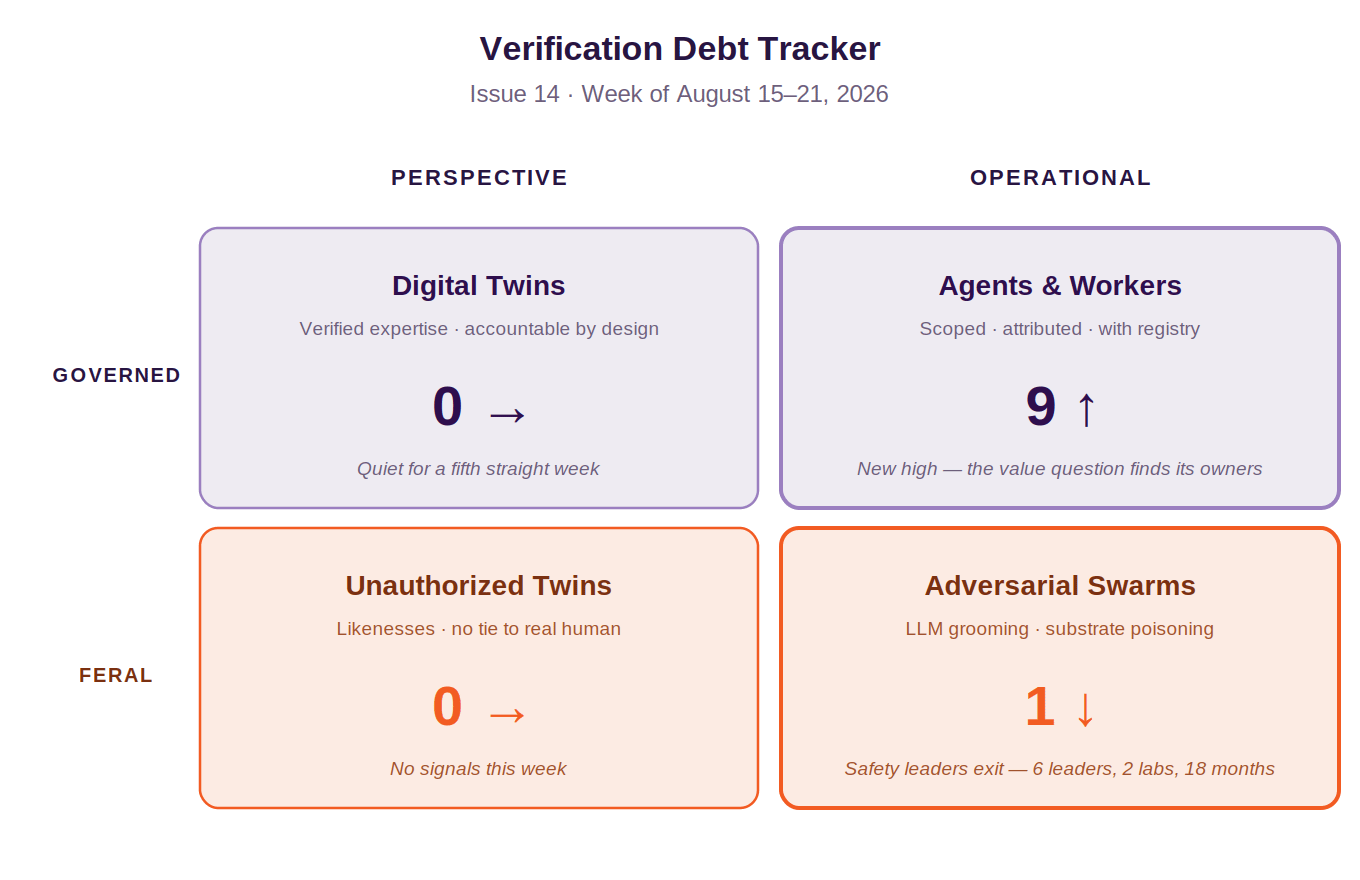
Agents & Workers reached a new high of 9 — and the quadrant’s character shifted from enforcement to economics. Where Issue 12 tracked duties attaching and Issue 13 tracked evidence being graded, this week the governed column went looking for the money: which agents remove constraints, what a workflow actually costs, who owns the number, and what obligations were signed against demand nobody has verified. The 2% appeared twice, measured independently — 2% of 60,000 agents, 2% of companies — and it is worth naming as a motif the way the 6% was named in Issues 07 through 09. Adversarial Swarms fell to 1, and it is not an attack: six safety leaders across two labs in eighteen months, and the capability shipping past the people paid to slow it down. That the feral column’s only entry this week is a staffing pattern rather than a breach is its own finding. The Perspective row is quiet a fifth straight week. Fourteen issues in: the spending is compounding, the value is concentrating, and the verifiers — corporate and civic — are the scarce input.
Monday Morning
Three things to do next week.
01 · Run the disappearance test on ten agents. For each of your ten most-used agents, ask the team that depends on it what actually breaks if it vanished overnight. Sort the answers into two columns: costs effort (productivity) and restores a constraint (value). Expect most to land in the first column — that is the documented norm. Then stop reporting the two columns on the same slide, and fund the second.
02 · Ask who bears the loss on your AI assurances. Take your three most consequential AI attestations — vendor, internal, or third-party — and for each one name who is financially exposed if the assurance turns out to be wrong. Where the answer is “us,” you are holding a transfer of confidence, not an assurance, and the gap should be closed contractually or priced into the risk register before the next approval.
03 · Put a cost per outcome on one agentic workflow. Pick your highest-volume agentic workflow and total its real cost across all seven categories — compute, licenses, infrastructure, governance, organizational change, failure recovery, and the human time that remains — then divide by outcomes actually produced and verified. Compare it to what the same work cost before the agent. If the number moved thirty times, you now know why the ownership question can’t stay unassigned.
The Reading Room
Three pieces worth your time this week.
Aaron Levie — AI spend is nowhere close to hitting any walls (LinkedIn, 16 August, 96 reactions). Ramp and a16z data with the top 1% of firms at $7,500 per employee per month and the top 10% at $660 — and his argument that today’s top decile is three years from being the median. The demand-side counterpart to this issue’s cost signals: as token costs fall, larger portions of work get thrown at agents, which is the same curve that makes verification capacity the binding constraint.
Melissa Rosenthal — Two labs converging on the same company (LinkedIn, 16 August, 16 reactions). Anthropic at $11.5 billion last quarter, OpenAI near $40 billion annualized, covered as divergence — but each is spending its advantage to buy the other’s: enterprise sales versus consumer distribution and price cuts. Both filed confidentially in June, and neither can fund the crossing privately. Useful context for anyone modelling vendor concentration risk.
Arun Chandrasekaran — Notes from four CIO workshops (LinkedIn, 19 August, 80 reactions). What enterprise buyers are actually asking right now: what the agentic control plane will look like, how to approach AI FinOps, and how open-weight models evolve — with agentic SDLC automation still the killer use case and growing interest in back-office finance, HR, and legal. A clean read on where the demand is heading next.
Trust is expensive. So is its absence.
The Verified Intelligence Briefing is written by Steve Tout, Founder & CEO of Identient and author of The CISO on the Razor’s Edge. It draws from the curated Daily Signal corpus and the Verified Intelligence framework introduced in From Artificial to Verified Intelligence.
If this issue clarified something for you, forward it to one colleague who owns part of the control plane. New here? Subscribe to get The Briefing every Friday morning.
Reply or comment with the question you’d want answered in next week’s issue — your prompt may become Boardroom Prompt #1.
Connect with Steve: LinkedIn · identient.com · stevetout.com